Question: First Draft, Final Drafi, Assignment Review, & Reflection Letter are due on your Portfolio site Final Draft is also due on Blackboard via the Assignments
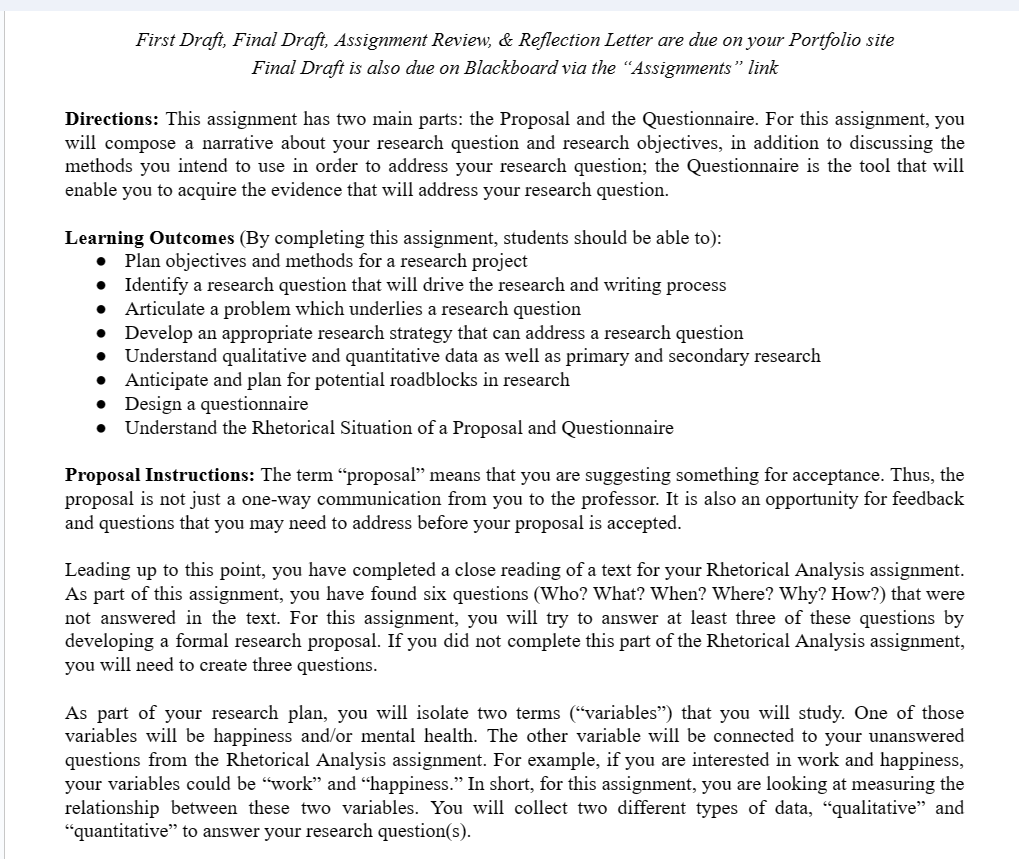
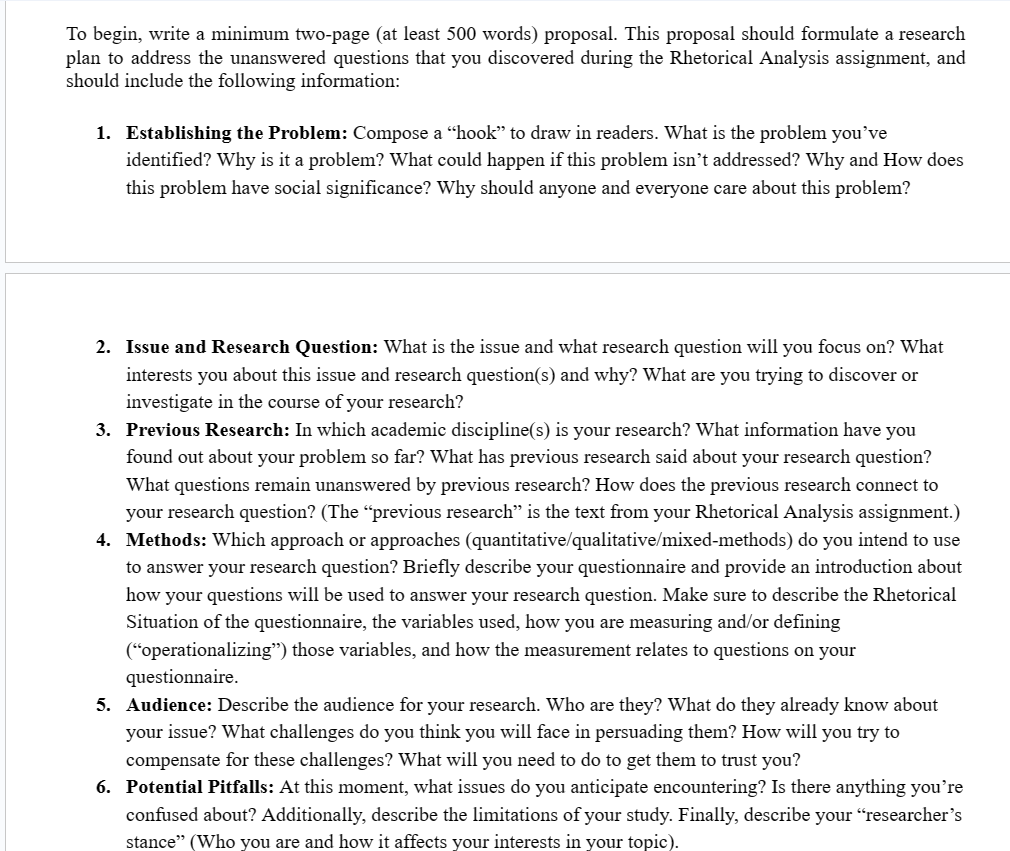
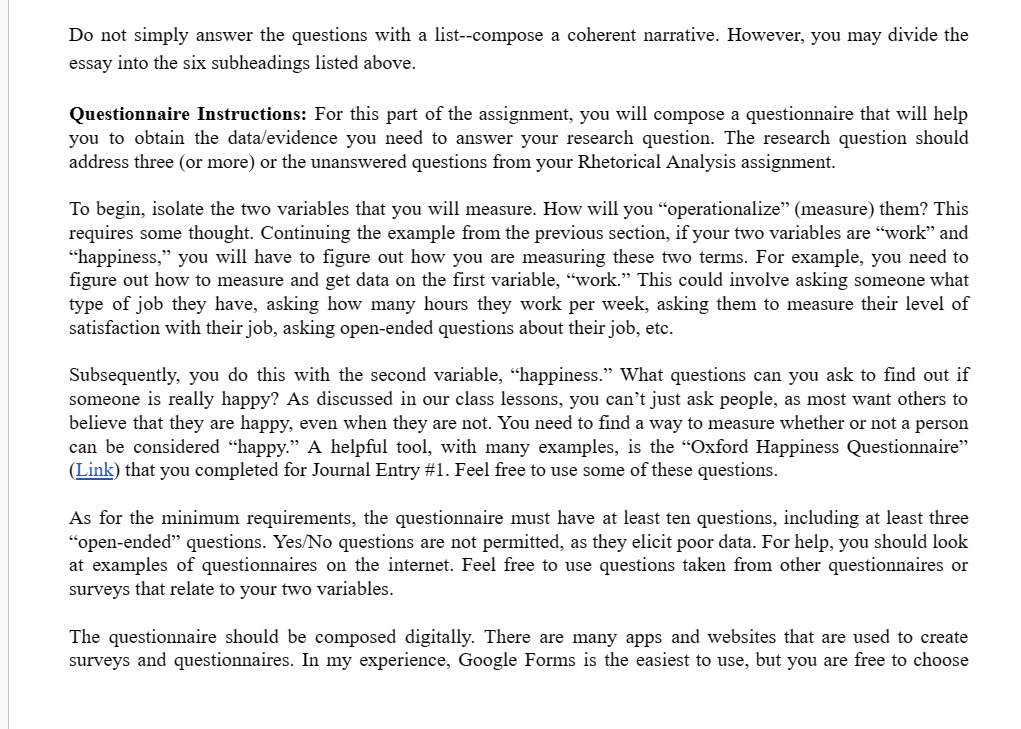
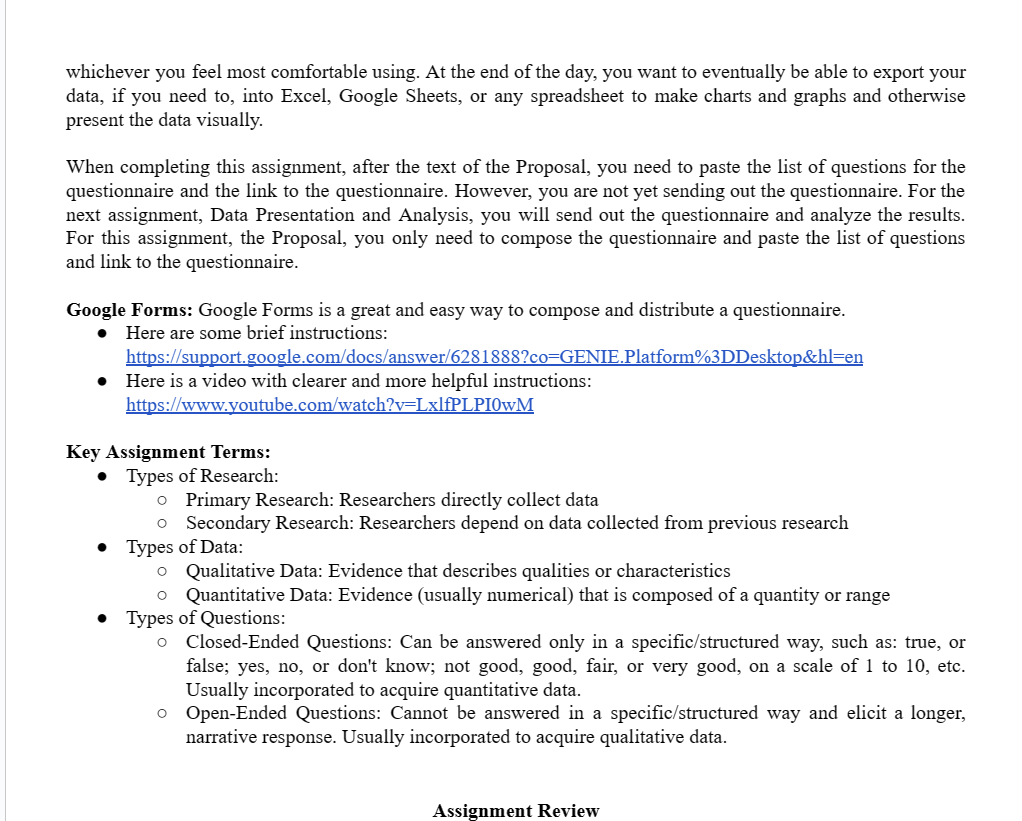
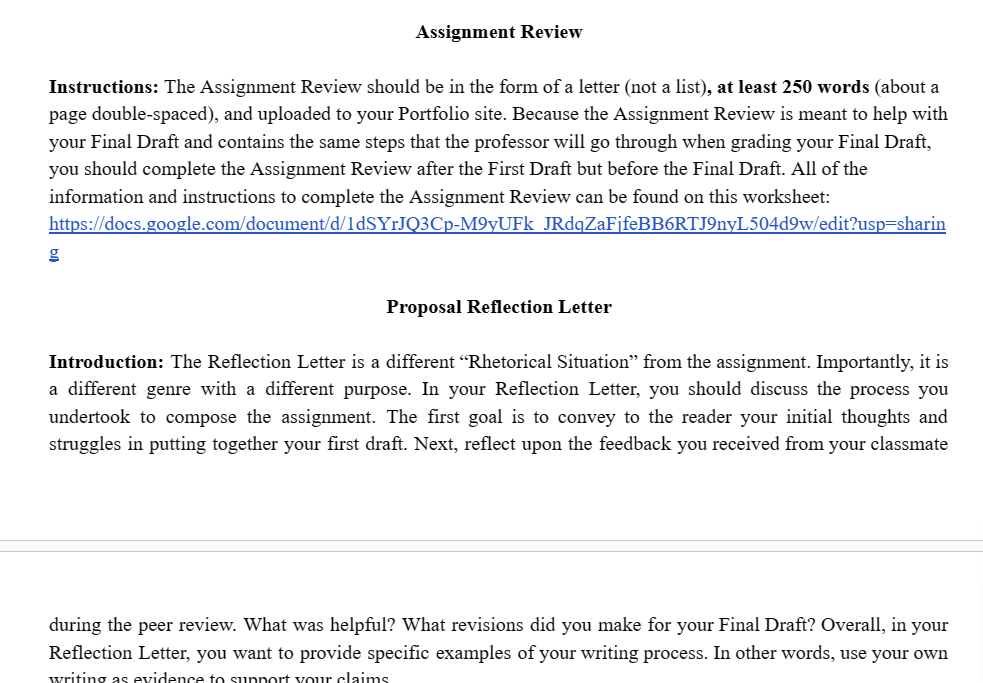
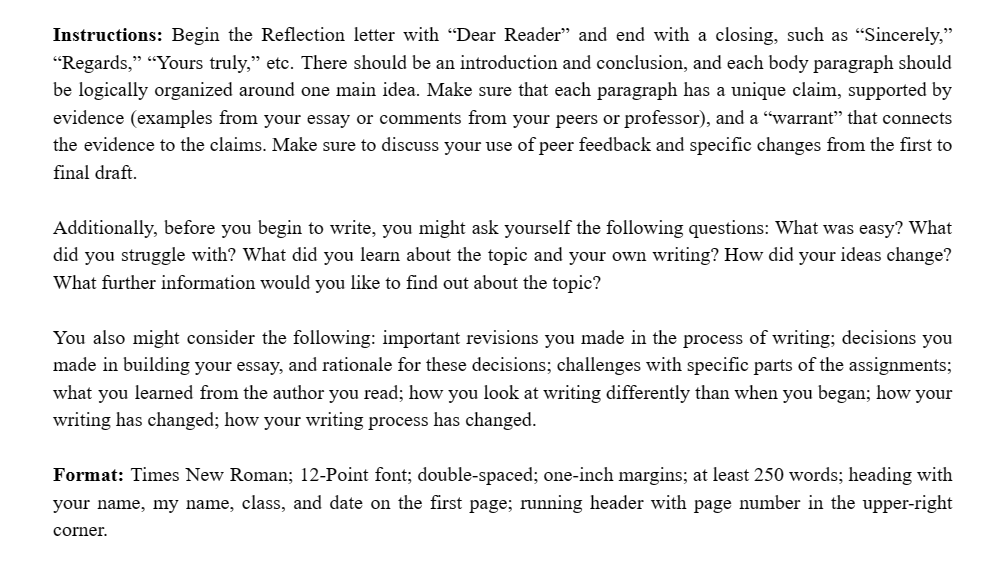
First Draft, Final Drafi, Assignment Review, & Reflection Letter are due on your Portfolio site Final Draft is also due on Blackboard via the \"Assignments\" link Directions: This assignment has two main parts: the Proposal and the Questionnaire. For this assignment, you will compose a narrative about your research question and research objectives, in addition to discussing the methods you intend to use in order to address your research question; the Questionnaire is the tool that will enable you to acquire the evidence that will address your research question. Learning Outcomes (By completing this assignment, students should be able to): Plan objectives and methods for a research project Identify a research question that will drive the research and writing process Articulate a problem which underlies a research question Develop an appropriate research strategy that can address a research question Understand qualitative and quantitative data as well as primary and secondary research Anticipate and plan for potential roadblocks in research Design a questionnaire Understand the Rhetorical Situation of a Proposal and Questionnaire Proposal Instructions: The term \"proposal\" means that you are suggesting something for acceptance. Thus, the proposal is not just a one-way communication from you to the professor. It is also an opportunity for feedback and questions that you may need to address before your proposal is accepted. Leading up to this point, you have completed a close reading of a text for your Rhetorical Analysis assignment. As part of this assignment, you have found six questions (Who? What? When? Where? Why? How?) that were not answered in the text. For this assignment, you will try to answer at least three of these questions by developing a formal research proposal. If you did not complete this part of the Rhetorical Analysis assignment, vou will need to create three questions. As part of your research plan, you will isolate two terms (\"variables\") that you will study. One of those variables will be happiness and/or mental health. The other variable will be connected to your unanswered questions from the Rhetorical Analysis assignment. For example, if you are interested in work and happiness, your variables could be \"work and \"happiness.\" In short, for this assignment, you are looking at measuring the relationship between these two wvariables. You will collect two different types of data, \"qualitative\" and \"quantitative\" to answer your research question(s). To begin, write a minimum two-page (at least 500 words) proposal. This proposal should formulate a research plan to address the unanswered questions that you discovered during the Rhetorical Analysis assignment, and should include the following information: 1. Establishing the Problem: Compose a \"hook to draw in readers. What is the problem you've identified? Why is it a problem? What could happen if this problem isn't addressed? Why and How does this problem have social significance? Why should anyone and everyone care about this problem? 2. Issue and Research Question: What is the issue and what research question will you focus on? What interests you about this issue and research question(s) and why? What are you trying to discover or investigate in the course of your research? 3. Previous Research: In which academic discipline(s) is your research? What information have you found out about your problem so far? What has previous research said about your research question? What questions remain unanswered by previous research? How does the previous research connect to vour research question? (The \"previous research\" is the text from your Rhetorical Analysis assignment.) 4. Methods: Which approach or approaches (quantitative/qualitative/mixed-methods) do you intend to use to answer your research question? Briefly deseribe your questionnaire and provide an introduction about how your questions will be used to answer your research question. Make sure to describe the Rhetorical Situation of the questionnaire, the variables used, how you are measuring and/or defining (\"operationalizing\") those variables, and how the measurement relates to questions on your questionnaire. 5. Audience: Describe the audience for your research. Who are they? What do they already know about vour issue? What challenges do you think you will face in persuading them? How will you try to compensate for these challenges? What will you need to do to get them to trust you? 6. Potential Pitfalls: At this moment, what issues do you anticipate encountering? Is there anything you're confused about? Additionally, describe the limitations of your study. Finally, describe your \"researcher's stance\" (Who you are and how it affects your interests in your topic). Do not simply answer the questions with a list--compose a coherent narrative. However, you may divide the essay into the six subheadings listed above. Questionnaire Instructions: For this part of the assignment, you will compose a questionnaire that will help you to obtain the data/evidence you need to answer your research question. The research question should address three (or more) or the unanswered questions from your Rhetorical Analysis assignment. To begin, isolate the two variables that you will measure. How will you \"operationalize (measure) them? This requires some thought. Continuing the example from the previous section, if your two variables are \"work\" and \"happiness,\" you will have to figure out how you are measuring these two terms. For example, you need to figure out how to measure and get data on the first variable, \"work.\" This could involve asking someone what type of job they have, asking how many hours they work per week, asking them to measure their level of satisfaction with their job, asking open-ended questions about their job, etc. Subsequently, you do this with the second variable, \"happiness.\" What questions can you ask to find out if someone is really happy? As discussed in our class lessons, you can't just ask people, as most want others to believe that they are happy, even when they are not. You need to find a way to measure whether or not a person can be considered \"happy.\" A helpful tool, with many examples, is the \"Oxford Happiness Questionnaire (Link) that vou completed for Journal Entry #1. Feel free to use some of these questions. As for the minimum requirements, the questionnaire must have at least ten questions, including at least three \"open-ended\" questions. Yes/No questions are not permitted, as they elicit poor data. For help, you should look at examples of questionnaires on the internet. Feel free to use questions taken from other questionnaires or surveys that relate to your two variables. The questionnaire should be composed digitally. There are many apps and websites that are used to create surveys and questionnaires. In my experience, Google Forms is the easiest to use, but you are free to choose whichever you feel most comfortable using. At the end of the day, you want to eventually be able to export your data, if you need to, into Excel, Google Sheets, or any spreadsheet to make charts and graphs and otherwise present the data visually. When completing this assignment, after the text of the Proposal, you need to paste the list of questions for the questionnaire and the link to the questionnaire. However, you are not yet sending out the questionnaire. For the next assignment, Data Presentation and Analysis, you will send out the questionnaire and analyze the results. For this assignment, the Proposal, you only need to compose the questionnaire and paste the list of questions and link to the questionnaire. Google Forms: Google Forms is a great and easy way to compose and distribute a questionnaire. . Here are some brief i mstructlons . Here isa Vldeo with clea.rer and more helpful instructions: https:/www.voutube.com/watch?v=I x|fPT PTOwM Key Assignment Terms: e Types of Research: o Primary Research: Researchers directly collect data Secondary Research: Researchers depend on data collected from previous research e Types of Data: o Qualitative Data: Evidence that describes qualities or characteristics Quantitative Data: Evidence (usually numerical) that is composed of a quantity or range e Types of Questions: o Closed-Ended Questions: Can be answered only in a specific/structured way, such as: true, or false; yes, no, or don't know; not good, good, fair, or very good, on a scale of 1 to 10, etc. Usually incorporated to acquire quantitative data. o Open-Ended Questions: Cannot be answered in a specific/structured way and elicit a longer, narrative response. Usually incorporated to acquire qualitative data. Assignment Review Assignment Review Instructions: The Assignment Review should be in the form of a letter (not a list), at least 250 words (about a page double-spaced), and uploaded to your Portfolio site. Because the Assignment Review is meant to help with vour Final Draft and contains the same steps that the professor will go through when grading your Final Draft, you should complete the Assignment Review after the First Draft but before the Final Draft. All of the information and instructions to complete the Assignment Review can be found on this worksheet: https://docs.google.com/document/d/1dSYrIQ3Cp-M9vUFk JRdqZaFifeBB6RTIInyl 504d9w/edit?usp=sharin Proposal Reflection Letter Introduction: The Reflection Letter is a different \"Rhetorical Situation from the assignment. Importantly, it is a different genre with a different purpose. In your Reflection Letter, you should discuss the process you undertook to compose the assignment. The first goal is to convey to the reader your initial thoughts and struggles in putting together your first draft. Next, reflect upon the feedback you received from your classmate during the peer review. What was helpful? What revisions did you make for your Final Draft? Overall, in your Reflection Letter, you want to provide specific examples of your writing process. In other words, use your own writino az avidance ta annnart vonr claime Instructions: Begin the Reflection letter with \"Dear Reader\" and end with a closing, such as \"Sincerely,\" \"Regards,\" \"Yours truly,\" etc. There should be an introduction and conclusion, and each body paragraph should be logically organized around one main idea. Make sure that each paragraph has a unique claim, supported by evidence (examples from your essay or comments from your peers or professor), and a \"warrant\" that connects the evidence to the claims. Make sure to discuss your use of peer feedback and specific changes from the first to final draft. Additionally, before you begin to write, you might ask yourself the following questions: What was easy? What did you struggle with? What did you learn about the topic and your own writing? How did your ideas change? What further information would you like to find out about the topic? You also might consider the following: important revisions you made in the process of writing; decisions you made in building your essay, and rationale for these decisions; challenges with specific parts of the assignments: what you learned from the author you read; how you look at writing differently than when you began; how your writing has changed; how your writing process has changed. Format: Times New Roman; 12-Point font; double-spaced; one-inch margins; at least 250 words; heading with your name, my name, class, and date on the first page; running header with page number in the upper-right corner
Step by Step Solution
There are 3 Steps involved in it
1 Expert Approved Answer
Step: 1 Unlock
Question Has Been Solved by an Expert!
Get step-by-step solutions from verified subject matter experts
Step: 2 Unlock
Step: 3 Unlock
Students Have Also Explored These Related Business Writing Questions!









 Study Help