







Question: first pic is the problem . second and third are the question 2 a,b 3 Working with the (Q,R) Model A local paint store uses
first pic is the problem . second and third are the question 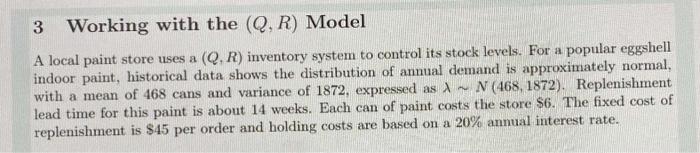
2 a,b
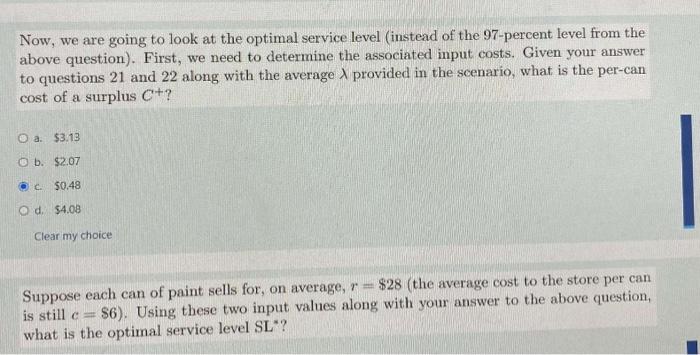
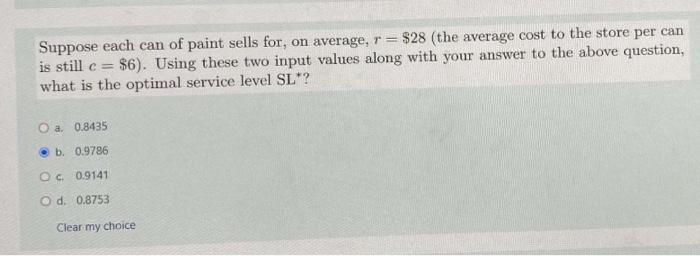
3 Working with the (Q,R) Model A local paint store uses a (Q,R) inventory system to control its stock levels. For a popular eggshell indoor paint, historical data shows the distribution of annual demand is approximately normal, with a mean of 468 cans and variance of 1872 , expressed as N(468,1872). Replenishment lead time for this paint is about 14 weeks. Each can of paint costs the store $6. The fixed cost of replenishment is $45 per order and holding costs are based on a 20% annual interest rate. Now, we are going to look at the optimal service level (instead of the 97-percent level from the above question). First, we need to determine the associated input costs. Given your answer to questions 21 and 22 along with the average provided in the scenario, what is the per-can cost of a surplus C+? a. $3.13 b. $2.07 c. 50.48 d. $4.08 Clear my choice Suppose each can of paint sells for, on average, r=$28 (the average cost to the store per can is still c=$6 ). Using these two input values along with your answer to the above question, what is the optimal service level SL*? Suppose each can of paint sells for, on average, r=$28 (the average cost to the store per can is still c=$6 ). Using these two input values along with your answer to the above question, what is the optimal service level SL ? a. 0.8435 b. 0.9786 c. 0.9141 d. 0.8753 Clear my choice
Step by Step Solution
There are 3 Steps involved in it
1 Expert Approved Answer
Step: 1 Unlock

Question Has Been Solved by an Expert!
Get step-by-step solutions from verified subject matter experts
Step: 2 Unlock
Step: 3 Unlock
 Study Help