







Question: First, solve the questions descriptively, then model using Comsol software. Answers and hypotheses should be typed. Only Comsol software should be used to answer the
First, solve the questions descriptively, then model using Comsol software.
Answers and hypotheses should be typed.
Only Comsol software should be used to answer the exercises.
Comsol output file related to each question must be attached.
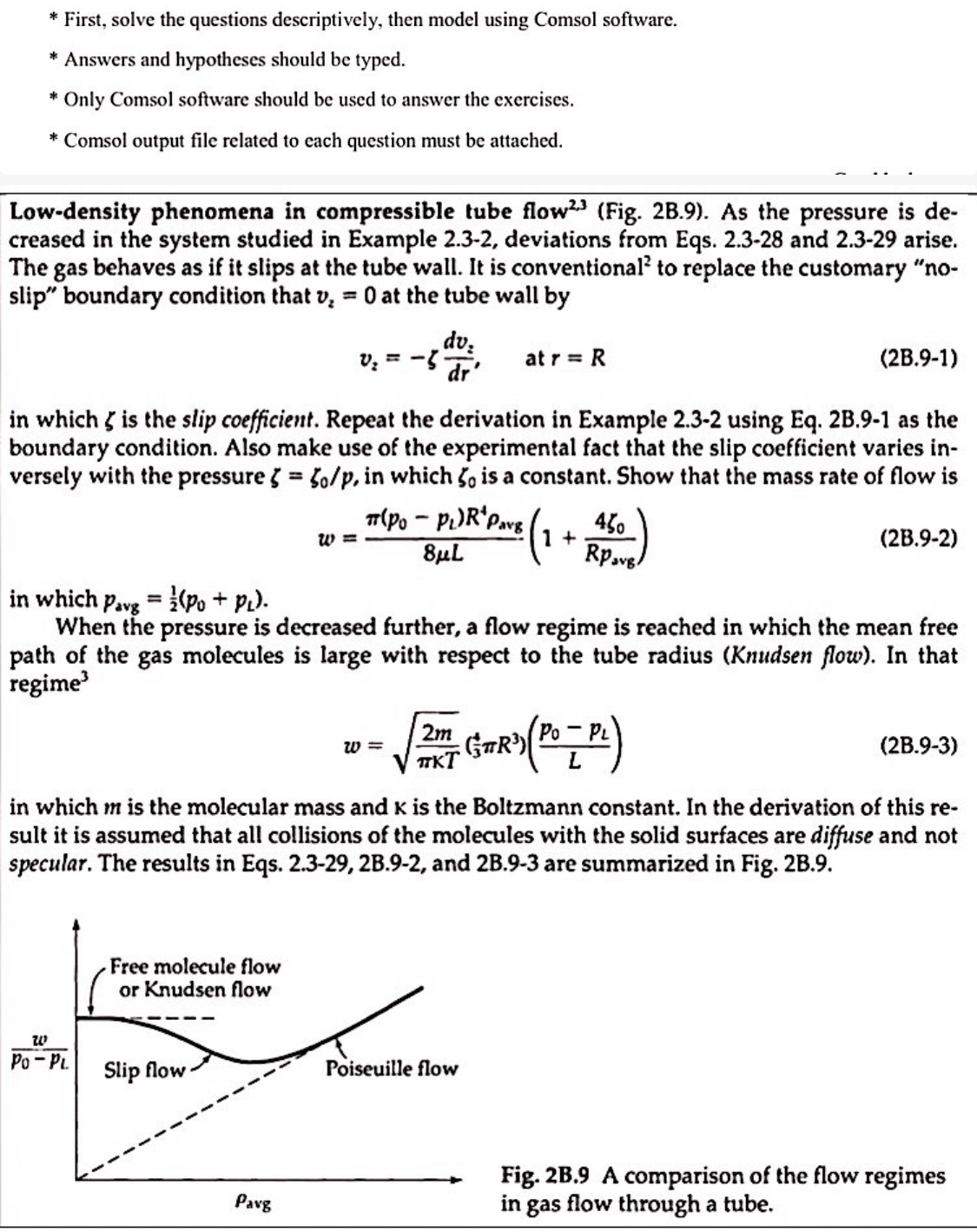
Lowdensity phenomena in compressible tube flow FigB As the pressure is decreased in the system studied in Example deviations from Eqs. and arise. The gas behaves as if it slips at the tube wall. It is conventional" to replace the customary "noslip" boundary condition that at the tube wall by
in which is the slip coefficient. Repeat the derivation in Example using EqB as the boundary condition. Also make use of the experimental fact that the slip coefficient varies inversely with the pressure in which is a constant. Show that the mass rate of flow is
in which
When the pressure is decreased further, a flow regime is reached in which the mean free path of the gas molecules is large with respect to the tube radius Knudsen flow In that regime
in which is the molecular mass and is the Boltzmann constant. In the derivation of this result it is assumed that all collisions of the molecules with the solid surfaces are diffuse and not specular. The results in Eqs. B and B are summarized in Fig. B
Fig. B A comparison of the flow regimes in gas flow through a tube.
Step by Step Solution
There are 3 Steps involved in it
1 Expert Approved Answer
Step: 1 Unlock

Question Has Been Solved by an Expert!
Get step-by-step solutions from verified subject matter experts
Step: 2 Unlock
Step: 3 Unlock
 Study Help