







Question: first, what is the expected average cost per week when your inventory is one unit k(1)? a- how much is the ordering cost b- how
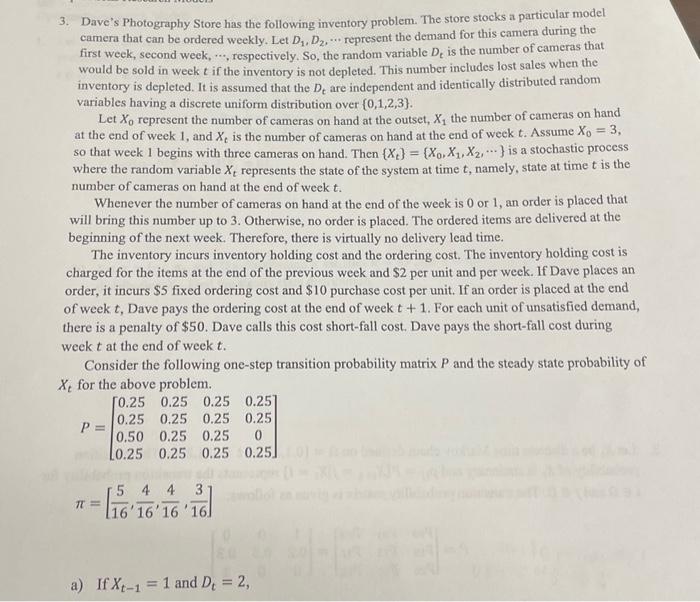
3. Dave's Photography Store has the following inventory problem. The store stocks a particular model camera that can be ordered weekly. Let D1,D2, represent the demand for this camera during the first week, second week, , respectively. So, the random variable Dt is the number of cameras that would be sold in week t if the inventory is not depleted. This number includes lost sales when the inventory is depleted. It is assumed that the Dt are independent and identically distributed random variables having a discrete uniform distribution over {0,1,2,3}. Let X0 represent the number of cameras on hand at the outset, X1 the number of cameras on hand at the end of week 1 , and Xt is the number of cameras on hand at the end of week t. Assume X0=3, so that week 1 begins with three cameras on hand. Then {Xt}={X0,X1,X2,} is a stochastic process where the random variable Xt represents the state of the system at time t, namely, state at time t is the number of cameras on hand at the end of week t. Whenever the number of cameras on hand at the end of the week is 0 or 1 , an order is placed that will bring this number up to 3 . Otherwise, no order is placed. The ordered items are delivered at the beginning of the next week. Therefore, there is virtually no delivery lead time. The inventory incurs inventory holding cost and the ordering cost. The inventory holding cost is charged for the items at the end of the previous week and \$2 per unit and per week. If Dave places an order, it incurs \$5 fixed ordering cost and \$10 purchase cost per unit. If an order is placed at the end of week t, Dave pays the ordering cost at the end of week t+1. For each unit of unsatisfied demand, there is a penalty of $50. Dave calls this cost short-fall cost. Dave pays the short-fall cost during week t at the end of week t. Consider the following one-step transition probability matrix P and the steady state probability of Xt for the above problem. a) If Xt1=1 and Dt=2
Step by Step Solution
There are 3 Steps involved in it

Get step-by-step solutions from verified subject matter experts
 Study Help