







Question: Five forces model of Ryanair base on case study: Ryanair- the low fare airlines RYANAR - THE LOW FARES AIRLINE Ryanair - the low-fares airline
Five forces model of Ryanair base on case study: Ryanair- the low fare airlines 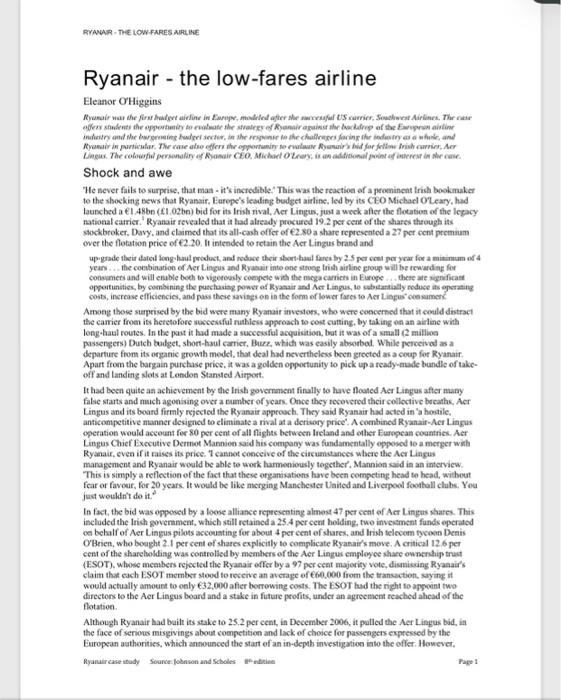
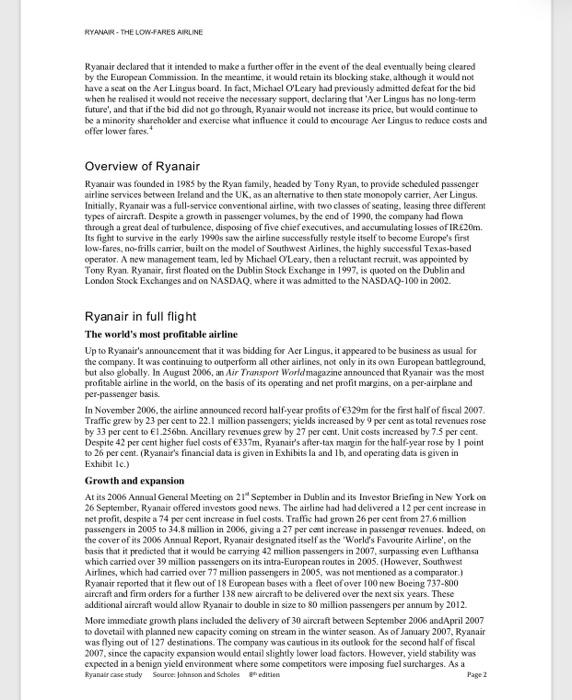
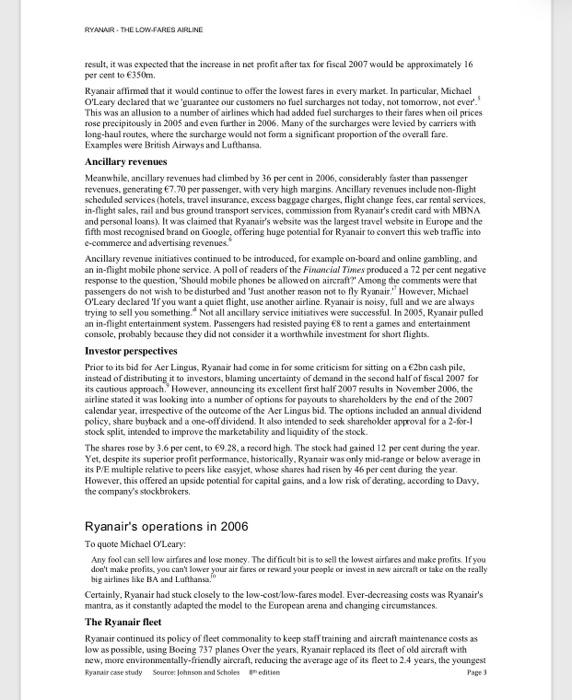
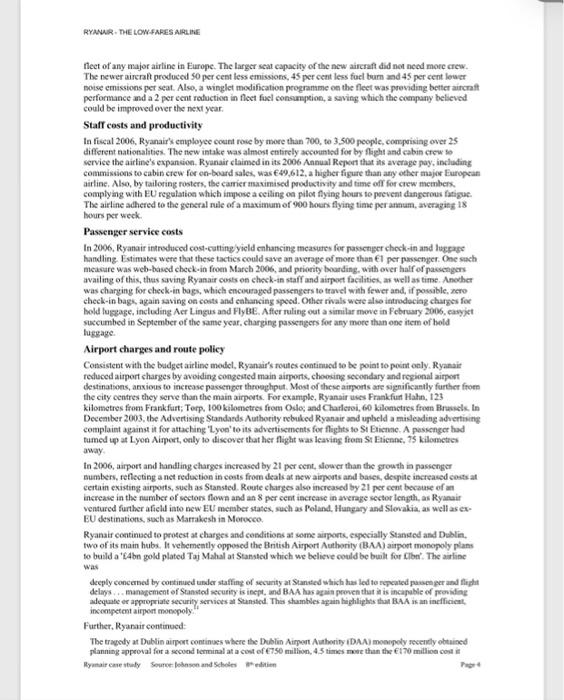
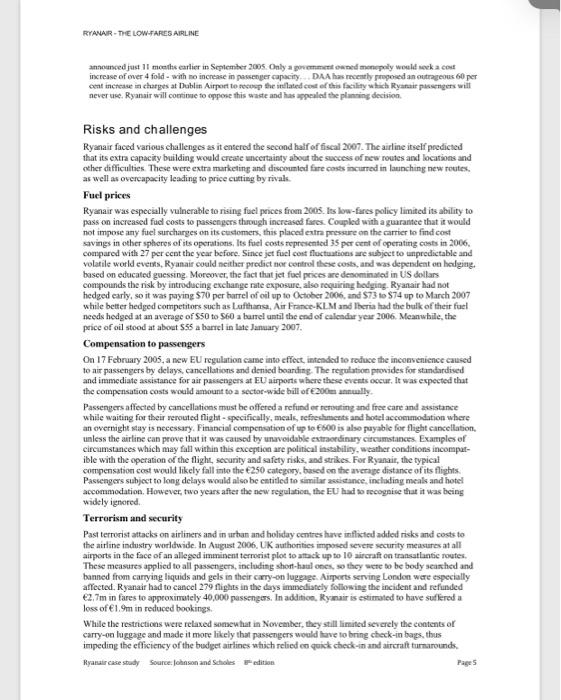
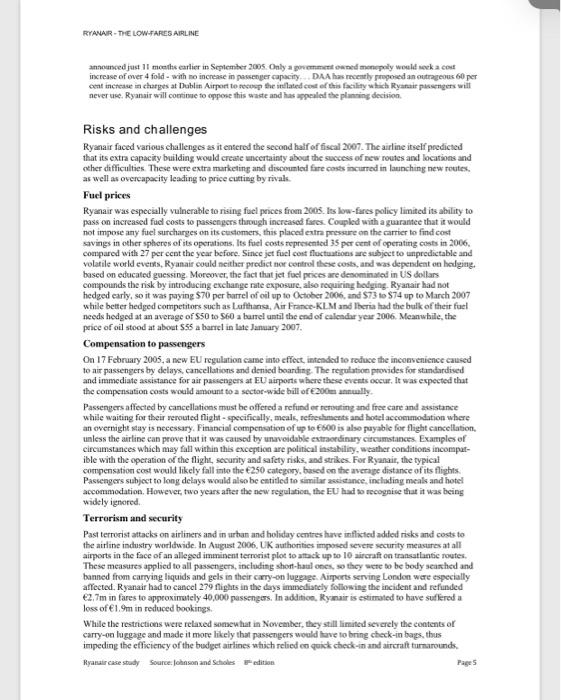
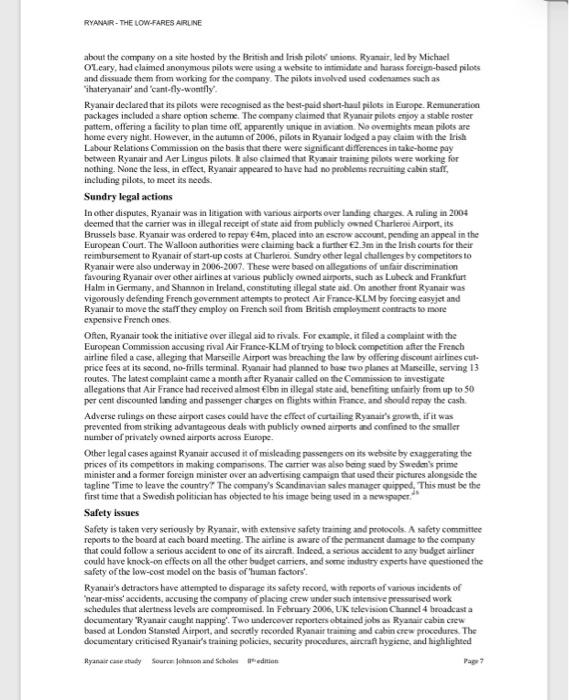
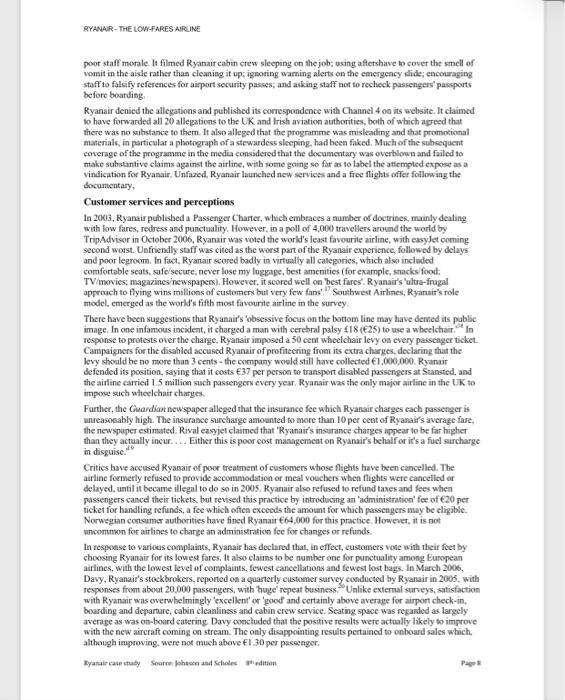
RYANAR - THE LOW FARES AIRLINE Ryanair - the low-fares airline Eleanor O'Higgins Ryanair was the first fully airline in Europe, medite alere US curier, Schwest Airlines. There ofery students the opportunity to evaluate the strategy of Ryanair against the crop of the Euro rustry and the lowering budget the response to the challenges faring seedestry as a whole, and Narai Maritalar, The ene opportunity aN kuraittur kaliam iruha Lingar. The colouw personality of sandir CEO, Michael O'Leary, in additional print dorest in the case. Shock and awe "He never fails to surprise, that man - it's incredible. This was the reaction of a prominent Irish bookmaker to the shocking news that Ryanair, Europe's leading budget airline, led by its CEO Michael O'Leary, had launched a 1 48bn (1.02b) bid for its Irish rival, Aer Lingus, just a week after the flotation of the legacy national carrier Ryanair revealed that it lud already procured 19.2 per cent of the shares through its stockbroker, Davy, and claimed that its all-cash offer of 2.80 a share represented a 27 per cent premium over the flotation price of 2.20. It intended to retain the Aer Lingus brand and upgrade the date longkal product, and reduce the short bulans by 2.5 per cel per year for a minum of 4 year the combination of Aer Lingus and Ryanair into one strong trinh sirtine group will be rewarding for consumers and will enable both to vigorously compete with the mega carries in Europe there are significant opportunities, by combining the purchasing power od Ryanair and Aer Lingus, to substantially reduce its operating costs, increase efficiencies and pass these savings on in the form of lower fares to Aer Lingus osumen Among those surprised by the bid were many Ryanair investors, who were concerned that it could distract the carrier from its heretofore successful ruthless approach to cost cutting, by taking on an airline with long-haul routes. In the past it had made a successful acquisition, but it was of a small 2 million passengers) Dutch budget, short-haul carrier, Burr, which was easily absorbol. While perceived as a departure from its organic growth model that deal had nevertheless been grected as a coup for Ryanair Apart from the bargain purchase price, it was a golden opportunity to pick up a ready-made bundle of take- off and landing slots at London Stansted Airport It had been quite an achievement by the Irish government finally to have floated Aer Lingus after many false starts and mich agonising over a number of years. Once they recovered their collective breaths. Aer Lingus and its board firmly rejected the Ryanair approach. They said Ryanair had acted in a hostile anticompetitive munner designed to eliminate a rival at a derisory price. A combined Ryanair-Aer Lingus operation would account for 80 per cent of all flights between Ireland and other European countries. Aer Lingus Chief Executive Dermot Mannion and his company was fundamentally opposed to a merger with Ryanair, even if it raises its price. '1 cannot conceive of the circumstances where the Aer Lingus management and Ryanair would be able to work harmoniously together. Mannion said in an interview "This is simply a reflection of the fact that these organisations have been competing head to head, without fear or favour, for 20 years. It would be like merging Manchester United and Liverpool football clubs. You just wouldn't do it. In fact, the bid was opposed by a loose alliance representing almost 47 per cent of Aer Lingus shares. This included the Irish government, which still retained a 25.4 per cent holding, two investment funds operated on behalf of Aer Lingus pilots accounting for about 4 per cent of shares, and Irish telecom tycoon Denis O'Brien, who bought 2.1 per cent of shares explicitly to complicate Ryanair's move. A critical 12.6 per cent of the shareholding was controlled by members of the Aer Lingus employee share ownership trust (ESOT), whose members rejected the Ryanair offer by a 97 per cent majority vote, dismissing Ryanair's claim that each ESOT member stood to receive an average of 60.000 from the transaction saying it would actually amount to only 32.000 after borrowing costs. The ESOT had the right to appoint two directors to the Aer Lingus board and a stake in future prolts, under an agreement reached ahead of the flotation Although Ryanair had built its stake to 25.2 per cent, in December 2006, it pulled the Aer Lingus bid, in the face of serious misgivings about competition and lack of choice for passengers expressed by the European authorities, which announced the start of an in-depth investigation into the offer. However, Ryanair case study sources and Scholesa RYANAIR - THE LOW-FARES AIRLINE Ryanair declared that it intended to make a further offer in the event of the deal eventually being cleared by the European Commission. In the meantime, it would retain its blocking stake, although it would not have a seat on the Aer Lingus board. In fact, Michael O'Leary had previously admitted defcat for the bid when he realised it would not receive the necessary support, declaring that 'Aer Lingus has no long-term future', and that if the bid did not go through, Ryanair would not increase its price, but would continue to be a minority shareholder and exercise what influence it could to encourage Aer Lingus to reduce costs and offer lower fares Overview of Ryanair Ryanair was founded in 1985 by the Ryan family, headed by Tony Ryan, to provide scheduled passenger airline services between Ireland and the UK, as an alternative to the state monopoly carrier, Aer Lingus. Initially, Ryanair was a full-service conventional airline with two classes of seating, leasing three different types of aircraft. Despite a growth in passenger volumes, by the end of 1990, the company had flown through a great deal of turbulence, disposing of five chief executives, and accumulating losses of IRE20m. Its fight to survive in the early 1990s saw the airline successfully restyle itself to become Europe's first low-fares, no-frills carrier, built on the model of Southwest Airlines, the highly successful Texas-based operator. A new management team, led by Michael O'Leary, then a reluctant recruit was appointed by Tony Ryan, Ryanair, first floated on the Dublin Stock Exchange in 1997. is quoted on the Dublin and London Stock Exchanges and on NASDAQ where it was admitted to the NASDAQ-100 in 2002. Ryanair in full flight The world's most profitable airline Up to Ryanair's announcement that it was bidding for Aer Lingus, it appeared to be business as usual for the company. It was continuing to outperform all other airlines, not only in its own European battleground, but also globally. In August 2006, an Air Transport World magazine announced that Ryanair was the most profitable airline in the world, on the basis of its operating and net profit margins, on a per-airplane and per passenger basis. In November 2006, the airline announced record half-year profits of 329m for the first half of fiscal 2007 Traffic grew by 23 per cent to 22.1 million passengers: yields increased by 9 per cent as total revenues rose by 33 per cent to El 256bn. Ancillary revenues grew by 27 percent. Unit costs increased by 75 per cent. Despite 42 per cent higher fuel costs of 337m, Ryanair's after-tax margin for the half-year rose by 1 point to 26 per cent. (Ryanair's financial data is given in Exhibits la and 1b, and operating data is given in Exhibit lc.) Growth and expansion At its 2006 Annual General Meeting on 21 September in Dublin and its lavestor Briefing in New York on 26 September, Ryanair offered investors good news. The airline had had delivered a 12 per cent increase in net profit, despite a 74 per cent increase in fuel costs. Traffic had grown 26 per cent from 27.6 million passengers in 2005 to 34.8 million in 2006, giving a 27 per cent increase in passenger revenues. Indeed, on the cover of its 2006 Annual Report, Ryanair designated itself as the World's Favourite Airline', on the basis that it predicted that it would be carrying 42 million passengers in 2007. surpassing even Lufthansa which carried over 39 million passengers on its intra-European routes in 2005. (However, Southwest Airlines, which had carried over 77 million passengers in 2005, was not mentioned as a comparator) Ryanair reported that it flew out of 18 European bases with a fleet of over 100 new Boeing 737-800 aircraft and firm orders for a further 138 new aircraft to be delivered over the next six years. These additional aircraft would allow Ryanair to double in size to 80 million passengers per annum by 2012 More immediate growth plans included the delivery of 30 aircraft between September 2006 and April 2007 to dovetail with planned new capacity coming on stream in the winter season. As of January 2007, Ryanair was flying out of 127 destinations. The company was cautious in its outlook for the second half of fiscal 2007. since the capacity expansion would entail slightly lower load factors. However, yield stability was expected in a benign yield environment where some competitors were imposing fuel surcharges. As a Ryanair case study sources Johnson and Scholes edition Page 2 RYANAIR. THE LOW FARES AIRLINE result, it was expected that the increase in net profit after tax fox fiscal 2007 would be approximately 16 per cent to 350m Ryanair affimed that it would continue to offer the lowest fares in every market. In particular, Michael O'Leary declared that we guarantee our customers no fuel surcharges not today, not tomorrow, not ever. This was an allusion to a number of airlines which had added fuel surcharges to their fares when oil prices rose precipitously in 2005 and even further in 2006. Many of the surcharges were levied by carriers with long-haul routes whete the surcharge would not form a significant proportion of the overall fare. Examples were British Airways and Lufthansa Ancillary revenues Meanwhile, ancillary revenues had climbed by 36 per cent in 2006, considerably faster than passenger revenues, generating 7.70 per passenger, with very high margins. Ancillary revenues include non-flight scheduled services (hotels, travel insurance, excess baggage charges, flight change fees, car rental services, in-flight sales, rail and bus ground transport services, commission from Ryanair's credit card with MBNA and personal loans). It was claimed that Ryanair's website was the largest travel website in Europe and the fifth most recognised brand on Google, offering huge potential for Ryanair to convert this web traffic into e-commerce and advertising revenues. Ancillary revenue initiatives continued to be introduced, for example on-board and online gambling, and an in-flight mobile phone service. A poll of readers of the Financial Times produced a 72 per cent negative response to the question, 'Should mobile phones be allowed on aircraft?" Among the comments were that passengers do not wish to be disturbed and "Just another reason not to fly Ryanair. However, Michael O'Leary declared 'If you want a quiet flight, use another airline. Ryanair is noisy, full and we are always trying to sell you something." Not all ancillary service initiatives were successful. In 2005, Ryanair pulled an in-flight entertainment system, Passengers had resisted paying 8 to rent a games and entertainment console, probably because they did not consider it a worthwhile investment for short flights. Investor perspectives Prior to its bid for Aer Lingus, Ryanair had come in for some criticism for sitting on a 2bn cash pile, instead of distributing it to investors, blaming uncertainty of demand in the second half of fiscal 2007 for its cautious approach. However, announcing its excellent first half 2007 results in November 2006, the airline stated it was looking into a number of options for payouts to shareholders by the end of the 2007 calendar year, irrespective of the outcome of the Aer Lingus bid. The options included an annual dividend policy, share buyback and a one-off dividend. It also intended to seek shareholder approval for a 2-for- stock split intended to improve the marketability and liquidity of the stock The shares rose by 3,6 per cent, to 9.28, a record high. The stock had gained 12 per cent during the year. Yet, despite its superior profit performance, historically, Ryanair was only mid-range or below average in its P/E multiple relative to peers like casyjet, whose shares had risen by 46 per cent during the year However, this offered an upside potential for capital gains, and a low risk of derating, according to Davy. the company's stockbrokers Ryanair's operations in 2006 To quote Michael O'Leary: Any fool can sell low airfares and lose money. The difficult bit is to sell the lowest airfares and make profits. If you don't make profits, you can't lower your airfares or reward your people or invest in mewaiterait or take on the really big airlines like BA and Lufthansa." Certainly. Ryanair had stuck closely to the low-cost low-fares model. Ever-decreasing costs was Ryanair's mantra, as it constantly adapted the model to the European arena and changing circumstances. The Ryanair fleet Ryanair continued its policy of fleet commonality to keep staff training and aircraft maintenance costs as low as possible, using Boeing 737 planes Over the years, Ryanair replaced its fleet of old aircraft with new, more environmentally friendly aircraft, reducing the average age of its fleet to 2.4 years, the youngest Ryanair Case Study Source Johnson and Scholes edition Page RYANUR THE LOW SARES AIRLINE fleet of any major airline in Europe. The larger seat capacity of the new aircraft did not need more crew. The newer airerat produced 50 per cent less emissions, 45 per cent less fuel bum and 45 per cent lower noise emissions per seat. Also, a winglet modification programme on the fleet was providing better aircraft performance and a 2 per cent reduction in fleet fuel consumption, a saving which the company believed could be improved over the next year Staff costs and productivity In fiscal 2006, Ryanair's employee count rose by more than 700,00 3.500 people, comprising over 25 different nationalities. The new intake was almost entirely accounted for by flight and cabin crew so service the airline's expansion, Ryanair claimed in its 2006 Annual Report that its average pay, including commissions to cabin crew for on-board sales, was 49,612, a higher figure than any other major European airline. Also, by tailoring posters, the carrier maximised productivity and time off for crew members complying with EU regulation which impose a ceiling on pilot flying hours to prevent dangerous fatigue The airline adhered to the general rule of a maximum of 900 hours flying time perantium, averaging 18 hours per week Passenger service costs In 2006, Ryanair introduced cost-cutting yield enhancing measures for passenger check-in and luggage handling Estimates were that these tactics could save an average of more than El per passenger. One such measure was web-based check-in from March 2006, and priority boarding, with over half of passengers availing of this, thus saving Ryanair costs on check-in staff and airport facilities, as well as time. Another was charging for check-in bags, which encouraged passengers to travel with fewer and, if possible, nero check-in bags again saving on costs and enhancing speed. Other rivals were also introducing charges for hold luggage, including Aer Lingus and FlyBE. After ruling out a similar move in February 2006. casyjet succumbed in September of the same year charging passengers for any more than one item of hold luggage Airport charges and route policy Consistent with the budget airline model. Ryanair's routes continued to be point to point only. Ryanait reduced airport charges by avoiding congested main airports.choosing secondary and regional airport destinations, anxious to increase passenger throughput. Most of these airports are significantly further from the city centres they serve than the main airports. For example, Ryanair uses Frankfurt Hahn, 123 kilometres from Frankfurt; Terp. 100 kilometres from Odo, and Charleroi, 60 kilometres from Bruwels. In December 2003, the Advertising Standards Authority rebuked Ryanair and upheld a misleading advertising complaint against it for attaching 'Lyon' to its advertisements for flights to St Etienne. A passenger had tumed up at Lyon Airport, only to discover that her flight was leaving from St Etienne, 75 kilometres away In 2006, airport and handling charges increased by 21 per cent slower than the growth in passenger numbers, reflecting a net reduction in costs from deals at new airports and bases, despite increased costs at certain existing airports, such as Stansted. Route charges also increased by 21 per cent because of an increase in the number of sectors flown and an 8 per cent increase in average sector length, as Ryanair ventured further afield into new EU member states, such as Poland, Hungary and Slovakia, as well as es EU destinations, such as Marrakesh in Morocco Ryanair continued to protest at charges and conditions at some airports, especially Stansted and Dublin, two of its main hubs. It vehemently opposed the British Airport Authority (BAA) airport monopoly plans to build a 64bn gold plated Taj Mahal at Stansted which we believe could be built for Cibe". The airline deeply concerned by continued under staffing of security at Stansted which has led to repeated passenger and flight delays..management of Sunstod security is inept, and BAA has again proven that it is incapable of providing adequate or appropriate security services at Stansted. The shambles again highlights that BAA is an inefficient incompetent airport mon poly . Further, Ryanair continued The trapody at Dublin airport continues where the Dublin Airport Authority (DAA) monopoly recently obtained planning approval for a second terminal at a cost of 750 million, 45 times more than the E170 million costi Ryair Care Study Scuro lose and Scholes edition RYANAIR -THE LOWFARES AIRLINE announced just 11 months earlier in September 2005 Only a government owned monopoly would seek a cout increase of over 4 fold - with no increase in passenger capacity DAA has recently proposed an outrageous 60 per cent increase in charges at Dublin Airport to recoup the dated cost of this facility which Ryanair passengers will never use. Ryanair will continue to oppose this waste and has appealed the planning decision Risks and challenges Ryanair faced various challenges as it entered the second half of fiscal 2007. The airline itself predicted that its extra capacity building would create uncertainty about the success of new routes and locations and other difficulties. These were extra marketing and discounted fare costs incurred in launching new routes as well as overcapacity leading to price cutting by rivali Fuel prices Ryanair was especially vulnerable to rising fuel prices from 2005. Its low-fares policy limited its ability to pass on increased fuel costs to passengers through increased fares Coupled with a grantee that it would not impose any fuel surcharges on its customers, this placed extra pressure on the carrier to find cost savings in other spheres of its operations. Its fuel costs represented 35 per cent of operating costs in 2006. compared with 27 per cent the year before. Since jet fuel cost fluctuations are subject to unpredictable and volatile world events, Ryanair could neither predict or control these costs, and was dependent on hedging, based on educated guessing. Moreover, the fact that jet fuel prices are desemnated in US dollars compounds the risk by introducing exchange rate exposure also requiring hedging, Ryanair had not hedged early, so it was paying $70 per barrel of oil up to October 2006 and 873 to $74 up to March 2007 while better hedged competitors such as Lufthansa, Air France-KLM and Theria had the bulk of their fuel needs hedged at an average of $50 to 560 a barel until the end of calendar year 2006. Meanwhile, the price of oil stood at about $55 a bartel in late January 2007. Compensation to passengers On 17 February 2005, a new EU regulation carne into effect intended to roduce the inconvenience caused to air passengers by delays, cancellations and denied boarding. The regulation provides for standardised and immediate assistance for air passengers at EU airports where these events occur. It was expected that the compensation costs would amount to a sectoe-wide bill of 200 annually Passengers affected by cancellations must be offered a refund or setting and free care and assistance while waiting for their rerouted flight-specifically, meals, refreshments and hotel accommodation where an overnight stay is necessary. Financial compensation of up to 500 is also payable for flight cancellation, unless the airline can prove that it was caused by unavoidable extraordinary circumstances Examples of circumstances which may fall within this exception are political instability, weather conditions incompat- ible with the operation of the flight, security and safety risks, and strikes. For Ryanair, the typical compensation cost would likely fall into the 250 category, based on the average distance of its flights Passengers subject to long delays would also be entitled to similar asistance, including meals and hotel accommodation. However, two years after the new regulation, the EU had to recognise that it was being widely ignored Terrorism and security Past terrorist attacks on airliners and in urban and holiday centres have inflicted added risks and costs to the airline industry worldwide. In August 2006, UK authorities imposed severe security measures at all airports in the face of an alleged imminent terrorist plot to attack up to 10 aircraft on transatlantic routes These measures applied to all passengers, including short-haul ones, so they were to be body seashed and banned from carrying liquids and gels in their carry-on luggage Airports serving London were especially affected. Ryanair had to cancel 279 flights in the days immediately following the incident and refunded 2,7m in fares to approximately 40,000 passengers. In addition, Ryanair is estimated to have suffered a Joss of 1.9m in reduced bookings. While the restrictions were relaxed somewhat in November, they still limited severely the contents of carry-on luggage and made it more likely that passengers would have to bring check-in bags, thus impeding the efficiency of the budget airlines which relied en quick check-in and aircraft turnarounds. Ryanair case study Source Johnson and Scholes edition Page 5 RYANAIR -THE LOWFARES AIRLINE announced just 11 months earlier in September 2005 Only a government owned monopoly would seek a cout increase of over 4 fold - with no increase in passenger capacity DAA has recently proposed an outrageous 60 per cent increase in charges at Dublin Airport to recoup the dated cost of this facility which Ryanair passengers will never use. Ryanair will continue to oppose this waste and has appealed the planning decision Risks and challenges Ryanair faced various challenges as it entered the second half of fiscal 2007. The airline itself predicted that its extra capacity building would create uncertainty about the success of new routes and locations and other difficulties. These were extra marketing and discounted fare costs incurred in launching new routes as well as overcapacity leading to price cutting by rivali Fuel prices Ryanair was especially vulnerable to rising fuel prices from 2005. Its low-fares policy limited its ability to pass on increased fuel costs to passengers through increased fares Coupled with a grantee that it would not impose any fuel surcharges on its customers, this placed extra pressure on the carrier to find cost savings in other spheres of its operations. Its fuel costs represented 35 per cent of operating costs in 2006. compared with 27 per cent the year before. Since jet fuel cost fluctuations are subject to unpredictable and volatile world events, Ryanair could neither predict or control these costs, and was dependent on hedging, based on educated guessing. Moreover, the fact that jet fuel prices are desemnated in US dollars compounds the risk by introducing exchange rate exposure also requiring hedging, Ryanair had not hedged early, so it was paying $70 per barrel of oil up to October 2006 and 873 to $74 up to March 2007 while better hedged competitors such as Lufthansa, Air France-KLM and Theria had the bulk of their fuel needs hedged at an average of $50 to 560 a barel until the end of calendar year 2006. Meanwhile, the price of oil stood at about $55 a bartel in late January 2007. Compensation to passengers On 17 February 2005, a new EU regulation carne into effect intended to roduce the inconvenience caused to air passengers by delays, cancellations and denied boarding. The regulation provides for standardised and immediate assistance for air passengers at EU airports where these events occur. It was expected that the compensation costs would amount to a sectoe-wide bill of 200 annually Passengers affected by cancellations must be offered a refund or setting and free care and assistance while waiting for their rerouted flight-specifically, meals, refreshments and hotel accommodation where an overnight stay is necessary. Financial compensation of up to 500 is also payable for flight cancellation, unless the airline can prove that it was caused by unavoidable extraordinary circumstances Examples of circumstances which may fall within this exception are political instability, weather conditions incompat- ible with the operation of the flight, security and safety risks, and strikes. For Ryanair, the typical compensation cost would likely fall into the 250 category, based on the average distance of its flights Passengers subject to long delays would also be entitled to similar asistance, including meals and hotel accommodation. However, two years after the new regulation, the EU had to recognise that it was being widely ignored Terrorism and security Past terrorist attacks on airliners and in urban and holiday centres have inflicted added risks and costs to the airline industry worldwide. In August 2006, UK authorities imposed severe security measures at all airports in the face of an alleged imminent terrorist plot to attack up to 10 aircraft on transatlantic routes These measures applied to all passengers, including short-haul ones, so they were to be body seashed and banned from carrying liquids and gels in their carry-on luggage Airports serving London were especially affected. Ryanair had to cancel 279 flights in the days immediately following the incident and refunded 2,7m in fares to approximately 40,000 passengers. In addition, Ryanair is estimated to have suffered a Joss of 1.9m in reduced bookings. While the restrictions were relaxed somewhat in November, they still limited severely the contents of carry-on luggage and made it more likely that passengers would have to bring check-in bags, thus impeding the efficiency of the budget airlines which relied en quick check-in and aircraft turnarounds. Ryanair case study Source Johnson and Scholes edition Page 5 RYANAIR - THE LOW-FARES AIRLINE about the company on a site hosted by the British and Irish pilots' mions Ryanair, led by Michael O'Leary, had claimed anonymous pilots were using a website to intimidate and harass forciyn-based pilots and dissuade them from working for the company. The pilots involved tased codenames sachas ihateryanair' and 'cant-fly-wonthly Ryanair declared that its pilots were recognised as the best-paid short-haul pilots in Europe. Remuneration packages included a share option scheme. The company claimed that Ryanair pilots enjoy a stable roster pattem, offering a facility to plan time off, apparently unique in aviation. No overights mean pilots are home every night. However, in the autumn of 2006, pilots in Ryanair lodged a pay claim with the Irish Labour Relations Commission on the basis that there were significant differences intake-home pay between Ryanair and Aer Lingus pilots, also claimed that Ryanair training piles were working for nothing. Nonetheless, in effect, Ryanair appeared to have had no problems recruiting cabin staff, including pilots, to meet its needs. Sundry legal actions In other disputes, Ryanair was in litigation with various airports over landing charges. A muling in 2004 deemed that the camer was in illegal receipt of state and from publicly owned Charleroi Airport, its Brussels buse, Ryanair was ordered to repay E4m, placed into an escrow account, pending an appeal in the European Court. The Walloon authorities were claiming back a further 2.3m in the Insh courts for their reimbursement to Ryanair of start-up costs at Charleroi Sundry other legal challenges by competitors to Ryanair were also underway in 2006-2007. These were based on allegations of unfair discrimination favouring Ryanair over other airlines at various publicly owned airports, such as Lubeck and Frankfurt Halm in Germany, and Shannon in Ireland, constituting illegal state ad: On another front Ryanair was vigorously defending French government attempts to protect Air France-KLM by forcing easyjet and Ryanair to move the staff they employ on French soll from British employment contracts to more expensive French ones Often, Ryanair took the initiative over illegal aid to rivals. For example, it filed a complaint with the European Commission accusing rival Air France-KLM of trying to block competition after the French airline filed a case, alleging that Marseille Airport was breaching the law by offering discount airlines cut- price fees at its second, no-frills terminal. Ryanair had planned to hase two planes at Marseille, serving 13 routes. The latest complaint came a month after Ryanair called on the Commission to investigate allegations that Air France had received almost Ibn in illegal state and benefiting unfairly from up to 50 per cent discounted landing and passenger charges on flights within France and should repay the cash Adverse rulings on these airport cases could have the effect of curtailing Ryanair's growth, if it was prevented from striking advantageous deals with publicly owned airports and confined to the muller number of privately owned airports across Europe. Other legal cases against Ryanair accused it of misleading passagers on its website by exaggerating the prices of its compettors in making companions. The carrier was also being sad by Sweden's prime minister and a former foreign minister over an advertising campaign that used their pictures alongside the tagline Time to leave the country? The company's Scandinavian sales manager quipped. This must be the first time that a Swedish politician has objected to his image being sed in a newspaper Safety issues Safety is taken very senously by Ryanair, with extensive safety training and protocols. A safety committee reports to the board at cach board meeting. The airline is aware of the permanent damage to the company that could follow a serious accident to one of its aircraft. Indeed, a serious accident to any budget airliner could have knock-on effects on all the other budget carriers, and some industry experts have questioned the safety of the low-cost model on the basis of "human factors Ryanair's detractors have attempted to disparage its safety record, with reports of various incidents of incar-miss' accidents, accusing the company of placing crew under such intensive pressurised work schedules that alertness levels are compromised. In February 2006, UK television Channel 4 broadcast a documentary "Ryanair caught mapping Two undercover reporters obtained jobs as Ryanair cabin crew based at London Stansted Airport, and secretly recorded Ryanair training and cabin crew procedures. The documentary criticised Ryanair's training policies, security procedures, aircraft hygiene and highlighted Ryanair case study Source Johnson and Scho edition RYANAIR - THE LOW-FARES AIRLINE poor staff morale It filmed Ryanair cabin crew sleeping on the job, using aftershave to cover the smell of vomit in the aisle rather than cleaning it up ignoring warning alerts on the emergency dide; encouraging staffto falsify references for airport security passes, and asking staff not to recheck passengers' passports before boarding Ryanair denied the allegations and published its correspondence with Channel 4 on its website. It claimed to have forwarded all 20 allegations to the UK and Irish aviation authorities, both of which agreed that there was no substance to them. It also alleged that the programme was misleading and that promotional materials, in particular a photograph of a stewardess sleeping, had been faked. Much of the subsequent coverage of the programme in the media considered that the documentary was overblown and failed to make substantive claims against the airline with some going so far as to label the attempted expose as a vindication for Ryanair, Unfuzed, Ryanair launched new services and a free flights offer following the documentary, Customer services and perceptions In 2003, Ryanair published a Passenger Charter, which embraces a number of doctrines, mainly dealing with low fares, redress and punctuality. However, in a poll of 4,000) travellers around the world by TripAdvisor in October 2006, Ryanair was voted the world's least favourite airline with easyJet coming second worst. Unfriendly staff was cited as the worst part of the Ryanair experience, followed by delays and poor legroom. In fact, Ryanair scored badly in virtually all categories, which also included comfortable seats, safe secure, never lose my luggage, best amenities (for example, snacks food TV movies, magazinesewspapers). However, it scored well on "best fares'. Ryanair's 'ultra-frugal approach to flying wins millions of customers but very few fans. Southwest Airlines, Ryanair's role model, emerged as the world's fifth most favourite airline in the survey There have been suggestions that Ryanair's obsessive focus on the bottom line may have dented its public image. In one infamous incident, it charged a man with cerebral palsy 18 (25) to use a wheelchair. In response to protests over the charge, Ryanair imposed a 50 cent wheelchair levy on every passenger ticket. Campaigners for the disabled accused Ryanair of profiteering from its extra charges, declaring that the levy should be no more than 3 cents - the company would still have collected 1,000,000. Ryanair defended its position, saying that it costs 37 per person to transport disabled passengers at Stansted, and the airline carried 15 million such passengers every year. Ryanair was the only major airline in the UK to impose sich wheelchair charges Further, the Guardian newspaper alleged that the insurance fee which Ryanair charges each passenger is unreasonably high. The insurance surcharge amounted to more than 10 per cent of Ryanair's average fare, the newspaper estimated Rival easyjet claimed that "Ryanair's insurance charges appear to be far higher than they actually incur... Either this is poor cost management on Ryanair's behalf or it's a fuel surcharge in disguise. Crities have accused Ryanair of poor treatment of customers whose flights have been cancelled. The airline formerly refused to provide accommodation or meal vouchers when flights were cancelled or delayed, until it became illegal to do so in 2005. Ryanair also refused to refund taxes and fees when passengers cancel their tickets, but revised this practice by introducing an 'administration fee of E20 per ticket for handling refunds, a fee which often exceeds the amount for which passengers may be eligible. Norwegian consumer authorities have fined Ryanair 64,000 for this practice. However, it is not uncommon for airlines to charge an administration fee for changes or refunds. In response to various complaints, Ryanair has declared that, in effect, customers vote with their feet by choosing Ryanair for its lowest fares. It also claims to be number one for punctuality among European airlines, with the lowest level of complaints, fewest cancellations and fewest lost bags. In March 2006, Davy, Ryanair's stockbrokers, reported on a quarterly customer survey conducted by Ryanair in 2005. with responses from about 20,000 passengers, with huge repeat business. Unlike external surveys, satisfaction with Ryanair was overwhelmingly excellent or good and certainly above average for airport check-in. boarding and departure, cabin cleanliness and cabin crew service. Seating space was regarded as largely average as was on-board catering Davy concluded that the positive results were actually likely to improve with the new aircraft coming on stream. The only disappointing results pertained to onboard sales which although improving, were not much above El 30 per passenger. Rytua case staly Sweet and Scholes edition RYANAR- THE LOW-FARES AIRLINE Competitors and comparators The potential of the budget sector in Europe was underlined by its growth, as low-cost carriers had 18 per cent of the market for all European flights in the three months ended 30 September 2006, compared with 15 per cent a year earlier. Davy saw the European market as healthy, with hage potential, and only incremental growth, even if many of the competitors were losing money. Some carriers were withdrawing from routes where they clashed with Ryanair, for example My Travellite from the Dublin-Birmingham route, or avoiding such routes altogether, The attractiveness of the budget sector in Europe is signified by the large number of entrants and rivals although as many as 50 have gone bankrupt, been taken over, disappeared or never got off the ground (www.et.nl/costgrn htm-Low Cost Graveyard website). Exhibit 2 gives an overview of the main budget carriers in Europe as of 2006." Learding Ryanair into the future In November 2005, Michael O'Leary, agod 44, announced that he had set 2005 as his own departure date from Ryanair At that stage he would have been with the airline for 20 years. He declared that he would sever all links with the airline, refusing to move upstairs' as Chairman "I think it is one of the worst things you can do you have to get out, otherwise you will be like Banquo's ghost, hanging around the comidors! he said. "You don't need a doddery old bastard hanging around the place." O'Leary bred horses at his Gigginstown Stud on a farm about 50 miles (80 kilometres) from Dublin. His horse. War of Attrition, won the Cheltenlam Gold Cup, one of the most prestigious races in steeplechasing, in 2006 In 2007. Michael O'Leary was Ryanair's largest shareholder with 4.53 per cent of the sure capital Although he consistently praised his management team, Ryanair was inextricably identified with its dynamic Chief Executive. He was credited with single-handedly transforming European air transport. The airline won various international awards, such as Best Managed Airline. In 2001, Leary was awarded the European Businessman of the Year Award by Fortune magazine in 2004, the Financial Times named Michael O'Leary as one of 25 European business stars, who are expected to make a difference. The newspaper described him as personifying the brash new lisch business elite and possessing head for numbers, a shrewd marketing brain and a ruthless competitive streak. In 2005, he was ranked 18th among the World's Most Respected Business Leaders in a Financial Times PricewaterhouseCooperspoll. Present and former staff have praised O'Leary's leadership style. According to Tum Jeans, a former Sales and Marketing Director of Ryanair, currently CEO of a small low-cost rival, MyTravellite Michael's genius is his ability to motivate and energise people. There is an incredible energy in that place People work incredibly hard and get a lot eat of it. They operate a very lean operation for a company of its selis without peer O'Leary's publicity-seeking antics have earned him a high profile. These included his declaration of war on easyjet when, wearing an army uniform, he drove up in a tank to casyjet's headquarters in Luton Airport. In similar vein, he flew to Milan Bergamo when Ryanair opened its hub there aboard a jet bearing the slogan "Arrividerci Alitalia'. He has also dressed up as St Patrick and as the Pope to promote ticket offers It is O'Leary's outspokenness that has made him a figure of public debate. He is called everything from arrogant pig" to "messiah". He has certainly made investors very happy and even detractors would credit Ryanair with opening up the era of inexpensive air travel. At the same time, he is a reviled figure among trade unionists, and he has antagonised Irish government circles with his continous attacks on the state airport authority. He is very personally involved in Ryanair's battles with the EU, and some pundits believe that his abrasive style has only served to annoy the Commissioners. Indeed, the Belgian Commissioner, Philippe Busquin, denounced Michael O'Leary as imitating and insists he is not the only Commissioner who is allergic to the mere mention of the name of Ryanair's arrogant chief Ryanair case study Source.obinson and Scholes de Page RYANAIR. THE LOW-FARES AIRLINE An Irish Times columnist, John McManus, has suggested that maybe it's time for Ryanair to jettison O'Leary" McManus claimed that O'Leary has become a caricature of himself fulfilling all 15 warning signs of an executive about to fail. Professor Sydney Finklestion of the Tack Business School at Dartmouth in the USA identified the 15 signs under five headings ignoring change the wrong vision, getting too close, arrogant attitudes and old formulae. After apparently demonstrating how well O'Leary fits the Finklestein criteria. McManus nonetheless concluded. So, is it time for Ryanair to dump Mr O'Leary? Depends whether you prefer the track record of one of the most successful businessmen in modern aviation, or the theories of a US academic from an Ivy League school Perhaps the last words should go to Michael O'L.cary himself: We could make a mistake and I could get hung', he said. He reiterated a point he had otten made before: 'It is okay doing the cheeky Chappie. running around Europe, thumbing your nose, but I am not Herb Kellcher (the legendary founder of the original budget airline. Southwest Airlines in the US). He was a genies and I am not.** In what could have been his darkest hour, O'Lcary was irrepressible: This is the most fun you can have without taking your clothes off. It is much more fun when the world is falling apart than when things are boring and going well, he declared on the day he announced a shock petits warning in January 2004. So, how do these comments and the Aer Lingus bid) fit with Michael O'Leary's declaration to part company with Ryanair? Would he really go in 2008, and if so, what would happen to Ryanair and its ambitions? No one really knows the answer to these questions, but it would certainly lie in Michael O'Leary's propensity to surprise his admirers and detractors alike... Ryanair Casey Source: handschoenen Pre 10
Step by Step Solution
There are 3 Steps involved in it
1 Expert Approved Answer
Step: 1 Unlock

Question Has Been Solved by an Expert!
Get step-by-step solutions from verified subject matter experts
Step: 2 Unlock
Step: 3 Unlock
 Study Help