







Question: Five semicircular conducting plates, each with radius a , are attached to a conducting rod along their common axis. The plates are parallel with a
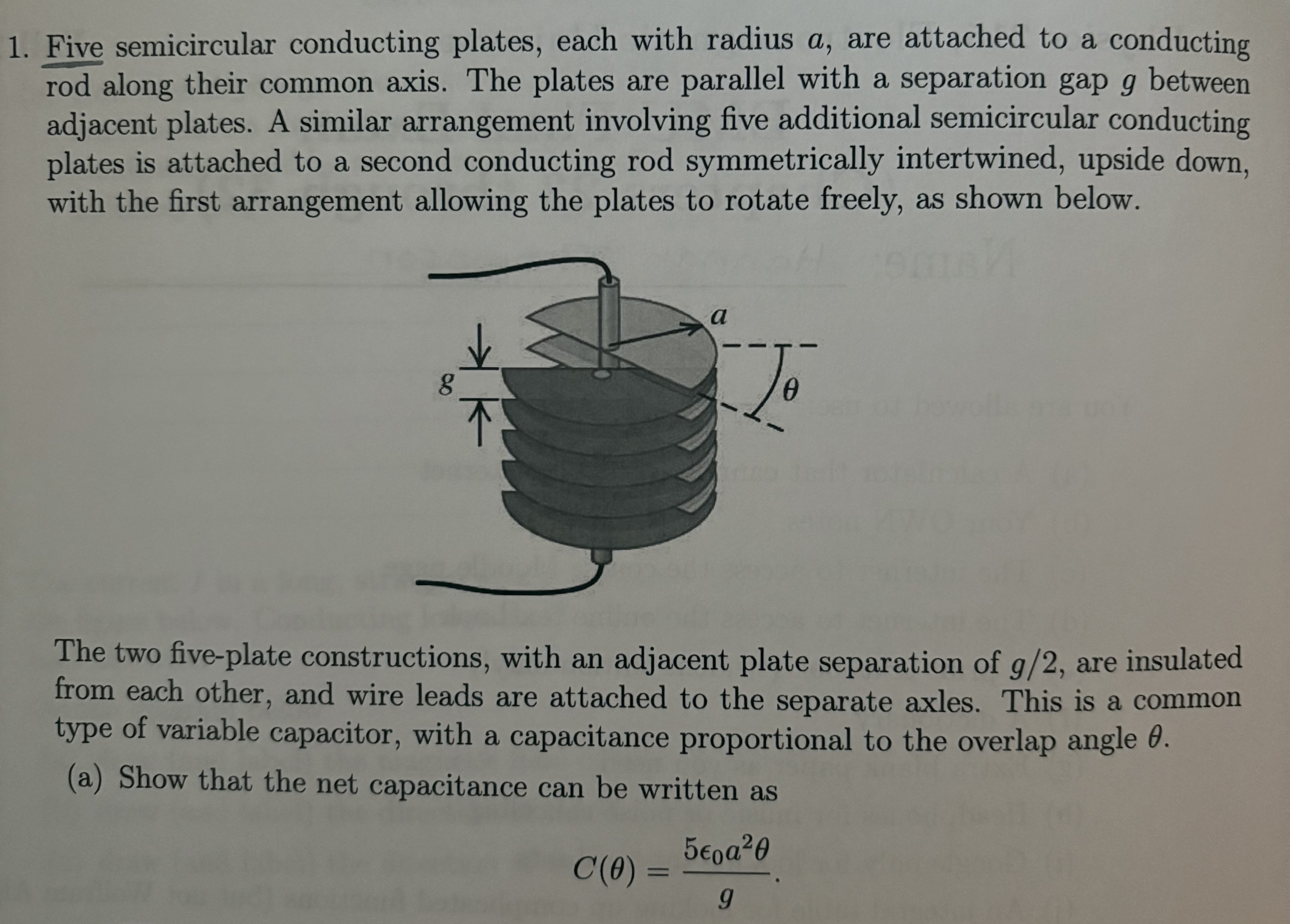
Five semicircular conducting plates, each with radius are attached to a conducting rod along their common axis. The plates are parallel with a separation gap between adjacent plates. A similar arrangement involving five additional semicircular conducting plates is attached to a second conducting rod symmetrically intertwined, upside down, with the first arrangement allowing the plates to rotate freely, as shown below.
The two fiveplate constructions, with an adjacent plate separation of are insulated from each other, and wire leads are attached to the separate axles. This is a common type of variable capacitor, with a capacitance proportional to the overlap angle
a Show that the net capacitance can be written as
b The plate radius is acm while the gap distance is gmm This variable capacitor is placed in series with a Microhenries inductor and a ohms resistor. An amplified signal from an antenna supplies a voltage source, and the output voltage is taken across the capacitor. The circuit is used as a radio receiver that receives a signal frequency equal to the resonance frequency of the LRC circuit. What capacitance should be used to receive an AM radio signal at kHz What angle theta in degrees should be selected to give that capacitance?
c Draw a phasor diagram for this circuit.
dWhat are the reactances of each component.
eIf the input signal is a sinusoidal voltage with an amplitude of mV at the AM frequency above what is the amplitude of the output voltage.
f If the knob on the capacitor is now turned so that theta degrees, what is the frequency the radio is now turned to
Step by Step Solution
There are 3 Steps involved in it
1 Expert Approved Answer
Step: 1 Unlock

Question Has Been Solved by an Expert!
Get step-by-step solutions from verified subject matter experts
Step: 2 Unlock
Step: 3 Unlock
 Study Help