







Question: Fix ? = {0, 1} and constout ? ? ? is a string constant that is not the code of any pair of the form
Fix ? = {0, 1} and constout ? ? ? is a string constant that is not the code of any pair of the form hM, wi where M is a Turing machine and w is a string. Consider this computable function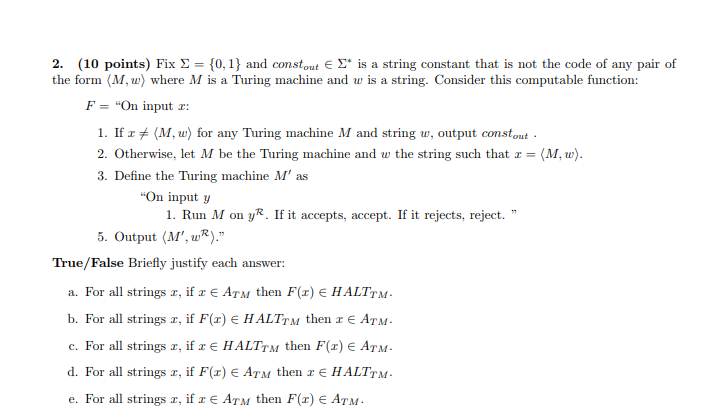
2. (10 points) Fix = {0,1} and constout * is a string constant that is not the code of any pair of the form (M,w) where M is a Turing machine and w is a string. Consider this computable function: F = "On input : 1. If x + (M, w) for any Turing machine M and string w, output constout. 2. Otherwise, let M be the Turing machine and w the string such that x = (M,w). 3. Define the Turing machine M' as "On input y 1. Run M on yR. If it accepts, accept. If it rejects, reject. " 5. Output (M', w')." True/False Briefly justify each answer: a. For all strings x, if x ATM then F(x) HALTTM- b. For all strings x, if F() HALTTM then I E ATM- c. For all strings 1, if IE HALTTM then F(x) E ATM- d. For all strings 1, if F(1) Arm then I E HALTTM- e. For all strings x, if I e Arm then F(x) E ATM. 2. (10 points) Fix = {0,1} and constout * is a string constant that is not the code of any pair of the form (M,w) where M is a Turing machine and w is a string. Consider this computable function: F = "On input : 1. If x + (M, w) for any Turing machine M and string w, output constout. 2. Otherwise, let M be the Turing machine and w the string such that x = (M,w). 3. Define the Turing machine M' as "On input y 1. Run M on yR. If it accepts, accept. If it rejects, reject. " 5. Output (M', w')." True/False Briefly justify each answer: a. For all strings x, if x ATM then F(x) HALTTM- b. For all strings x, if F() HALTTM then I E ATM- c. For all strings 1, if IE HALTTM then F(x) E ATM- d. For all strings 1, if F(1) Arm then I E HALTTM- e. For all strings x, if I e Arm then F(x) E ATM
Step by Step Solution
There are 3 Steps involved in it

Get step-by-step solutions from verified subject matter experts
 Study Help