







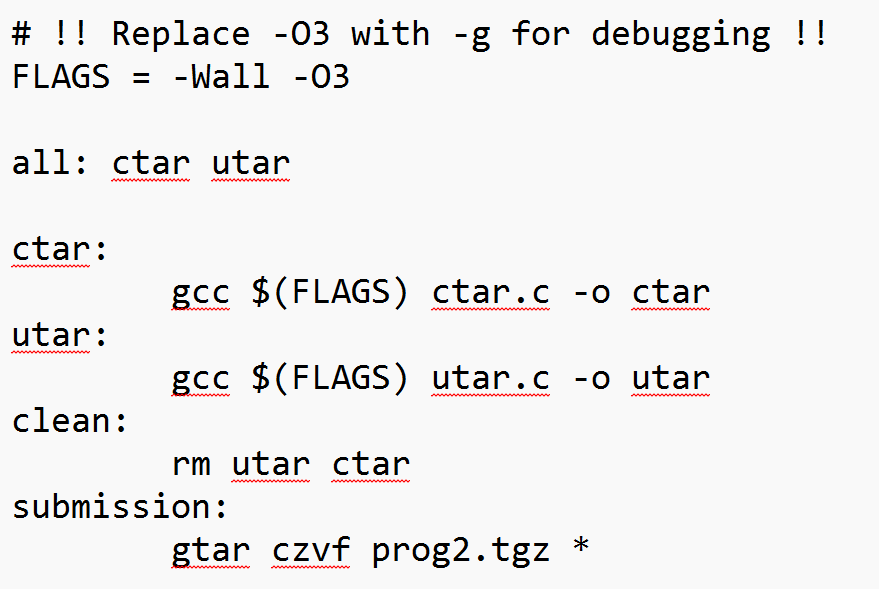
Question: FLAGS = - Wall - 0 3 all: ctar utar ctar: gcc $ ( FLAGS ) ctar.c - o ctar utar: gcc $ ( FLAGS
FLAGS Wall
all: ctar utar
ctar:
gcc $FLAGS ctar.c o ctar
utar:
gcc $FLAGS utar.c o utar
clean:
rm utar ctar
submission:
gtar czvf progtgz ctar.In this project, we will develop two programs; a program to tar a given list of files and create an archive file, and another program that can untar a given archive file. You should call the program which combines the given list of files ctar and the program which extracts an archive file utar.
The usage information for the commands is given below:
To create an empty archive file:
ctar a
To append files to a given archive and create if not present :
ctar a file file filen
To delete a file from the archive
ctar d
To extract contents of the archive file :
utar
In order to simplify your implementation, assume that each of the file parameters should be the name of a file, and not a directory and no wildcards will be allowed. In order to find if a given argument is a regular file or not, you can use lstat kernel call. The archive file should begin with a header which contains pointers to where each file starts, the size of the file, and another pointer to its name. The header will provide enough space to store information about files and an overflow link next. The link, when not zero is a pointer to another header of identical structure.
The C structure describing the header is shown below :
typedef struct
int magic; This must have the value x
int eop; End of file pointer.
int blockcount; Number of entries in the block which are inuse.
int filesize; File size in bytes for files
char deleted; Contains binary one at position i if ith entry was deleted.
int filename; pointer to the name of the file.
int next; pointer to the next header block.
hdr;
There is no maximum file name length or file size. For the size of the header, do not assume a constant value; use sizeof instead. After the header has been written to file, up to eight files can be written to the archive. If there are more than files to be archived, create a new header at the end of the file. The process will be repeated for the entire list of files to be archived.
If a delete command is given, your program should locate the header for the required file and rewrite the
header back by marking the corresponding header position as deleted. You do not have to delete the file
contents from the archive file.
Error Checking
Your program should implement all or nothing semantics, ie you should verify all input arguments for
validity and unless all are valid, you should not create a new archive, or modify an existing archive file. Some
possible problems that you should definitely check for are:
Not an archive file.
Non existing file argument.
Nonregular file input argument.
File already in the archive.
In order to avoid erronously updating a nonarchive file, the program should check to see if the given file was indeed created by the ctar program. The program can do this by ensuring the initial header contains the magic number in the magic variable, and the size of the archive file in eop. The above error list is not exhaustive. Your program should check the return value from any kernel call, give an appropriate error message on standard error and terminate. The program does not need to protect against file corruption if an unanticipated IO error is encountered.
utar program
Program utar should read a given archive file, validate that it is indeed an archive file and extract each of the stored files one by one. Do not worry about the time stamps of the files you are restoring. Each untarred file must have permissions. If the directory contains a file with the same name, the program should not override the file by generating an error message of the form:
File blah blah already exists. Move away that file and restart.
and terminate.
Your submission must be written in C Use the provided templates for the Makefile and your two main programs, ctar.c and utar.c You may NOT use any stdio functions no printf, scanf, etc. except sprintf and sscanf That means if you open the manpage of a function, and it asks you to include you may not use it
progtgz must contain utar.h
v v v Include headers her:
A copy of the source with comments.
A makefile with all, ctar, utar and clean
A file named TESTS in the main project directory that contains a description of the test cases you executed against the code to verify correct operation.
A README file which describes what works and what does not and how to use any of the tests in the TESTS directory.
Step by Step Solution
There are 3 Steps involved in it
1 Expert Approved Answer
Step: 1 Unlock

Question Has Been Solved by an Expert!
Get step-by-step solutions from verified subject matter experts
Step: 2 Unlock
Step: 3 Unlock
 Study Help