







Question: Floating Point Arithmetic Let X greater than or equal to 0 be an arbitrary number and n a nonnegative integer. In exact arithmetic, the following
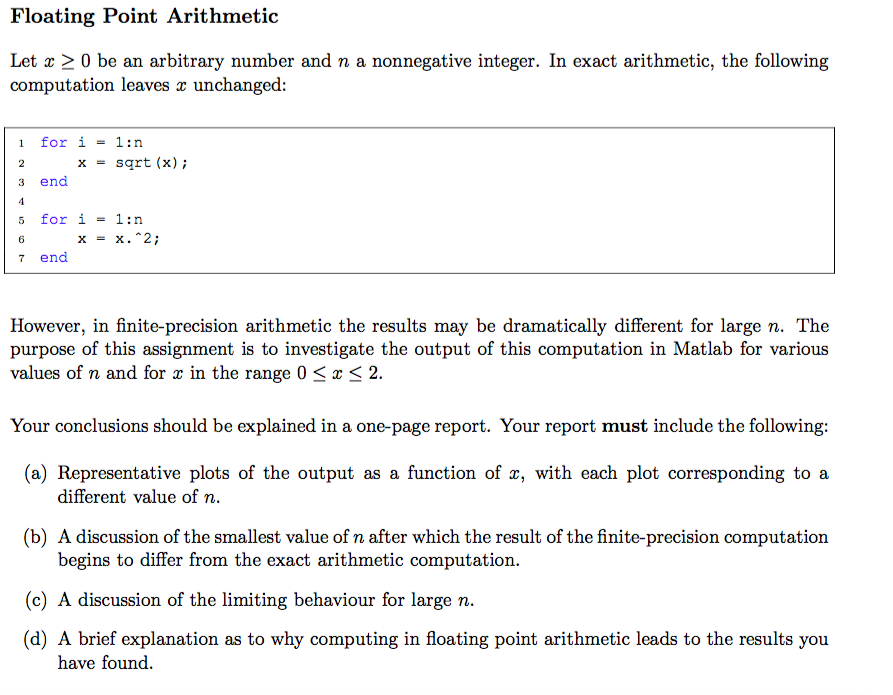
Floating Point Arithmetic Let X greater than or equal to 0 be an arbitrary number and n a nonnegative integer. In exact arithmetic, the following computation leaves x unchanged: However, in finite-precision arithmetic the results may be dramatically different for large n. The purpose of this assignment is to investigate the output of this computation in Matlab for various values of n and for x in the range 0 less than or equal to x less than or equal to 2. Your conclusions should be explained in a one-page report. Your report must include the following: Representative plots of the output as a function of x, with each plot corresponding to a different value of n. A discussion of the smallest value of n after which the result of the finite-precision computation begins to differ from the exact arithmetic computation. A discussion of the limiting behaviour for large n. A brief explanation as to why computing in floating point arithmetic leads to the results you have found
Step by Step Solution
There are 3 Steps involved in it

Get step-by-step solutions from verified subject matter experts
 Study Help