







Question: Flow situations in biofluid mechanics involve the flow through tubes that change in size with time (such as blood vessels) or are supplied by an
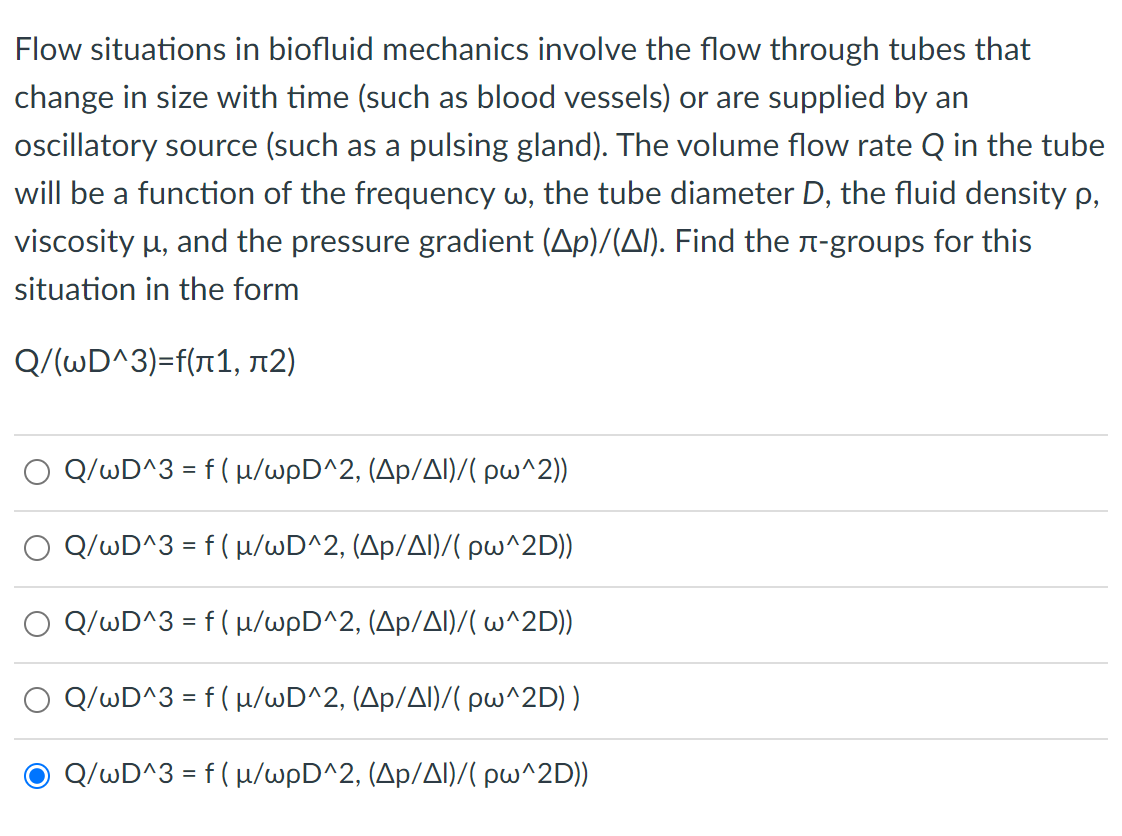
Flow situations in biofluid mechanics involve the flow through tubes that change in size with time (such as blood vessels) or are supplied by an oscillatory source (such as a pulsing gland). The volume flow rate Q in the tube will be a function of the frequency w, the tube diameter D, the fluid density p, viscosity u, and the pressure gradient (Ap)/(A/). Find the n-groups for this situation in the form Q/(wD^3)=f(11, 12) Q/wD^3 = f(u/wpD^2, (Ap/Al)/(pw^2)) Q/wD^3 = f(u/wD^2, (Ap/Al)/( pw^2D)) O Q/wD^3 = f(u/wpD^2, (Ap/Al)/( W^2D)) Q/wD^3 = f (m/wD^2, (Ap/Al)/( pw^2D) ) O Q/wD^3 = f(u/wpD^2, (Ap/Al)/( pw^2D))
Step by Step Solution
There are 3 Steps involved in it
1 Expert Approved Answer
Step: 1 Unlock

Question Has Been Solved by an Expert!
Get step-by-step solutions from verified subject matter experts
Step: 2 Unlock
Step: 3 Unlock
 Study Help