







Question: FOLLOW THE FUNCTION PARAMETERS GIVEN You are given two arrays each containing n floating point numbers with the ollowing properties: E1 values are in non-decreasing
FOLLOW THE FUNCTION PARAMETERS GIVEN
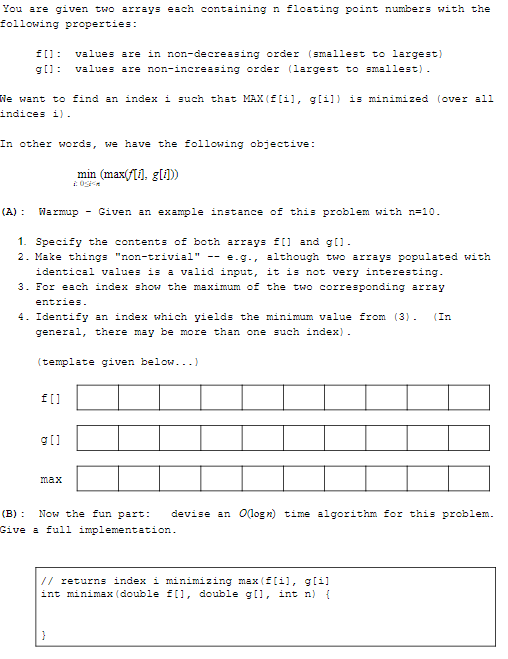
You are given two arrays each containing n floating point numbers with the ollowing properties: E1 values are in non-decreasing order smallest to largest) givalues are non-increasing order (largest to smallest) We want to find an index i such that gX f[i], g[1]) is minirnized (over all indices i) In other words, we have the tollowing objective: min (max fA, gl1) (A) : ilarm up- Given an example instance of this problem with n=10. 1. Specify the contents of both arrays ll and g 2. Make things "non-trivial" - e.g, although two arrays populated with identical values is a valid input, it is not very interesting 3. For each index show the maximum of the to corresponding array entries. 4. Identisy an index which yields the minimum value from (3) In general, there may be more than one such index) template given below f ll g [l (B): Now the fun pa devise an Olog) ime algorithm tor this problem. Give a full implementation. / returns index i minimizing max (Eiil, glil int minimax (double , double gli, int n) f
Step by Step Solution
There are 3 Steps involved in it

Get step-by-step solutions from verified subject matter experts
 Study Help