







Question: Follow the guidelines for writing pseudocode: C/Java/Python instructions are fine. But do not write object-oriented additions. Do not declare or use any class. Declare only
Follow the guidelines for writing pseudocode:
-
C/Java/Python instructions are fine. But do not write object-oriented additions. Do not declare or use any class. Declare only procedures (if necessary) and explain in words what each procedure does, and what is the use of each parameter.
-
One instruction per line
-
from C, do not use !, :, ?, or double assignment. As a general rule, this is not the place to be too smart
-
Match the brackets with a horizontal line
-
Number the lines of pseudocode
-
Write down if your array is indexed 0...n1 or 1...n.
-
It can help the grader if you describe in English the idea of the algorithm, or examples of instances on which you run your algorithm.
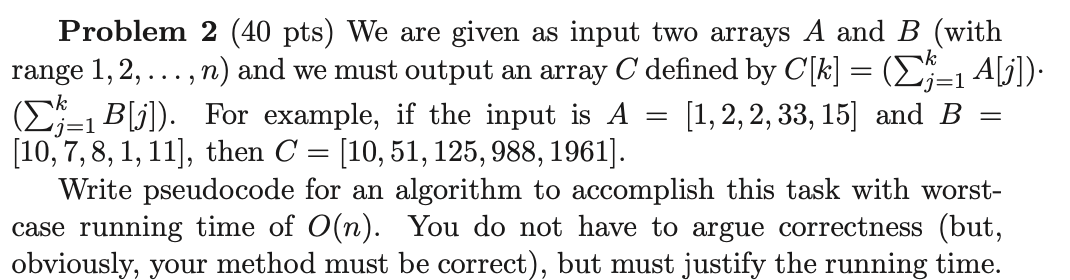
Problem 2 (40 pts) We are given as input two arrays A and B (with range 1, 2, ..., n) and we must output an array C defined by C[k] = (=1 A[j]). (51B[j]). For example, if the input A [1, 2, 2, 33, 15) and B (10,7,8, 1, 11], then C = [10,51, 125,988, 1961). Write pseudocode for an algorithm to accomplish this task with worst- case running time of O(n). You do not have to argue correctness (but, obviously, your method must be correct), but must justify the running time. Problem 2 (40 pts) We are given as input two arrays A and B (with range 1, 2, ..., n) and we must output an array C defined by C[k] = (=1 A[j]). (51B[j]). For example, if the input A [1, 2, 2, 33, 15) and B (10,7,8, 1, 11], then C = [10,51, 125,988, 1961). Write pseudocode for an algorithm to accomplish this task with worst- case running time of O(n). You do not have to argue correctness (but, obviously, your method must be correct), but must justify the running time
Step by Step Solution
There are 3 Steps involved in it

Get step-by-step solutions from verified subject matter experts
 Study Help