



Question: Follow the method in Step 1 to determine if the third expression is a perfect square trinomial. The first term and the third term
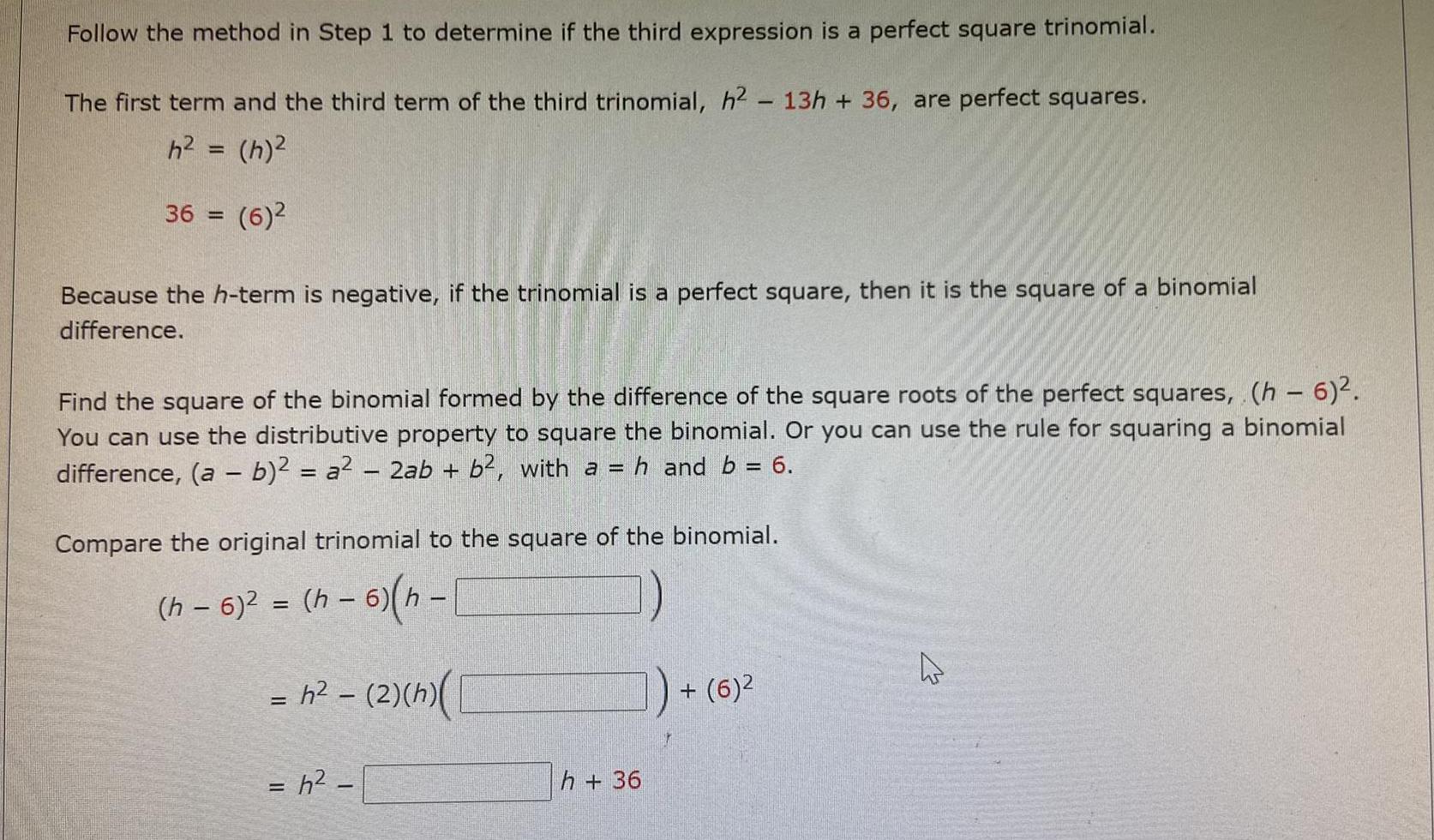
Follow the method in Step 1 to determine if the third expression is a perfect square trinomial. The first term and the third term of the third trinomial, h - 13h+ 36, are perfect squares. h = (h) (6)2 36 = Because the h-term is negative, if the trinomial is a perfect square, then it is the square of a binomial difference. Find the square of the binomial formed by the difference of the square roots of the perfect squares, (h-6). You can use the distributive property to square the binomial. Or you can use the rule for squaring a binomial difference, (a - b) = a - 2ab+ b, with a = h and b = 6. Compare the original trinomial to the square of the binomial. (h-6)= (h-6)(h- = h - (2)(h)( = h - ]) + (6) h+ 36
Step by Step Solution
There are 3 Steps involved in it

Get step-by-step solutions from verified subject matter experts