







Question: Following is a partially completed performance report for a recent week for direct labor in the binding department of a book publisher: Direct labor Original
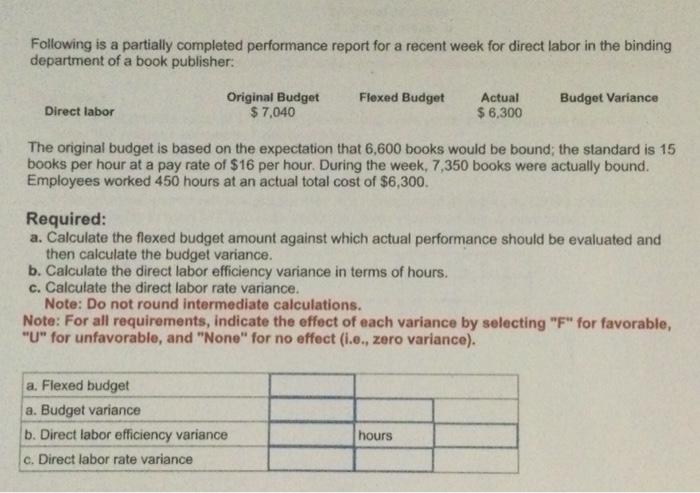
Following is a partially completed performance report for a recent week for direct labor in the binding department of a book publisher: The original budget is based on the expectation that 6,600 books would be bound; the standard is 15 books per hour at a pay rate of $16 per hour. During the week, 7,350 books were actually bound. Employees worked 450 hours at an actual total cost of $6,300. Required: a. Calculate the flexed budget amount against which actual performance should be evaluated and then calculate the budget variance. b. Calculate the direct labor efficiency variance in terms of hours. c. Calculate the direct labor rate variance. Note: Do not round intermediate calculations. Note: For all requirements, indicate the effect of each variance by selecting "F" for favorable, "U" for unfavorable, and "None" for no effect (i.e., zero variance). Following is a partially completed performance report for a recent week for direct labor in the binding department of a book publisher: The original budget is based on the expectation that 6,600 books would be bound; the standard is 15 books per hour at a pay rate of $16 per hour. During the week, 7,350 books were actually bound. Employees worked 450 hours at an actual total cost of $6,300. Required: a. Calculate the flexed budget amount against which actual performance should be evaluated and then calculate the budget variance. b. Calculate the direct labor efficiency variance in terms of hours. c. Calculate the direct labor rate variance. Note: Do not round intermediate calculations. Note: For all requirements, indicate the effect of each variance by selecting "F" for favorable, "U" for unfavorable, and "None" for no effect (i.e., zero variance)
Step by Step Solution
There are 3 Steps involved in it

Get step-by-step solutions from verified subject matter experts
 Study Help