







Question: following questions: Question 6: Given the quantities a = 3 m, b = 6 s, and c = 16 m/s, what is the value of
following questions:
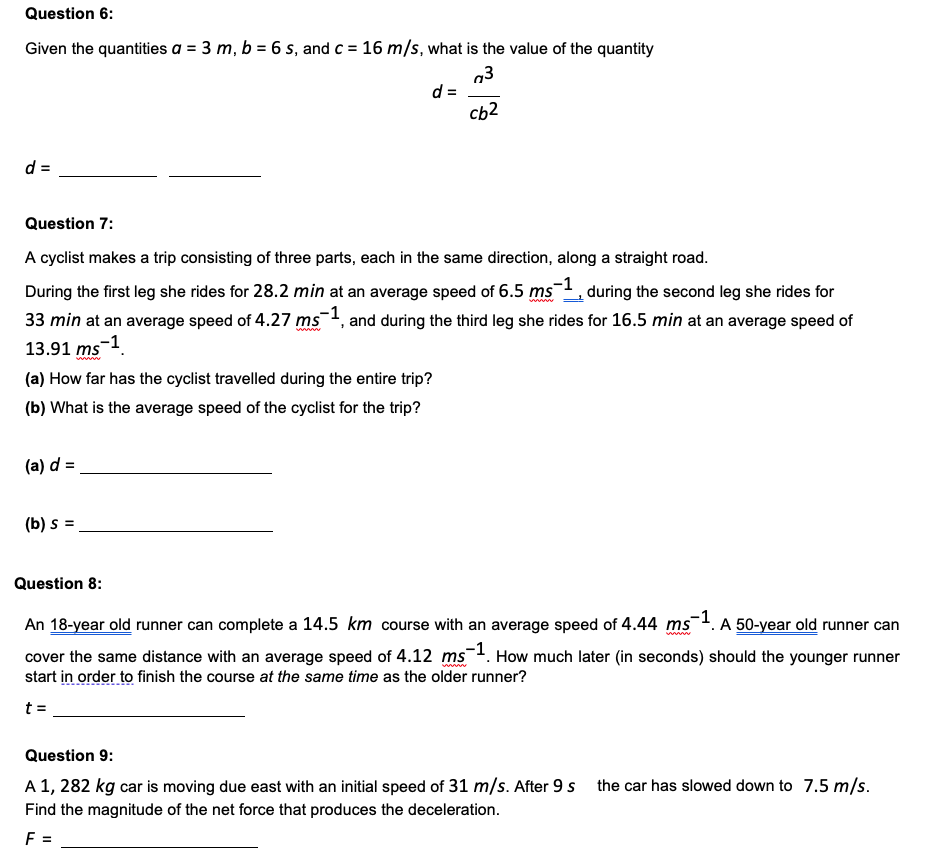
Question 6: Given the quantities a = 3 m, b = 6 s, and c = 16 m/s, what is the value of the quantity d = cb2 d = Question 7: A cyclist makes a trip consisting of three parts, each in the same direction, along a straight road. During the first leg she rides for 28.2 min at an average speed of 6.5 ms"_ , during the second leg she rides for 33 min at an average speed of 4.27 ms", and during the third leg she rides for 16.5 min at an average speed of 13.91 ms-1. (a) How far has the cyclist travelled during the entire trip? (b) What is the average speed of the cyclist for the trip? (a) d = ( b ) s = Question 8: An 18-year old runner can complete a 14.5 km course with an average speed of 4.44 ms"J. A 50-year old runner can cover the same distance with an average speed of 4.12 ms . How much later (in seconds) should the younger runner start in order to finish the course at the same time as the older runner? t= Question 9: A 1, 282 kg car is moving due east with an initial speed of 31 m/s. After 9 s the car has slowed down to 7.5 m/s. Find the magnitude of the net force that produces the deceleration. F=
Step by Step Solution
There are 3 Steps involved in it

Get step-by-step solutions from verified subject matter experts
 Study Help