Question: Following the 3-Step Problem-Solving Approach, analyze the issues prevalent in the Problem- Solving Application, Food Fight on Campus, Chapter 10. 1011 Food Fight on Campus
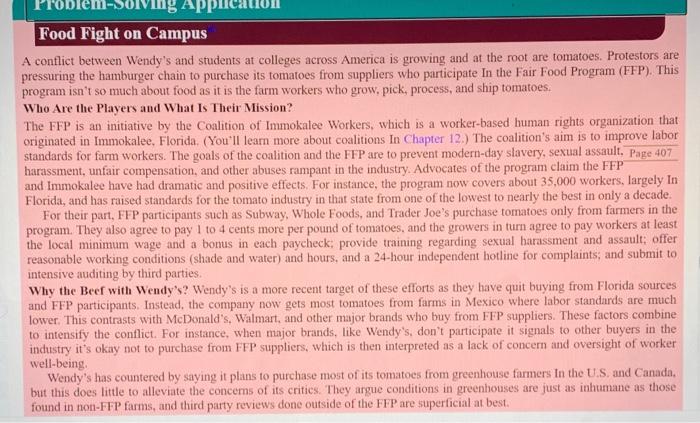
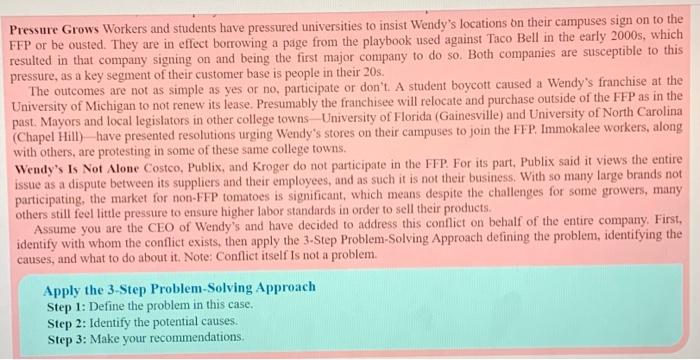
Following the 3-Step Problem-Solving Approach, analyze the issues prevalent in the Problem- Solving Application, "Food Fight on Campus," Chapter 10. 1011 Food Fight on Campus A conflict between Wendy's and students at colleges across America is growing and at the root are tomatoes. Protestors are pressuring the hamburger chain to purchase its tomatoes from suppliers who participate in the Fair Food Program (FFP). This program isn't so much about food as it is the farm workers who grow, pick, process, and ship tomatoes. Who Are the Players and What Is Their Mission? The FFP is an initiative by the Coalition of Immokalee Workers, which is a worker-based human rights organization that originated in Immokalee, Florida. (You'll learn more about coalitions in Chapter 12.) The coalition's aim is to improve labor standards for farm workers. The goals of the coalition and the FFP are to prevent modern-day slavery, sexual assault. Page 407 harassment, unfair compensation, and other abuses rampant in the industry. Advocates of the program claim the FFP and Immokalee have had dramatic and positive effects. For instance, the program now covers about 35,000 workers, largely In Florida, and has raised standards for the tomato industry in that state from one of the lowest to nearly the best in only a decade. For their part, FFP participants such as Subway, Whole Foods, and Trader Joe's purchase tomatoes only from farmers in the program. They also agree to pay 1 to 4 cents more per pound of tomatoes, and the growers in turn agree to pay workers at least the local minimum wage and a bonus in each paycheck; provide training regarding sexual harassment and assault: offer reasonable working conditions (shade and water) and hours, and a 24-hour independent hotline for complaints, and submit to intensive auditing by third parties. Why the Beer with Wendy's? Wendy's is a more recent target of these efforts as they have quit buying from Florida sources and FFP participants. Instead, the company now gets most tomatoes from farms in Mexico where labor standards are much lower. This contrasts with McDonald's, Walmart, and other major brands who buy from FFP suppliers. These factors combine to intensify the conflict. For instance, when major brands, like Wendy's, don't participate it signals to other buyers in the industry it's okay not to purchase from FFP suppliers, which is then interpreted as a lack of concern and oversight of worker well-being Wendy's has countered by saying it plans to purchase most of its tomatoes from greenhouse farmers in the US and Canada, but this does little to alleviate the concems of its critics. They argue conditions in greenhouses are just as inhumane as those found in non-FFP farms, and third party reviews done outside of the FFP are superficial at best. Pressure Grows Workers and students have pressured universities to insist Wendy's locations on their campuses sign on to the FFP or be ousted. They are in effect borrowing a page from the playbook used against Taco Bell in the early 2000s, which resulted in that company signing on and being the first major company to do so. Both companies are susceptible to this pressure, as a key segment of their customer base is people in their 20s. The outcomes are not as simple as yes or no, participate or don't. A student boycott caused a Wendy's franchise at the University of Michigan to not renew its lease. Presumably the franchisee will relocate and purchase outside of the FFP as in the past. Mayors and local legislators in other college towns-University of Florida (Gainesville) and University of North Carolina (Chapel Hill) have presented resolutions urging Wendy's stores on their campuses to join the FFP. Immokalee workers, along with others, are protesting in some of these same college towns. Wendy's Is Not Alone Costco, Publix, and Kroger do not participate in the FFP. For its part, Publix said it views the entire issue as a dispute between its suppliers and their employees, and as such it is not their business. With so many large brands not participating, the market for non-FFP tomatoes is significant, which means despite the challenges for some growers, many others still feel little pressure to ensure higher labor standards in order to sell their products. Assume you are the CEO of Wendy's and have decided to address this conflict on behalf of the entire company, First, identify with whom the conflict exists, then apply the 3-Step Problem Solving Approach defining the problem, identifying the causes, and what to do about it. Note: Conflict itself is not a problem Apply the 3-Step Problem Solving Approach Step 1: Define the problem in this case. Step 2: Identify the potential causes. Step 3: Make your recommendations










 Study Help