


Question: Following the class notes, within the framework of our course, what does it mean when we say that we would like to study a financial

Following the class notes, within the framework of our course, what does it mean when we say that we would like to study a financial time series p=p(t)? In other words, what is the basic set of steps that one should be taking to produce inference about a high-frequency financial price series? Give both brief and detailed answers. Try to use your own words and thoughts.
Following the class notes, within the framework
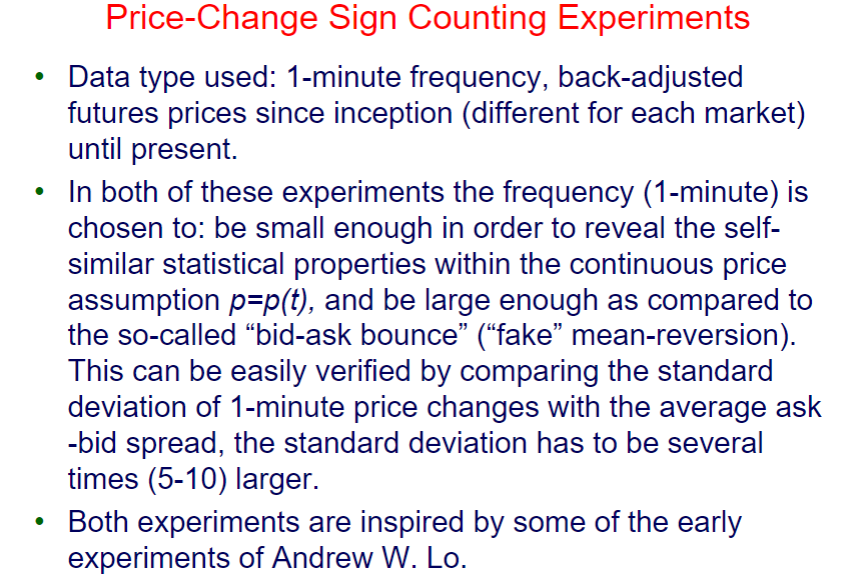
Price-Change Sign Counting Experiments - Data type used: 1-minute frequency, back-adjusted futures prices since inception (different for each market) until present. - In both of these experiments the frequency (1-minute) is chosen to: be small enough in order to reveal the self- similar statistical properties within the continuous price assumption p=p(t), and be large enough as compared to the so-called "bid-ask bounce\" (\"fake" mean-reversion). This can be easily veried by comparing the standard deviation of 1-minute price changes with the average ask -bid spread, the standard deviation has to be several times (5-10) larger. - Both experiments are inspired by some of the early experiments of Andrew W. Lo

Step by Step Solution

There are 3 Steps involved in it

1 Expert Approved Answer
Step: 1 Unlock blur-text-image

Question Has Been Solved by an Expert!

Get step-by-step solutions from verified subject matter experts

Step: 2 Unlock
Step: 3 Unlock

Students Have Also Explored These Related Finance Questions!