



Question: Following the set-up of Section 15.2 in the class notes by Dr, Kolya Chernov, do the following in Matlab. Part 1:) Use Matlab to simulate
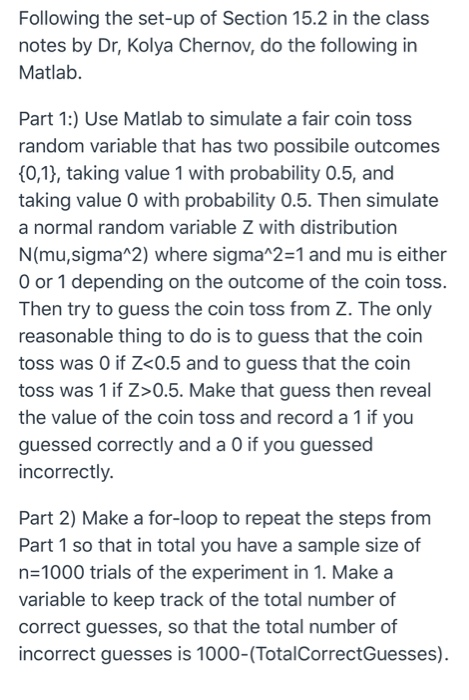
Following the set-up of Section 15.2 in the class notes by Dr, Kolya Chernov, do the following in Matlab. Part 1:) Use Matlab to simulate a fair coin toss random variable that has two possibile outcomes {0,1}, taking value 1 with probability 0.5, and taking value 0 with probability 0.5. Then simulate a normal random variable Z with distribution N(mu,sigma^2) where sigma^2=1 and mu is either O or 1 depending on the outcome of the coin toss. Then try to guess the coin toss from Z. The only reasonable thing to do is to guess that the coin toss was 0 if Z0.5. Make that guess then reveal the value of the coin toss and record a 1 if you guessed correctly and a 0 if you guessed incorrectly. Part 2) Make a for-loop to repeat the steps from Part 1 so that in total you have a sample size of n=1000 trials of the experiment in 1. Make a variable to keep track of the total number of correct guesses, so that the total number of incorrect guesses is 1000-(TotalCorrectGuesses). Following the set-up of Section 15.2 in the class notes by Dr, Kolya Chernov, do the following in Matlab. Part 1:) Use Matlab to simulate a fair coin toss random variable that has two possibile outcomes {0,1}, taking value 1 with probability 0.5, and taking value 0 with probability 0.5. Then simulate a normal random variable Z with distribution N(mu,sigma^2) where sigma^2=1 and mu is either O or 1 depending on the outcome of the coin toss. Then try to guess the coin toss from Z. The only reasonable thing to do is to guess that the coin toss was 0 if Z0.5. Make that guess then reveal the value of the coin toss and record a 1 if you guessed correctly and a 0 if you guessed incorrectly. Part 2) Make a for-loop to repeat the steps from Part 1 so that in total you have a sample size of n=1000 trials of the experiment in 1. Make a variable to keep track of the total number of correct guesses, so that the total number of incorrect guesses is 1000-(TotalCorrectGuesses)
Step by Step Solution
There are 3 Steps involved in it

Get step-by-step solutions from verified subject matter experts