





Question: - Font Crea Shape Effects Styles Select Paragraph Drawing Editing Ad CHEMICAL TITRATIONS Fuel cells and water electrolyzers are energy converters. Water electrolyzers convert electrical
- Font Crea Shape Effects Styles Select Paragraph

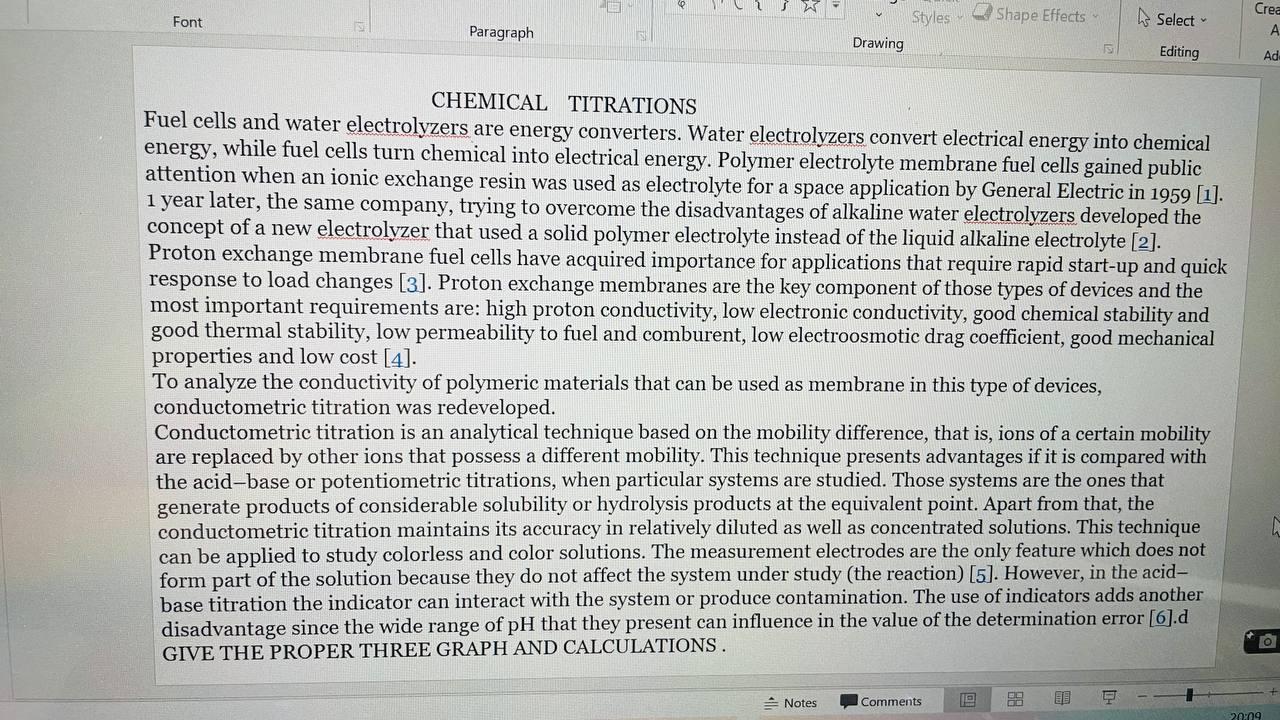
- Font Crea Shape Effects Styles Select Paragraph Drawing Editing Ad CHEMICAL TITRATIONS Fuel cells and water electrolyzers are energy converters. Water electrolyzers convert electrical energy into chemical energy, while fuel cells turn chemical into electrical energy. Polymer electrolyte membrane fuel cells gained public attention when an ionic exchange resin was used as electrolyte for a space application by General Electric in 1959 [1]. 1 year later, the same company, trying to overcome the disadvantages of alkaline water electrolyzers developed the concept of a new electrolyzer that used a solid polymer electrolyte instead of the liquid alkaline electrolyte [2]. Proton exchange membrane fuel cells have acquired importance for applications that require rapid start-up and quick response to load changes [3]. Proton exchange membranes are the key component of those types of devices and the most important requirements are: high proton conductivity, low electronic conductivity, good chemical stability and good thermal stability, low permeability to fuel and comburent, low electroosmotic drag coefficient, good mechanical properties and low cost [4]. To analyze the conductivity of polymeric materials that can be used as membrane in this type of devices, conductometric titration was redeveloped. Conductometric titration is an analytical technique based on the mobility difference, that is, ions of a certain mobility are replaced by other ions that possess a different mobility. This technique presents advantages if it is compared with the acid-base or potentiometric titrations, when particular systems are studied. Those systems are the ones that generate products of considerable solubility or hydrolysis products at the equivalent point. Apart from that, the conductometric titration maintains its accuracy in relatively diluted as well as concentrated solutions. This technique can be applied to study colorless and color solutions. The measurement electrodes are the only feature which does not form part of the solution because they do not affect the system under study (the reaction) [5]. However, in the acid- base titration the indicator can interact with the system or produce contamination. The use of indicators adds another disadvantage since the wide range of pH that they present can influence in the value of the determination error [6].d GIVE THE PROPER THREE GRAPH AND CALCULATIONS. Comments Notes 10 D 20:09

Step by Step Solution

There are 3 Steps involved in it

1 Expert Approved Answer
Step: 1 Unlock blur-text-image

Question Has Been Solved by an Expert!

Get step-by-step solutions from verified subject matter experts

Step: 2 Unlock
Step: 3 Unlock

Students Have Also Explored These Related General Management Questions!