







Question: For 7 b) (a) (3 points) Let A be an array with n distinct integer elements. Let AlgoA be an arbitrary algorithm that needs to
For 7 b)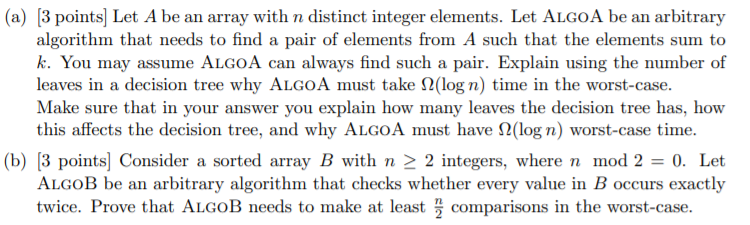
(a) (3 points) Let A be an array with n distinct integer elements. Let AlgoA be an arbitrary algorithm that needs to find a pair of elements from A such that the elements sum to k. You may assume ALGOA can always find such a pair. Explain using the number of leaves in a decision tree why ALGOA must take N(log n) time in the worst-case. Make sure that in your answer you explain how many leaves the decision tree has, how this affects the decision tree, and why ALGOA must have (log n) worst-case time. (b) (3 points) Consider a sorted array B with n > 2 integers, where n mod 2 = 0. Let AlgoB be an arbitrary algorithm that checks whether every value in B occurs exactly twice. Prove that AlgoB needs to make at least comparisons in the worst-case. (a) (3 points) Let A be an array with n distinct integer elements. Let AlgoA be an arbitrary algorithm that needs to find a pair of elements from A such that the elements sum to k. You may assume ALGOA can always find such a pair. Explain using the number of leaves in a decision tree why ALGOA must take N(log n) time in the worst-case. Make sure that in your answer you explain how many leaves the decision tree has, how this affects the decision tree, and why ALGOA must have (log n) worst-case time. (b) (3 points) Consider a sorted array B with n > 2 integers, where n mod 2 = 0. Let AlgoB be an arbitrary algorithm that checks whether every value in B occurs exactly twice. Prove that AlgoB needs to make at least comparisons in the worst-case
Step by Step Solution
There are 3 Steps involved in it

Get step-by-step solutions from verified subject matter experts
 Study Help