







Question: for a fixed k, let k................................................ For a xed k, let qu be equal to the number of partitions of 11 into k distinct parts,
for a fixed k, let k................................................
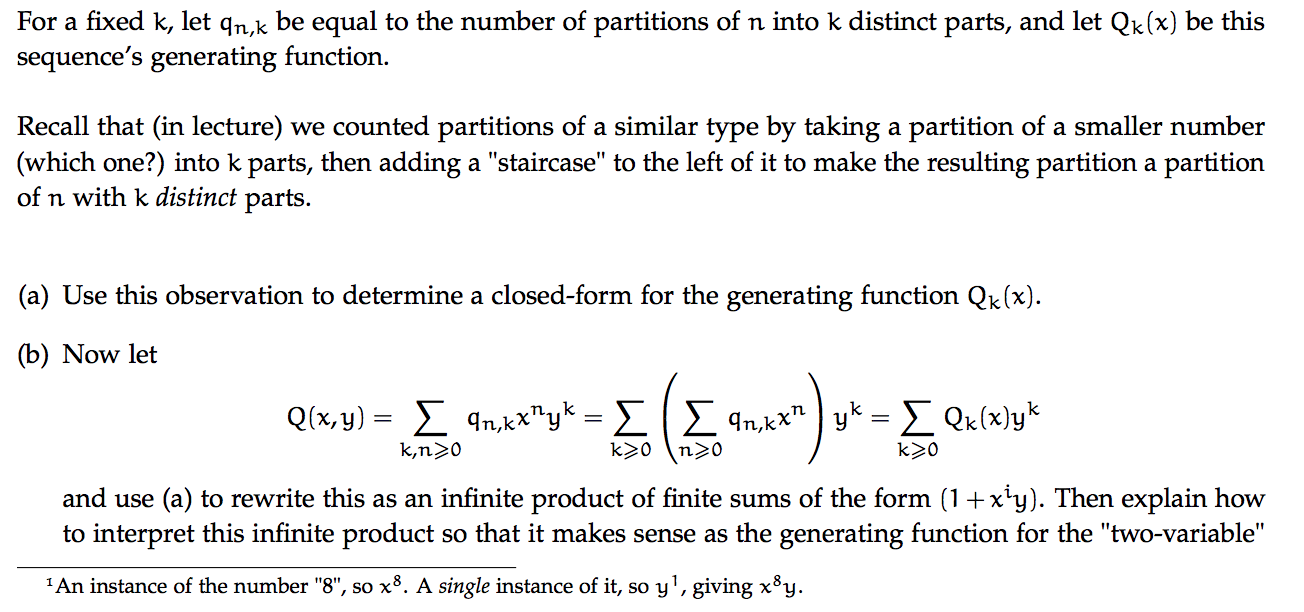
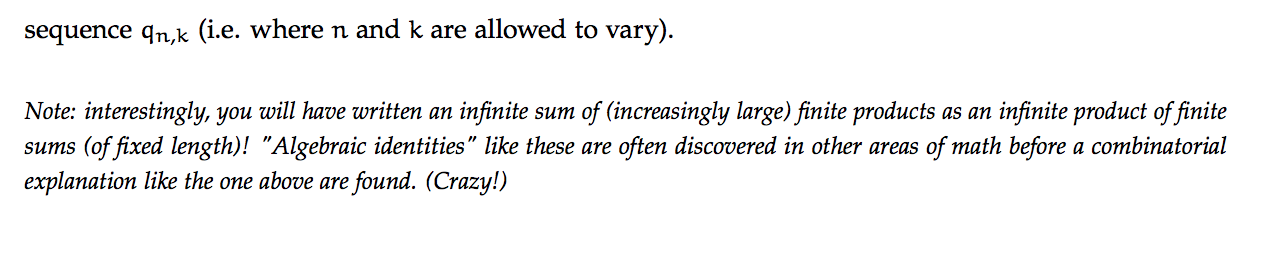
For a xed k, let qu be equal to the number of partitions of 11 into k distinct parts, and let Qx) be this sequence's generating function. Recall that (in lecture) we counted partitions of a similar type by taking a partition of a smaller number (which one?) into k parts, then adding a "staircase" to the left of it to make the resulting partition a partition of n with k distinct parts. (a) Use this observation to determine a closed-form for the generating function Qk[x]. (b) Now let thry] = Z qn,kxnyk = Z (Z qn,kX\") yk = Z kaclyk k2o k,n;o 1:20 190 and use (a) to rewrite this as an innite product of finite sums of the form [1 + xiy). Then explain how to interpret this infinite product so that it makes sense as the generating function for the "two-variable" 1An instance of the number "8", so x8. A sing-12 instance of it, so 9', giving xsy. sequence qu (i.e. where n. and k are allowed to vary). Note: interestingly, you will have written an innite sum of (increasingly large) nite products as an innite product ofnite sums (afxed length)! \"Algebraic identities " like these are often discovered in other areas of math before a combinatorial explanation like the one above are mnd. (Crazy!)
Step by Step Solution
There are 3 Steps involved in it

Get step-by-step solutions from verified subject matter experts
 Study Help