







Question: For a given undirected, unweighted simple graph and a fixed positive integer k , the k - coloring problem asks us to assign a color
For a given undirected, unweighted simple graph and a fixed positive integer the coloring problem asks us to assign a color to each vertex, using at most different colors, such that no two adjacent vertices have the same color.
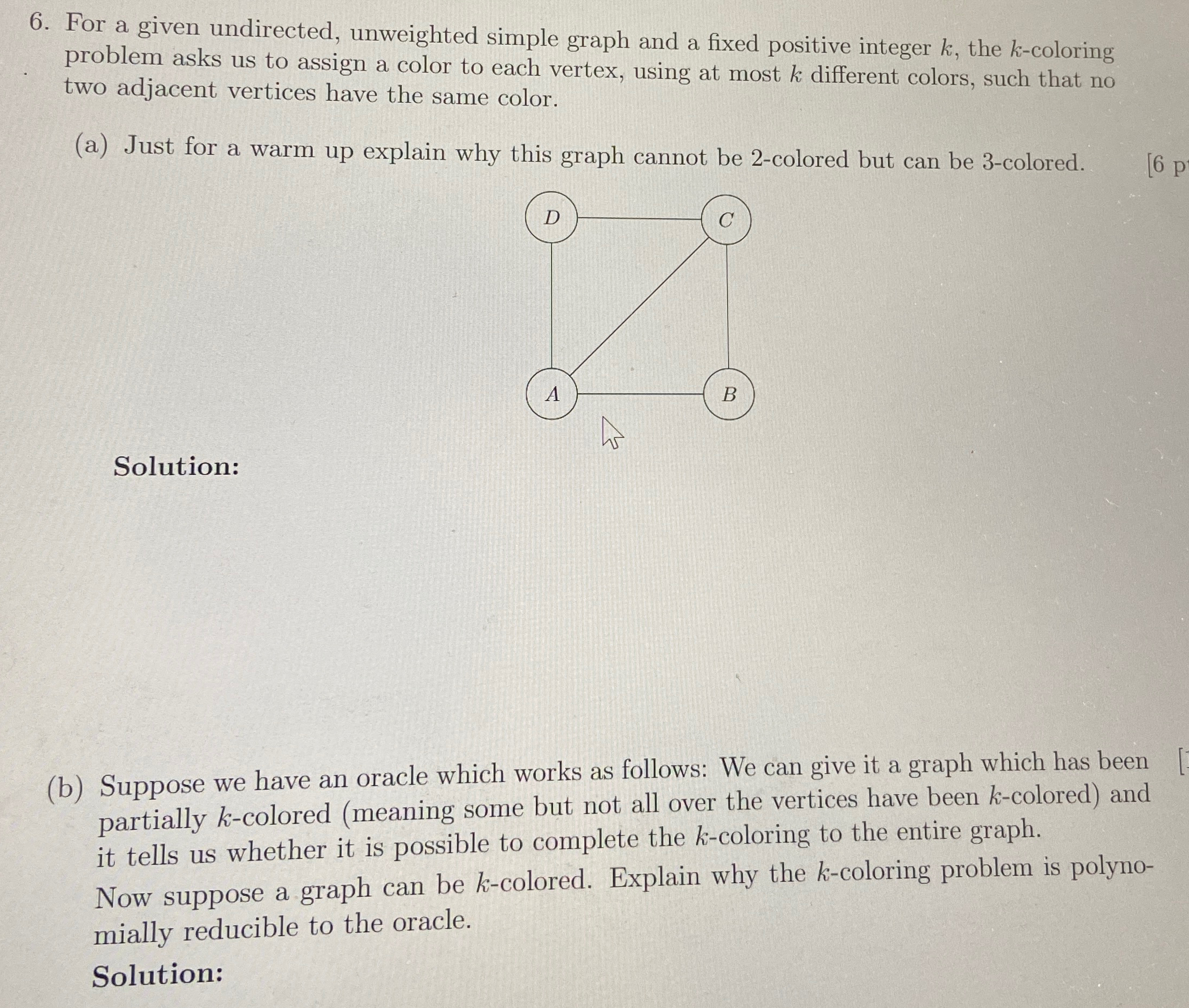
a Just for a warm up explain why this graph cannot be colored but can be colored.
Solution:
b Suppose we have an oracle which works as follows: We can give it a graph which has been partially colored meaning some but not all over the vertices have been colored and it tells us whether it is possible to complete the coloring to the entire graph. Now suppose a graph can be colored. Explain why the coloring problem is polynomially reducible to the oracle.
Solution:
Step by Step Solution
There are 3 Steps involved in it
1 Expert Approved Answer
Step: 1 Unlock

Question Has Been Solved by an Expert!
Get step-by-step solutions from verified subject matter experts
Step: 2 Unlock
Step: 3 Unlock
 Study Help