







Question: For a homogeneous constant coefficient linear differential equation dy an dn-ly + an-1 dan-1 dy + a1 + aoy = 0 ... dr dx
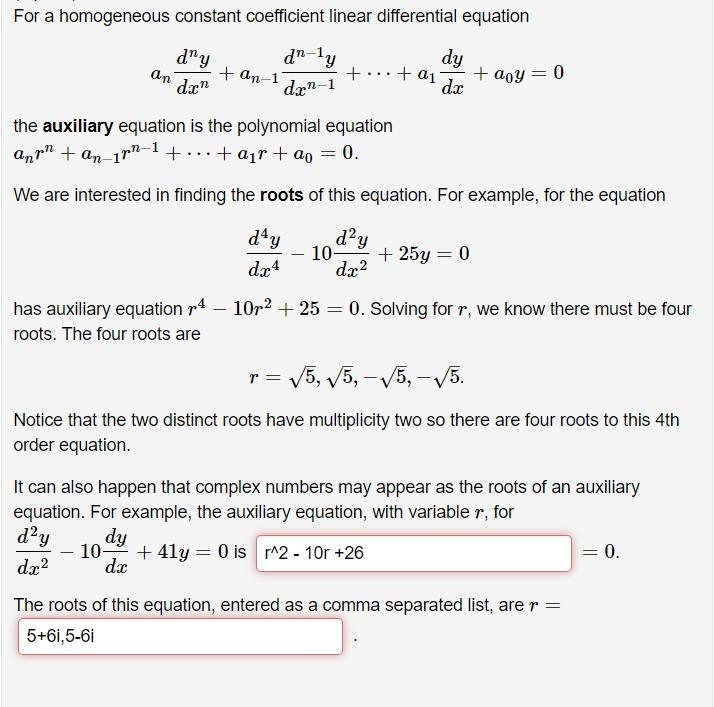
For a homogeneous constant coefficient linear differential equation d"y an dn-ly + an-1 dan-1 dy + a1 + aoy = 0 ... dr" dx the auxiliary equation is the polynomial equation anr" + an-1r"++ a1r + ao = 0. We are interested in finding the roots of this equation. For example, for the equation d?y 10- + 25y = 0 dx? d'y dx4 has auxiliary equation r4 10r2 + 25 = 0. Solving for r, we know there must be four roots. The four roots are r = V5, V5, -V5, - V5. Notice that the two distinct roots have multiplicity two so there are four roots to this 4th order equation. It can also happen that complex numbers may appear as the roots of an auxiliary equation. For example, the auxiliary equation, with variable r, for d?y dy - 10- dx + 41y = 0 is ^2 - 10r +26 = 0. dx? The roots of this equation, entered as a comma separated list, are r = 5+6i,5-6i
Step by Step Solution
3.43 Rating (150 Votes )
There are 3 Steps involved in it
Solution Given that dxt The ... View full answer

Get step-by-step solutions from verified subject matter experts
 Study Help