







Question: For a one dimensional 2-class problem with 2 actions a1, a2, (ai: choose @1; au choose ). We assume P(1) = 3/5, Pan) = 2/5,
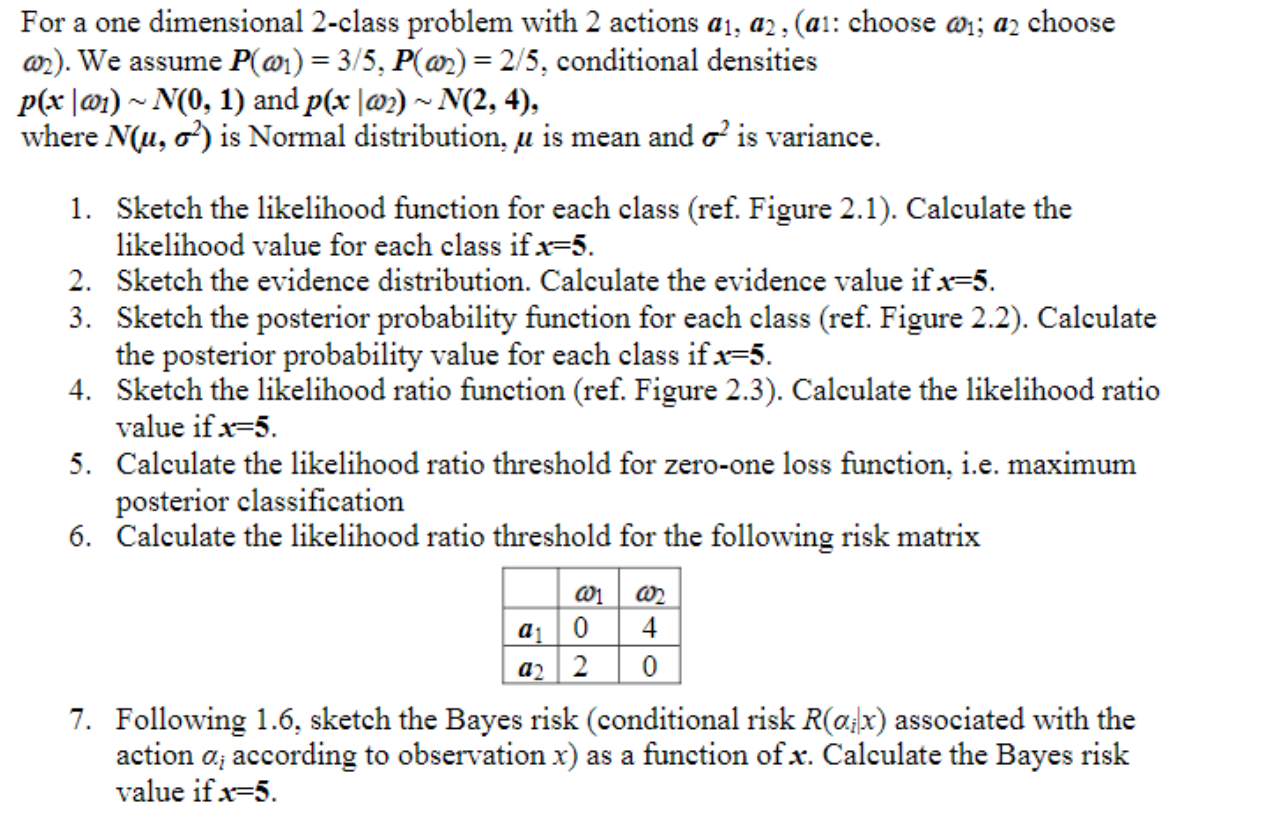
For a one dimensional 2-class problem with 2 actions a1, a2, (ai: choose @1; au choose ). We assume P(1) = 3/5, Pan) = 2/5, conditional densities p(x|01) ~ N(0, 1) and p(x |02) -N(2, 4), where N(u, c) is Normal distribution, u is mean and o- is variance. 1. Sketch the likelihood function for each class (ref. Figure 2.1). Calculate the likelihood value for each class if x=5. 2. Sketch the evidence distribution. Calculate the evidence value if x=5. 3. Sketch the posterior probability function for each class (ref. Figure 2.2). Calculate the posterior probability value for each class if x=5. 4. Sketch the likelihood ratio function (ref. Figure 2.3). Calculate the likelihood ratio value if x=5. 5. Calculate the likelihood ratio threshold for zero-one loss function, i.e. maximum posterior classification 6. Calculate the likelihood ratio threshold for the following risk matrix @ia ao | 4 a2 20 7. Following 1.6, sketch the Bayes risk (conditional risk Rax) associated with the action 0; according to observation x) as a function of x. Calculate the Bayes risk value if x=5. For a one dimensional 2-class problem with 2 actions a1, a2, (ai: choose @1; au choose ). We assume P(1) = 3/5, Pan) = 2/5, conditional densities p(x|01) ~ N(0, 1) and p(x |02) -N(2, 4), where N(u, c) is Normal distribution, u is mean and o- is variance. 1. Sketch the likelihood function for each class (ref. Figure 2.1). Calculate the likelihood value for each class if x=5. 2. Sketch the evidence distribution. Calculate the evidence value if x=5. 3. Sketch the posterior probability function for each class (ref. Figure 2.2). Calculate the posterior probability value for each class if x=5. 4. Sketch the likelihood ratio function (ref. Figure 2.3). Calculate the likelihood ratio value if x=5. 5. Calculate the likelihood ratio threshold for zero-one loss function, i.e. maximum posterior classification 6. Calculate the likelihood ratio threshold for the following risk matrix @ia ao | 4 a2 20 7. Following 1.6, sketch the Bayes risk (conditional risk Rax) associated with the action 0; according to observation x) as a function of x. Calculate the Bayes risk value if x=5
Step by Step Solution
There are 3 Steps involved in it

Get step-by-step solutions from verified subject matter experts
 Study Help