







Question: For all problems in this homework, unless otherwise noted, assume the reactor is homo- geneous. Additionally, we can make the assumption the fuel (only 235U)
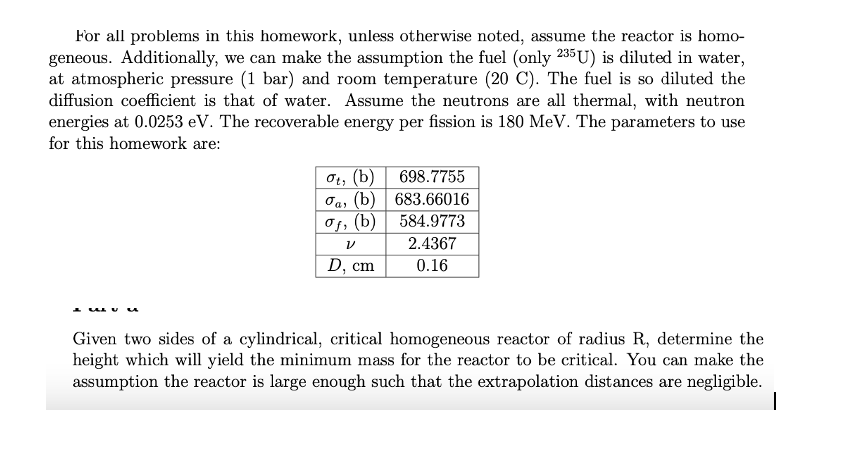
For all problems in this homework, unless otherwise noted, assume the reactor is homo- geneous. Additionally, we can make the assumption the fuel (only 235U) is diluted in water, at atmospheric pressure (1 bar) and room temperature (20 C). The fuel is so diluted the diffusion coefficient is that of water. Assume the neutrons are all thermal, with neutron energies at 0.0253 eV. The recoverable energy per fission is 180 MeV. The parameters to use for this homework are: 0t, (b) 698.7755 0a, (b) 683.66016 Of, (b) 584.9773 2.4367 D, cm 0.16 V u Uu Given two sides of a cylindrical, critical homogeneous reactor of radius R, determine the height which will yield the minimum mass for the reactor to be critical. You can make the assumption the reactor is large enough such that the extrapolation distances are negligible. For all problems in this homework, unless otherwise noted, assume the reactor is homo- geneous. Additionally, we can make the assumption the fuel (only 235U) is diluted in water, at atmospheric pressure (1 bar) and room temperature (20 C). The fuel is so diluted the diffusion coefficient is that of water. Assume the neutrons are all thermal, with neutron energies at 0.0253 eV. The recoverable energy per fission is 180 MeV. The parameters to use for this homework are: 0t, (b) 698.7755 0a, (b) 683.66016 Of, (b) 584.9773 2.4367 D, cm 0.16 V u Uu Given two sides of a cylindrical, critical homogeneous reactor of radius R, determine the height which will yield the minimum mass for the reactor to be critical. You can make the assumption the reactor is large enough such that the extrapolation distances are negligible
Step by Step Solution
There are 3 Steps involved in it

Get step-by-step solutions from verified subject matter experts
 Study Help