







Question: For all problems that require the use of MATLAB, please submit all of your MATLAB code along with the required plots and results. 1 )
For all problems that require the use of MATLAB, please submit all of your MATLAB code along with the required plots and results.
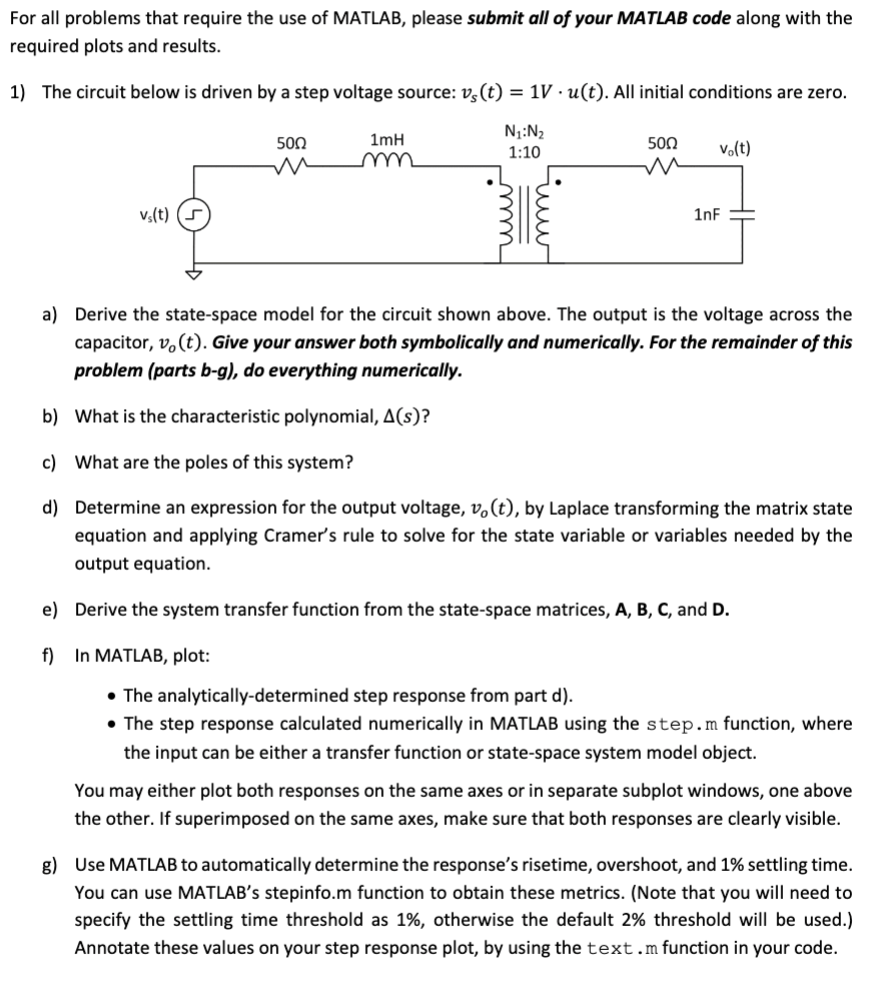
The circuit below is driven by a step voltage source: vst V cdot ut All initial conditions are zero.
a Derive the statespace model for the circuit shown above. The output is the voltage across the capacitor, vot Give your answer both symbolically and numerically. For the remainder of this problem parts bg do everything numerically.
b What is the characteristic polynomial, Deltas
c What are the poles of this system?
d Determine an expression for the output voltage, vot by Laplace transforming the matrix state equation and applying Cramer's rule to solve for the state variable or variables needed by the output equation.
e Derive the system transfer function from the statespace matrices, A B C and D
f In MATLAB, plot:
The analyticallydetermined step response from part d
The step response calculated numerically in MATLAB using the step.m function, where the input can be either a transfer function or statespace system model object.
You may either plot both responses on the same axes or in separate subplot windows, one above the other. If superimposed on the same axes, make sure that both responses are clearly visible.
g Use MATLAB to automatically determine the response's risetime, overshoot, and settling time. You can use MATLAB's stepinfo.m function to obtain these metrics. Note that you will need to specify the settling time threshold as otherwise the default threshold will be used. Annotate these values on your step response plot, by using the text.m function in your code.
Please SOLVE THIS ASAP!! Answers and Matlab code and graph screen shot. PLEASE PLEASE PLEASE do this ASAP. Thank you and will Like if done!!
Step by Step Solution
There are 3 Steps involved in it
1 Expert Approved Answer
Step: 1 Unlock

Question Has Been Solved by an Expert!
Get step-by-step solutions from verified subject matter experts
Step: 2 Unlock
Step: 3 Unlock
 Study Help