



Question: For alphabet , given languages L 1 and L 2 over , the set - wise concatenation is defined as L 1 L 2 =
For alphabet given languages and over the setwise concatenation is defined as
for some strings and :
Q
Point
Consider the alphabet How many strings are in the set @
iel the set is empty
Some other finite number
Infinitely many unique strings
Q
Points
Let and be NFAs. When applying the
construction in Theorem to build the NFA that recognizes @
select all and only the statements below that are universally true.
Q
Point
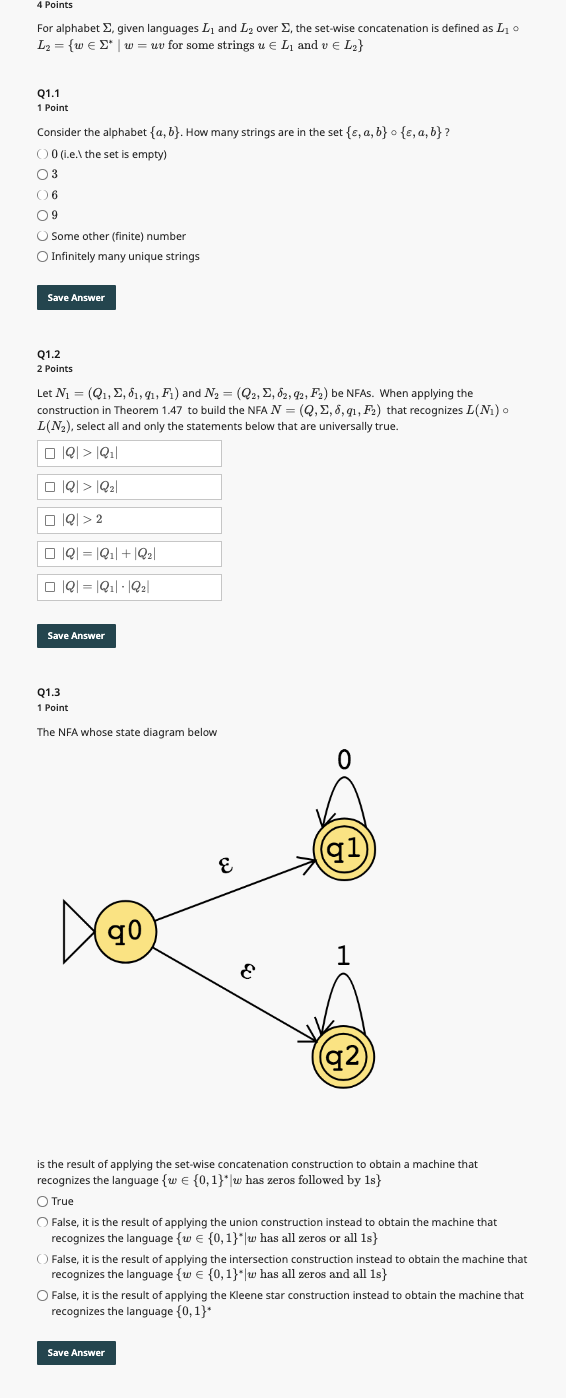
The NFA whose state diagram below
is the result of applying the setwise concatenation construction to obtain a machine that
recognizes the language has zeros followed by :
True
False, it is the result of applying the union construction instead to obtain the machine that
recognizes the language has all zeros or all :
False, it is the result of applying the intersection construction instead to obtain the machine that
recognizes the language has all zeros and all :
False, it is the result of applying the Kleene star construction instead to obtain the machine that
recognizes the language
Step by Step Solution
There are 3 Steps involved in it
1 Expert Approved Answer
Step: 1 Unlock

Question Has Been Solved by an Expert!
Get step-by-step solutions from verified subject matter experts
Step: 2 Unlock
Step: 3 Unlock