







Question: For any integer n we define its successor S(n) = n+1. For any x, y N, let f be the function defined by f(x,0) =
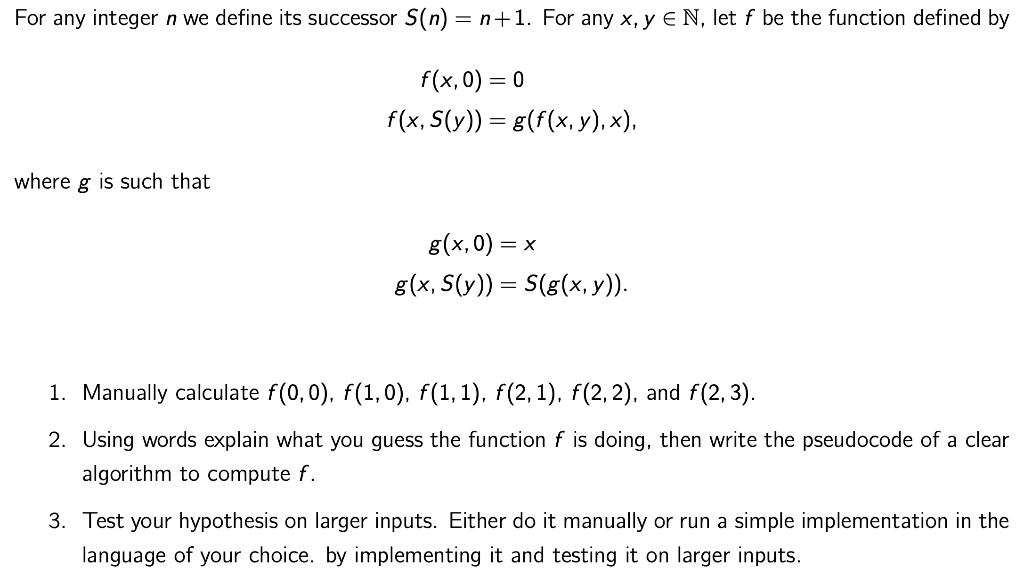
For any integer n we define its successor S(n) = n+1. For any x, y N, let f be the function defined by f(x,0) = 0 f(x, S(y)) = g(f(x, y), x), where g is such that = X g(x,0) = g(x, S(y)) = S(g(x, y)). 1. Manually calculate f(0,0), f(1,0), f(1, 1), f(2, 1), f(2,2), and f(2, 3). 2. Using words explain what you guess the function f is doing, then write the pseudocode of a clear algorithm to compute f. 3. Test your hypothesis on larger inputs. Either do it manually or run a simple implementation in the language of your choice. by implementing it and testing it on larger inputs
Step by Step Solution
There are 3 Steps involved in it
1 Expert Approved Answer
Step: 1 Unlock

Question Has Been Solved by an Expert!
Get step-by-step solutions from verified subject matter experts
Step: 2 Unlock
Step: 3 Unlock
 Study Help