







Question: FOR CONSIDERATION/DISCUSSION 1. How does this value survey help you better understand yourself? Or others? 2. Do you believe that values drive behavior (including ethical
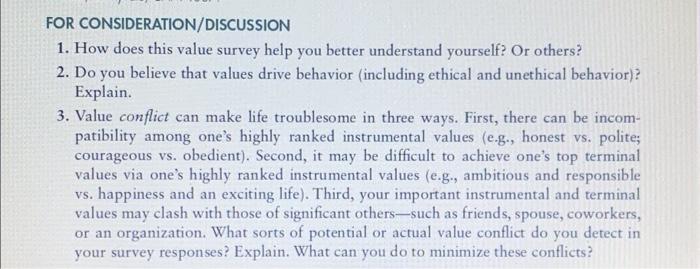
FOR CONSIDERATION/DISCUSSION 1. How does this value survey help you better understand yourself? Or others? 2. Do you believe that values drive behavior (including ethical and unethical behavior)? Explain. 3. Value conflict can make life troublesome in three ways. First, there can be incompatibility among one's highly ranked instrumental values (e.g., honest vs. polite; courageous vs. obedient). Second, it may be difficult to achieve one's top terminal values via one's highly ranked instrumental values (e.g., ambitious and responsible vs. happiness and an exciting life). Third, your important instrumental and terminal values may clash with those of significant others-such as friends, spouse, coworkers, or an organization. What sorts of potential or actual value conflict do you detect in your survey responses? Explain. What can you do to minimize these conflicts? FOR CONSIDERATION/DISCUSSION 1. How does this value survey help you better understand yourself? Or others? 2. Do you believe that values drive behavior (including ethical and unethical behavior)? Explain. 3. Value conflict can make life troublesome in three ways. First, there can be incompatibility among one's highly ranked instrumental values (e.g., honest vs. polite; courageous vs. obedient). Second, it may be difficult to achieve one's top terminal values via one's highly ranked instrumental values (e.g., ambitious and responsible vs. happiness and an exciting life). Third, your important instrumental and terminal values may clash with those of significant others-such as friends, spouse, coworkers, or an organization. What sorts of potential or actual value conflict do you detect in your survey responses? Explain. What can you do to minimize these conflicts
Step by Step Solution
There are 3 Steps involved in it

Get step-by-step solutions from verified subject matter experts
 Study Help