







Question: For each assertion in 7(a)-(c), prove the assertion directly from the definition of the big-O asymptotic notation if it is true by finding values for
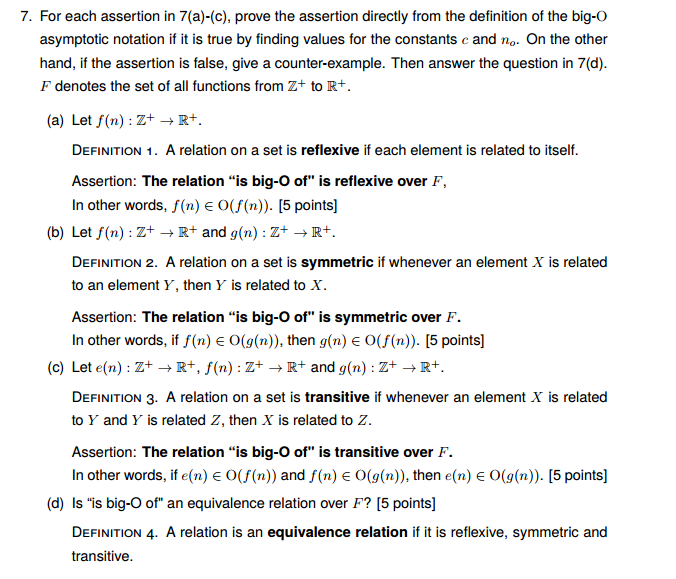
For each assertion in 7(a)-(c), prove the assertion directly from the definition of the big-O asymptotic notation if it is true by finding values for the constants c and n_0. On the other hand, if the assertion is false, give a counter-example. Then answer the question in 7(d). F denotes the set of all functions from Z^+ to R^+. Let f(n):Z^+ rightarrow R^+. DEFINITION 1. A relation on a set is reflexive if each element is related to itself. Assertion: The relation "is big-o of" is reflexive over F, n other words, f(n) O(f(n)). Let f(n) Z^+ rightarrow R^+ and g(n):Z^+ rightarrow R^+. DEFINITION 2. A relation on a set is symmetric if whenever an element X is related to an element Y, then Y is related to X. Assertion: The relation "is big-o of" is symmetric over F In other words, if f(n) O(g(n)), then g(n) O(f(n)). Let e(n):Z^+ R^+, f(n):Z^+ rightarrow R^+ and g(n):Z^+ rightarrow R^+. DEFINITION 3. A relation on a set is transitive if whenever an element X is related to Y and Y is related Z, then X is related to Z. Assertion: The relation "is big-O of" is transitive over F. In other words, if e(n) O(f(n)) and f(n) O(g(n)), then e(n) (g(n)). ls "is big-O of" an equivalence relation over F? DEFINITION 4. A relation is an equivalence relation f it is reflexive, symmetric and transitive
Step by Step Solution
There are 3 Steps involved in it

Get step-by-step solutions from verified subject matter experts
 Study Help