







Question: For each case study you need to identify five aspects of theories and/or practices related to leadership. These theories and practices must be listed numerically,
For each case study you need to identify five aspects of theories and/or practices related to leadership. These theories and practices must be listed numerically, and you must clearly show how these theories and practices relate to the case study specifically.
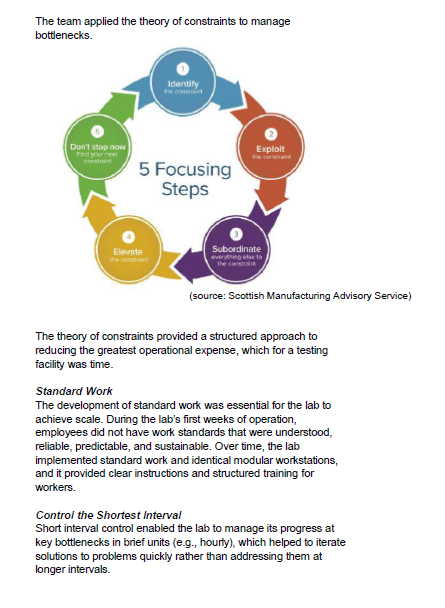
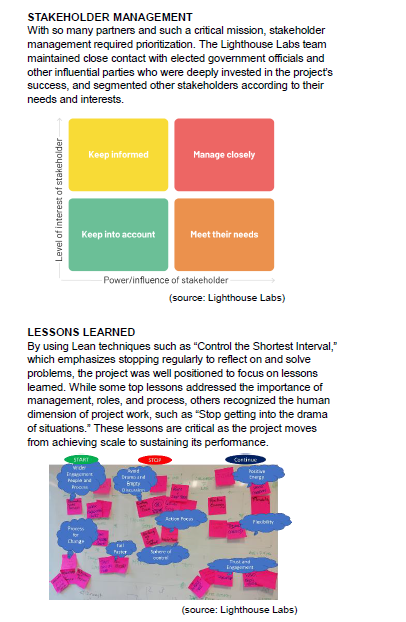
LIGHTHOUSE LABS Innovating in a Crisis CHALLENGE: Scale + Speed With the outbreak of the COVID-19 global pandemic in the spring of 2020, Lighthouse Labs needed to achieve scale rapidly to help the Scottish government meet the need for a massive increase in COVID testing capacity. On its first day of operation, the facility processed 41 tests. By June, it could process 5,000 tests per day with a 24-hour turnaround time through a brute-force effort that was not sustainable over time. Moreover, it sought to achieve a sixteen-fold increase in capacity over 3-4 months. Scaling an ongoing program of this size would typically take years. CONTEXT: FROM RESEARCH TO TESTING When COVID-19 struck, governments around the world faced sudden, overwhelming demand for rapid, reliable COVID testing capacity. Jerome Finlayson of the Scottish Manufacturing Advisory Service reached out to the Scottish government to discuss ways of achieving the scale required to address the needs of this crisis. A series of meetings led to the identification of a research laboratory at Queen Elizabeth University Hospital in Glasgow as a site that could be repurposed as COVID testing facility. The new facility, dubbed the Lighthouse Laboratory, was founded as a partnership among Glasgow University, the National Health Service (NHS), The Department of Health and Social Care and Bio Clavis, a private industry firm. The Lighthouse Laboratory, one of the largest COVID diagnostic testing facilities in the United Kingdom, is hosted by the University of Glasgow at the Queen Elizabeth University Hospital campus. It opened as a collaborative effort among the UK Govemment, Scottish govemment, private industry, and academic research partners. Key Results Currently capable of processing 85,000 COVID tests within 24-hour tumaround time. Hybrid-Whatever Works With a compelling mission of the utmost importance, Lighthouse Labs attracted 750 passionate volunteers willing to fill 220 roles. The pandemic provided a sense of purpose that was a critical motivator for a team facing long hours and a massive learning challenge. FIND A STARTING POINT The lab's leadership team began by developing a comprehensive 12-week project plan, but quickly realized that the dynamic environment of the pandemic required a more agile approach. Instead, it tumed to the techniques of Kaizen and Focused Improvement Teams in order to work toward very clear objectives over daily and weekly timeframes. LEAN PRINCIPLES The team made extensive use of lean principles to implement process improvements that would allow it to work most efficiently and effectively while maintaining the highest quality standards. Plan > Do > Check > Act As soon as the team agreed on a more agile approach, it implemented tightly coupled Plan > Do > Check > Act cycles that enabled it to iterate continuously in response to changing circumstances. Bottleneck Management / Theory of Constraints The team identified bottlenecks in its processes that set the pace for how long it would take to complete tasks with dependencies. Not all bottlenecks were viewed as problems to be solved. For instance, the time necessary to open a box containing a test sample could not be eliminated-it would always be a factor in the overall speed of delivering a test result. Even so, the process of opening boxes could be managed so that all workers on all shifts opened them using the same process in a uniform The team applied the theory of constraints to manage bottlenecks. (source: scotusn manutactunng Advisory Service) The theory of constraints provided a structured approach to reducing the greatest operational expense, which for a testing facility was time. Standard Work The development of standard work was essential for the lab to achieve scale. During the lab's first weeks of operation, employees did not have work standards that were understood, reliable, predictable, and sustainable. Over time, the lab implemented standard work and identical modular workstations, and it provided clear instructions and structured training for workers. Control the Shortest Interval Short interval control enabled the lab to manage its progress at key bottlenecks in brief units (e.g., hourly), which helped to iterate solutions to problems quickly rather than addressing them at longer intervals. STAKEHOLDER MANAGEMENT With so many partners and such a critical mission, stakeholder management required prioritization. The Lighthouse Labs team maintained close contact with elected government officials and other influential parties who were deeply invested in the project's success, and segmented other stakeholders according to their needs and interests. (source: Lighthouse Labs) LESSONS LEARNED By using Lean techniques such as "Control the Shortest Interval," which emphasizes stopping regularly to reflect on and solve problems, the project was well positioned to focus on lessons leamed. While some top lessons addressed the importance of management, roles, and process, others recognized the human dimension of project work, such as "Stop getting into the drama of situations." These lessons are critical as the project moves from achieving scale to sustaining its performance. (suUive. Ligritiunbt Lath)
Step by Step Solution
There are 3 Steps involved in it

Get step-by-step solutions from verified subject matter experts
 Study Help