







Question: . For each factor and the interaction, also report SPSS calculations of observed power and interpret them in terms of Type II error. The results
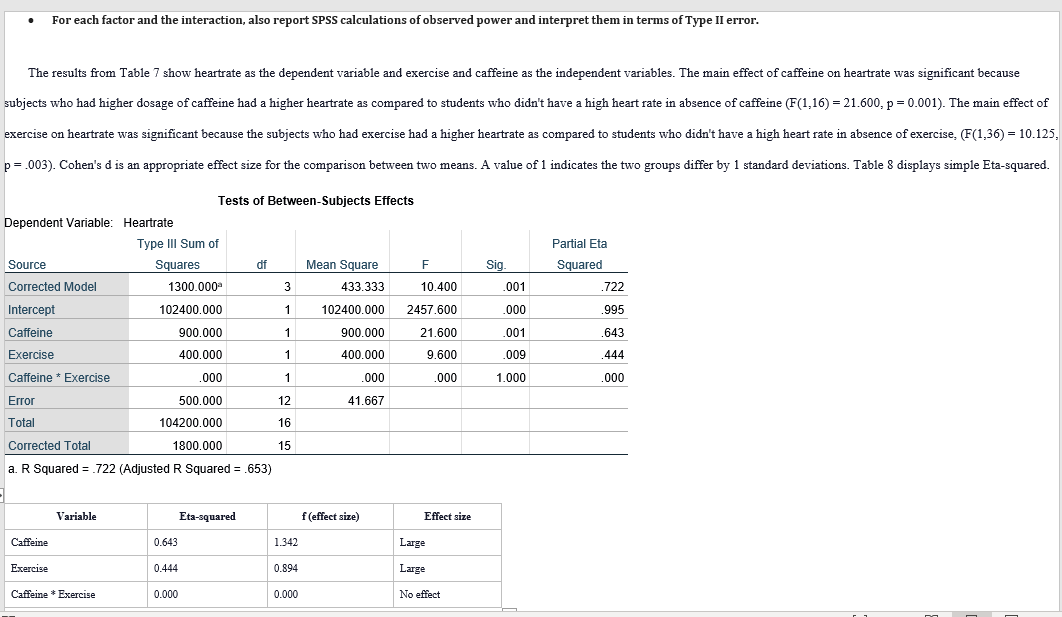
. For each factor and the interaction, also report SPSS calculations of observed power and interpret them in terms of Type II error. The results from Table 7 show heartrate as the dependent variable and exercise and caffeine as the independent variables. The main effect of caffeine on heartrate was significant because subjects who had higher dosage of caffeine had a higher heartrate as compared to students who didn't have a high heart rate in absence of caffeine (F(1,16) = 21.600, p = 0.001). The main effect of exercise on heartrate was significant because the subjects who had exercise had a higher heartrate as compared to students who didn't have a high heart rate in absence of exercise, (F(1,36) = 10.125, p =.003). Cohen's d is an appropriate effect size for the comparison between two means. A value of 1 indicates the two groups differ by 1 standard deviations. Table $ displays simple Eta-squared. Tests of Between-Subjects Effects Dependent Variable: Heartrate Type Ill Sum of Partial Eta Source Squares df Mean Square F Sig. Squared Corrected Model 1300.000 3 433.333 10.400 001 722 Intercept 102400.000 102400.000 2457.600 000 995 Caffeine 900.000 900.000 21.600 001 643 Exercise 400.000 400.000 9.600 009 444 Caffeine * Exercise 000 000 000 1.000 000 Error 500.000 12 41.667 Total 104200.000 16 Corrected Total 1800.000 15 a. R Squared = .722 (Adjusted R Squared = .653) Variable Eta-squared f (effect size) Effect size Caffeine 0.643 1.342 Large Exercise 0.444 0.894 Large Caffeine * Exercise 0.000 0.000 No effect
Step by Step Solution
There are 3 Steps involved in it

Get step-by-step solutions from verified subject matter experts
 Study Help