







Question: For each integer k 1, let ak = ln(2k + 3) ln(2k + 1).a) Consider the sequence {ak}k=1 = {ln(2k + 3) ln(2k + 1)}k=1.Is
For each integer k 1, let ak = ln(2k + 3) ln(2k + 1).a) Consider the sequence {ak}k=1 = {ln(2k + 3) ln(2k + 1)}k=1.Is this sequence convergent or divergent? If it converges, find its exact value. Show all your workto justify your answer. Be sure to use appropriate mathematical notation.b) Consider the telescopic series Xk=1ak =Xk=1ln(2k + 3) ln(2k + 1).Find a simplified expression for the nth partial sum Sn, by cancelling terms telescopically. Showall your work!c) Determine whether the series Xk=1ak converges or diverges. If it converges, find its exact sum;otherwise, briefly explain why it diverges.
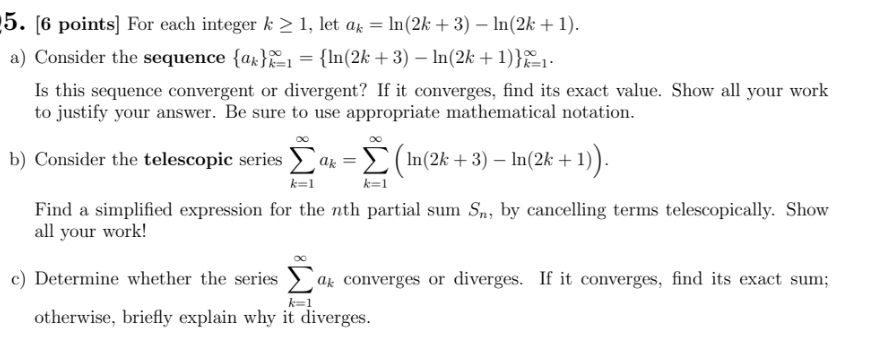
5. [6 points] For each integer k 2 1, let ak = In(2k + 3) - In(2k + 1). a) Consider the sequence {ax}, = {In(2k + 3) - In(2k + 1)}20]. Is this sequence convergent or divergent? If it converges, find its exact value. Show all your work to justify your answer. Be sure to use appropriate mathematical notation. b) Consider the telescopic series _ ax = > (In(2k + 3) - In(2k + 1) ). k=1 k=1 Find a simplified expression for the nth partial sum Sn, by cancelling terms telescopically. Show all your work! c) Determine whether the series ax converges or diverges. If it converges, find its exact sum; k=1 otherwise, briefly explain why it diverges
Step by Step Solution
There are 3 Steps involved in it

Get step-by-step solutions from verified subject matter experts
 Study Help