







Question: For each polynomial, provide the following information. Note: It is not necessary to utilize a calculator until you get to part d. During part
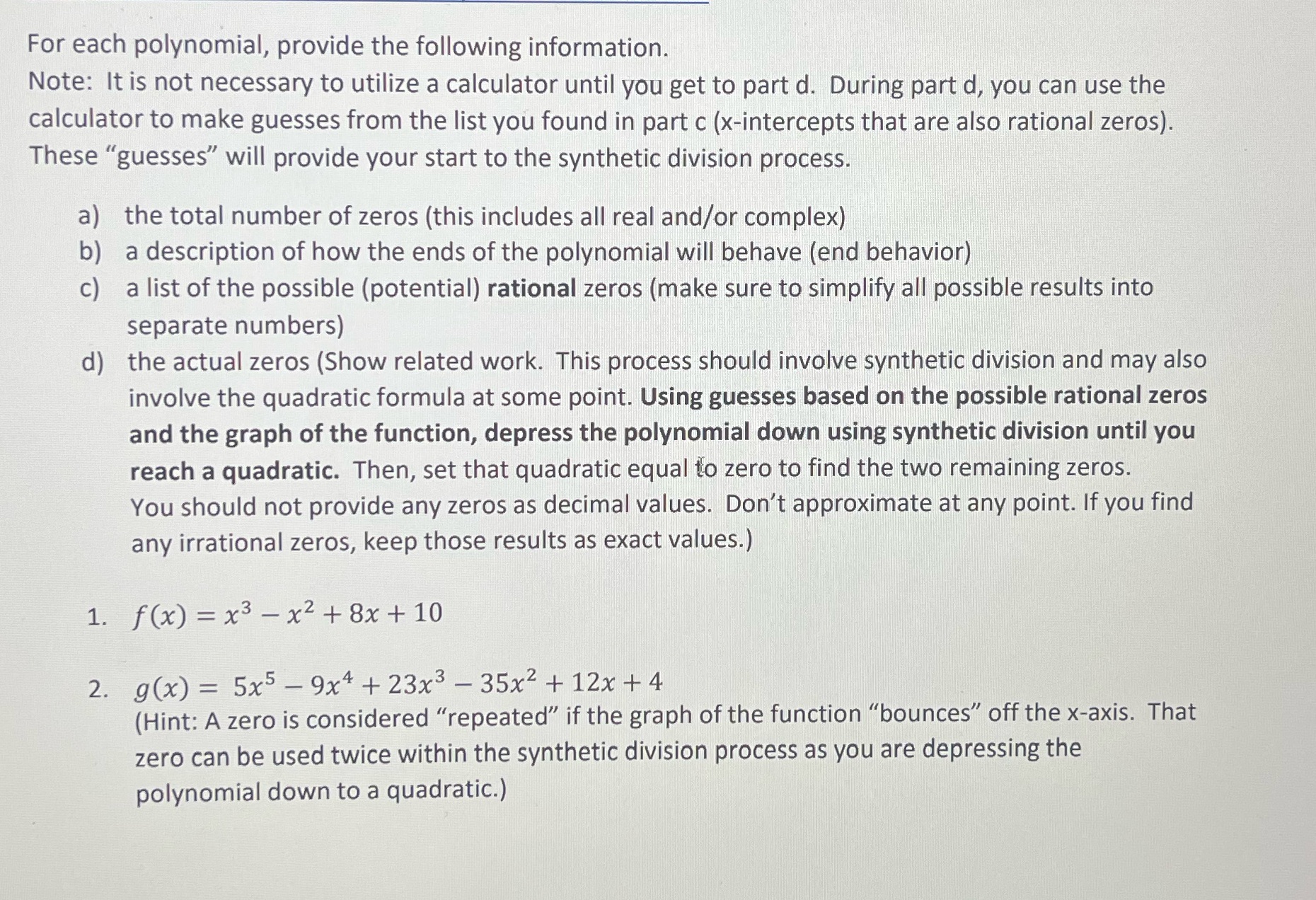
For each polynomial, provide the following information. Note: It is not necessary to utilize a calculator until you get to part d. During part d, you can use the calculator to make guesses from the list you found in part c (x-intercepts that are also rational zeros). These "guesses" will provide your start to the synthetic division process. a) the total number of zeros (this includes all real and/or complex) b) a description of how the ends of the polynomial will behave (end behavior) c) a list of the possible (potential) rational zeros (make sure to simplify all possible results into separate numbers) d) the actual zeros (Show related work. This process should involve synthetic division and may also involve the quadratic formula at some point. Using guesses based on the possible rational zeros and the graph of the function, depress the polynomial down using synthetic division until you reach a quadratic. Then, set that quadratic equal to zero to find the two remaining zeros. You should not provide any zeros as decimal values. Don't approximate at any point. If you find any irrational zeros, keep those results as exact values.) 1. f(x) = x-x+8x + 10 2. g(x) = 5x5 - 9x4 + 23x3 - 35x + 12x+4 (Hint: A zero is considered "repeated" if the graph of the function "bounces" off the x-axis. That zero can be used twice within the synthetic division process as you are depressing the polynomial down to a quadratic.)
Step by Step Solution
There are 3 Steps involved in it

Get step-by-step solutions from verified subject matter experts
 Study Help