







Question: For each problem, display the final numerical answer and the equation(s) used to form the answer. Leave combinations, permutations, factorials, and exponents intact. Good example:
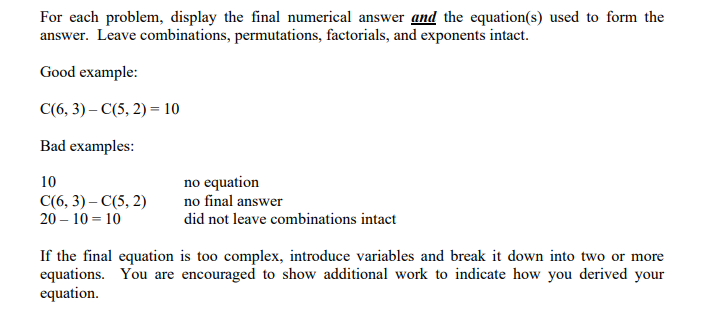
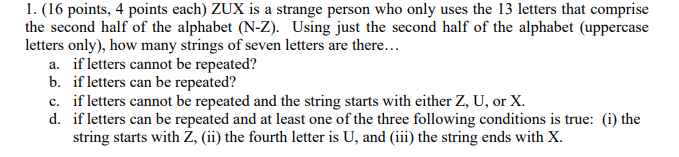
For each problem, display the final numerical answer and the equation(s) used to form the answer. Leave combinations, permutations, factorials, and exponents intact. Good example: C(6,3)-C(5,2)=10 Bad examples: 10 no equation C(6,3)-C(5,2) no final answer 20-10=10 did not leave combinations intact If the final equation 1s too complex, introduce variables and break i1t down into two or more equations. You are encouraged to show additional work to indicate how you derived your equation. l. (16 points, 4 points each) ZUX 1s a strange person who only uses the 13 letters that comprise the second half of the alphabet (N-Z). Using just the second half of the alphabet (uppercase letters only), how many strings of seven letters are there... a. 1f letters cannot be repeated? b. 1if letters can be repeated? c. 1f letters cannot be repeated and the string starts with either Z, U, or X. d. if letters can be repeated and at least one of the three following conditions is true: (1) the string starts with Z, (11) the fourth letter 1s U, and (111) the string ends with X
Step by Step Solution
There are 3 Steps involved in it

Get step-by-step solutions from verified subject matter experts
 Study Help