







Question: For each question, an algorithm will be described that operates on N elements, and your answer should include: (a) a big-O expression that describes the
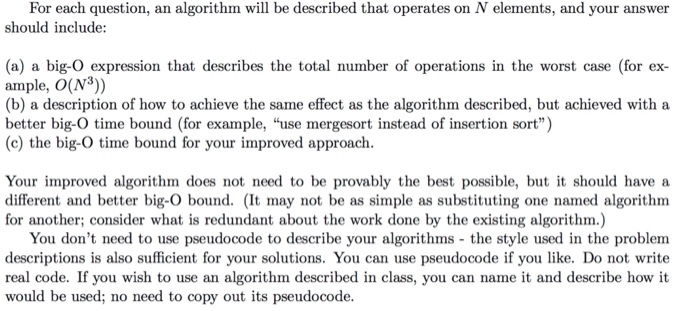

For each question, an algorithm will be described that operates on N elements, and your answer should include: (a) a big-O expression that describes the total number of operations in the worst case (for ex ample, O(N3) (b) a description of how to achieve the same effect as the algorithm described, but achieved with a better big-O time bound (for example, "use mergesort instead of insertion sort") (c) the big-O time bound for your improved approach Your improved algorithm does not need to be provably the best possible, but i should have a different and better big-O bound. (It may not be as simple as substituting one named algorithm for another; consider what is redundant about the work done by the existing algorithm.) You don't need to use pseudocode to describe your algorithms the style used in the problem descriptions is also sufficient for your solutions. You can use pseudocode if you like. Do not write real code. If you wish to use an algorithm described in class, you can name it and describe how it would be used; no need to copy out its pseudocode
Step by Step Solution
There are 3 Steps involved in it

Get step-by-step solutions from verified subject matter experts
 Study Help