







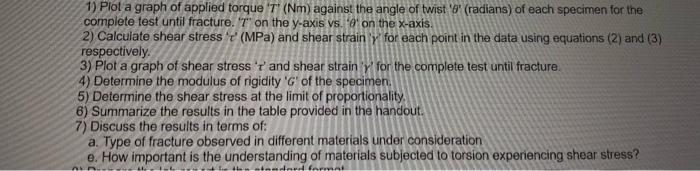
Question: For each specimen draw two curves on the same graph showing the torque ( N - m ) versus the rate of twist ( rad
For each specimen draw two curves on the same graph showing the torque Nm versus the rate of twist radm: one curve from zero to the yield point and the other one on a different scale for the rate of twist from zero to rupture. Using two curves will allow both the elastic and the plastic range of behaviour to be viewed at once. If you are using a computer to prepare the graphs, you may simply plot two graphs for each specimen. Determine for each of the specimens: The elastic limit proportional limit for shear stress. The yield strength at an offset of radm of gauge length the concept of an offset to define a property is shown in Hibbeler Section Modulus of rigidity, G; The Poisson's ratio if Est GPa, Eal GPa, and Ebr GPa see Hibbeler Section Fully plastic torque is given by the equation: c T y u Calculate the plastic torque for both materials using the yield stress calculated above with a radm offset and comment on any difference between this value and the torque value observed at failure. The elastic energy up to the elastic limit Useful equations include: shear strain is given by: L c bar rotation is given by: GJ TL and the maximum shear stress for a given value of T is given by: J Tc max for a circular shaft with radius c
Step by Step Solution
There are 3 Steps involved in it
1 Expert Approved Answer
Step: 1 Unlock

Question Has Been Solved by an Expert!
Get step-by-step solutions from verified subject matter experts
Step: 2 Unlock
Step: 3 Unlock
 Study Help