







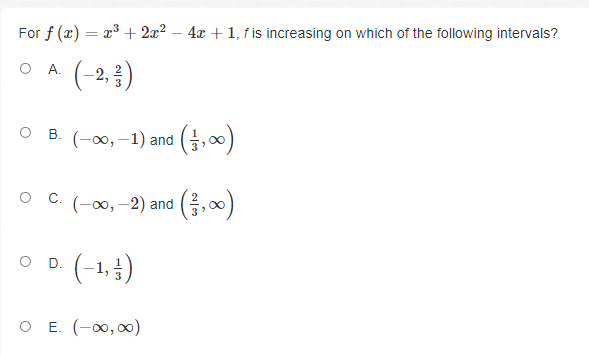
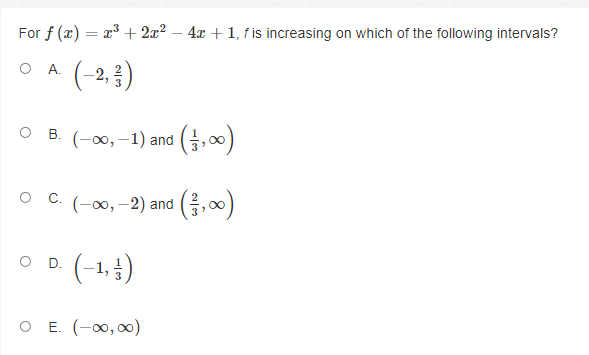
Question: For f (x) = 3 + 2x- - 4x + 1, fis increasing on which of the following intervals? O A. (-2, 3 O B.
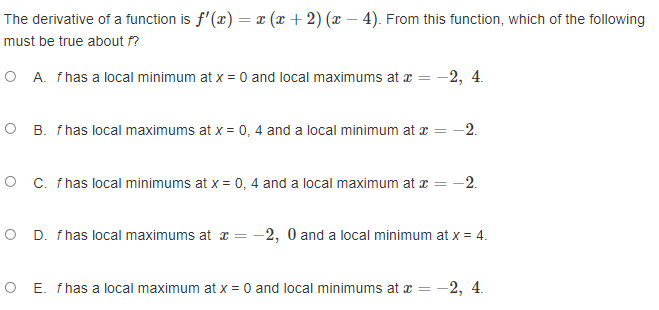
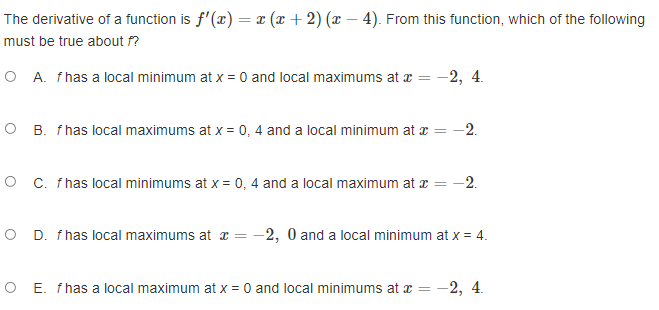
![f'{:s] = a: [a + 2] {a 4]. From this function, Iwhich](https://s3.amazonaws.com/si.experts.images/answers/2024/06/667cf9b03324a_416667cf9b020938.jpg)
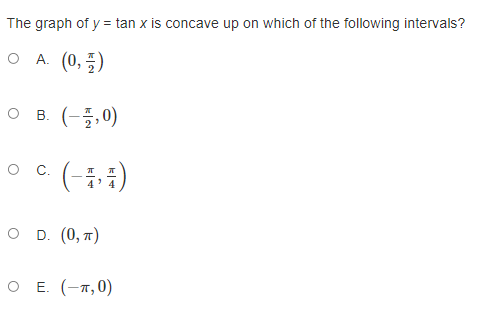
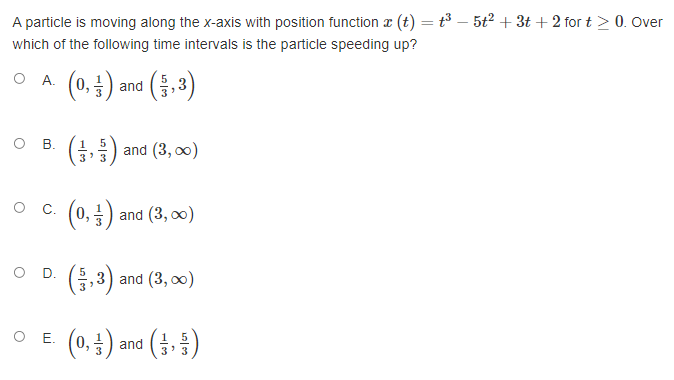
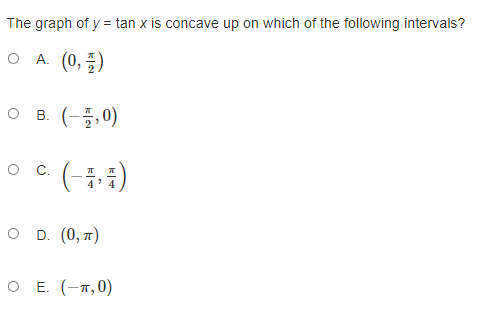
For f (x) = 3 + 2x- - 4x + 1, fis increasing on which of the following intervals? O A. (-2, 3 O B. (-00, -1) and ( , 00 ) O C. (-00, -2) and 3,00 ) O D. (-1, } O E. (-00, 00)The graph of y = tan 1: is concave up on which of the following intervals? 0 A ('31? D 8- (en) Cl _ 1c 1': c (m) C! D. {IL-Jr} The derivative of a function is f'{:s] = a: [a + 2] {a 4]. From this function, Iwhich of the following must be two about 1"? C! A. f has a local minimum at x = III and local maximums at a: = 2, 4. D E. f has local maximums at x = (l, 4 and a local minimum at a: = 2. D C. f has local minimums at x = (1,4 and a local maximum at a: = 2. C! D. fhas local maximums at a = 2, and a local minimum atx= 4. D E. fhas a local maximum at x: o and local minimums at: = 2, 4. A particle is moving along the x-axis with position function r (t) = t - 5t- + 3t + 2 fort > 0. Over which of the following time intervals is the particle speeding up? O A. (0, ;) and , 3 O B. and (3, co) O C. 0, and (3, co) O D. , 3 and (3, 0o) O E. (0,3) and
Step by Step Solution
There are 3 Steps involved in it

Get step-by-step solutions from verified subject matter experts
 Study Help