







Question: for fluid mixing different agitators solve the discusion and write a conclusion for experiment 1. In single graph, plot the Power Number ( y-axis) against
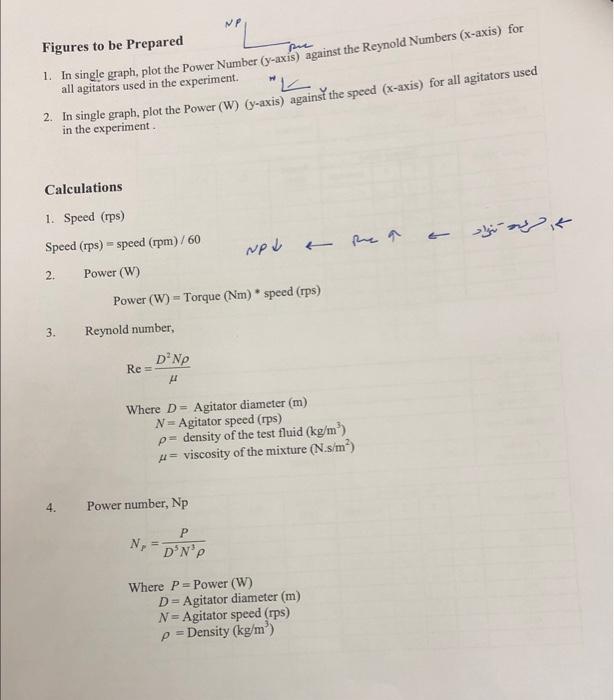
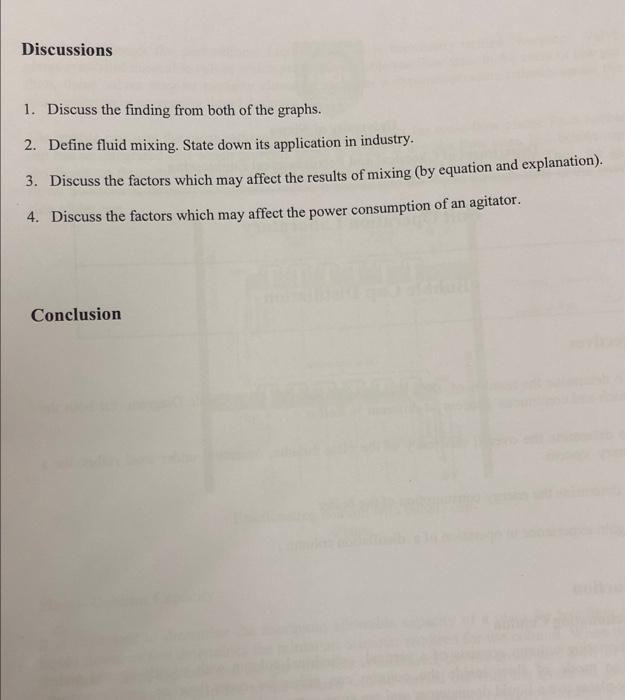
1. In single graph, plot the Power Number ( y-axis) against the Reynold Numbers ( x-axis) for Figures to be Prepared 2. In single graph, plot the Power (W) ( y-axis) against the speed ( x-axis) for all agitators used all agitators used in the experiment. in the experiment . Calculations 1. Speed (rps) Speed (rps)=speed(rpm)/60NP Ne 2. Power (W) Power (W)= Torque (Nm) speed (rps) 3. Reynold number, Re=D2N Where D= Agitator diameter (m) N= Agitator speed (rps) = density of the test fluid (kg/m3) = viscosity of the mixture (N.sim2) 4. Power number, Np Nf=D5N3P Where P= Power (W) D= Agitator diameter (m) N= Agitator speed (rps) = Density (kg/m3) Discussions 1. Discuss the finding from both of the graphs. 2. Define fluid mixing. State down its application in industry. 3. Discuss the factors which may affect the results of mixing (by equation and explanation). 4. Discuss the factors which may affect the power consumption of an agitator. Conclusion 1. In single graph, plot the Power Number ( y-axis) against the Reynold Numbers ( x-axis) for Figures to be Prepared 2. In single graph, plot the Power (W) ( y-axis) against the speed ( x-axis) for all agitators used all agitators used in the experiment. in the experiment . Calculations 1. Speed (rps) Speed (rps)=speed(rpm)/60NP Ne 2. Power (W) Power (W)= Torque (Nm) speed (rps) 3. Reynold number, Re=D2N Where D= Agitator diameter (m) N= Agitator speed (rps) = density of the test fluid (kg/m3) = viscosity of the mixture (N.sim2) 4. Power number, Np Nf=D5N3P Where P= Power (W) D= Agitator diameter (m) N= Agitator speed (rps) = Density (kg/m3) Discussions 1. Discuss the finding from both of the graphs. 2. Define fluid mixing. State down its application in industry. 3. Discuss the factors which may affect the results of mixing (by equation and explanation). 4. Discuss the factors which may affect the power consumption of an agitator. Conclusion
Step by Step Solution
There are 3 Steps involved in it

Get step-by-step solutions from verified subject matter experts
 Study Help