







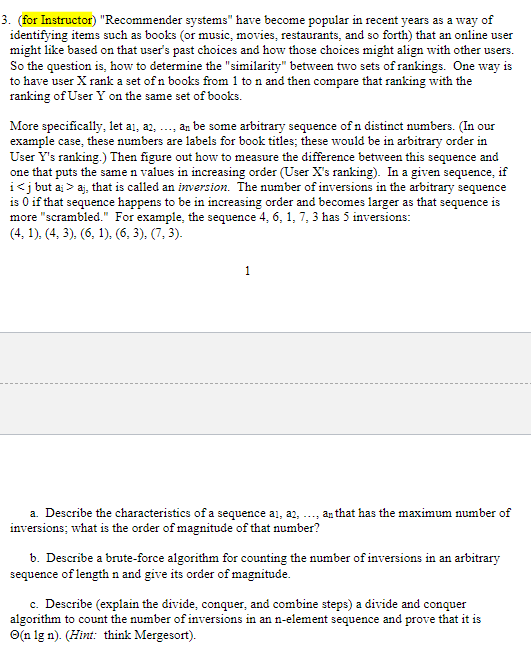
Question: ( for Instructor ) Recommender systems have become popular in recent years as a way of identifying items such as books ( or music, movies,
for Instructor "Recommender systems" have become popular in recent years as a way of
identifying items such as books or music, movies, restaurants, and so forth that an online user
might like based on that user's past choices and how those choices might align with other users.
So the question is how to determine the "similarity" between two sets of rankings. One way is
to have user X rank a set of n books from to n and then compare that ranking with the
ranking of User Y on the same set of books.
More specifically, let dots, be some arbitrary sequence of n distinct numbers. In our
example case, these numbers are labels for book titles; these would be in arbitrary order in
User Ys ranking. Then figure out how to measure the difference between this sequence and
one that puts the same values in increasing order User ranking In a given sequence, if
dots, but that called inversion. The number inversions the arbitrary sequence
that sequence happens increasing order and becomes larger that sequence
more "scrambled." For example, the sequence has inversions:
Describe the characteristics a sequence dots, that has the maximum number
inversions; what the order magnitude that number?
Describe a bruteforce algorithm for counting the number inversions arbitrary
sequence length and give its order magnitude.
Describe the divide, conquer, and combine steps a divide and conquer
algorithm count the number inversions element sequence and prove that
: think Mergesort
Step by Step Solution
There are 3 Steps involved in it
1 Expert Approved Answer
Step: 1 Unlock

Question Has Been Solved by an Expert!
Get step-by-step solutions from verified subject matter experts
Step: 2 Unlock
Step: 3 Unlock
 Study Help