







Question: For java, submitting given code and documentation given for assignment. Separated classes with equal signs. public class Adventure { public static void main(String[] args) {
For java, submitting given code and documentation given for assignment. Separated classes with equal signs.
public class Adventure { public static void main(String[] args) { NightInTheWilderness night = new NightInTheWilderness(); Character[] partyMembers = new Character[4];
partyMembers[0] = new Knight(night); partyMembers[1] = new Barbarian(night); partyMembers[2] = new Ranger(night); partyMembers[3] = new Wizard(night);
System.out.println("--- First Watch ---"); partyMembers[0].stayAwakeForWatch(); partyMembers[1].stayAwakeForWatch(); partyMembers[2].goToSleep(); partyMembers[3].goToSleep(); night.setEncounter(Encounter.Troll);
for (Character member : partyMembers) { System.out.println("* " + member); member.display(); System.out.println(); }
System.out.println("--- Second Watch ---"); partyMembers[0].goToSleep(); partyMembers[1].stayAwakeForWatch(); partyMembers[2].stayAwakeForWatch(); partyMembers[3].goToSleep(); night.setEncounter(Encounter.Squirrel);
for (Character member : partyMembers) { System.out.println("* " + member); member.display(); System.out.println(); }
System.out.println("--- Third Watch ---"); partyMembers[0].goToSleep(); partyMembers[1].goToSleep(); partyMembers[2].stayAwakeForWatch(); partyMembers[3].stayAwakeForWatch(); night.setEncounter(Encounter.Goblin);
for (Character member : partyMembers) { System.out.println("* " + member); member.display(); System.out.println(); }
System.out.println("--- Fourth Watch ---"); partyMembers[0].stayAwakeForWatch(); partyMembers[1].goToSleep(); partyMembers[2].goToSleep(); partyMembers[3].stayAwakeForWatch(); night.setEncounter(Encounter.Dragon);
for (Character member : partyMembers) { System.out.println("* " + member); member.display(); System.out.println(); }
} } ============================================= public class Barbarian extends Character {
public String toString() { return "Fur-clad Raging Barbarian"; } } ============================================= public abstract class Character implements OnWatch, DisplayAttitude {
public Character(LongRest rest) { }
public void goToSleep() { }
public void stayAwakeForWatch() { } } ============================================= interface DisplayAttitude { void display(); } ============================================= public enum Encounter { Nothing, Squirrel, Goblin, Troll, Dragon } ============================================= public class Knight extends Character {
public String toString() { return "Knight in Shining Armor"; } } ============================================= interface LongRest { void stayAwake(OnWatch watcher); void goToSleep(OnWatch watcher); void somethingHappened(); } ============================================= public class NightInTheWilderness implements LongRest {
public void setEncounter(Encounter encounter) {
}
} ============================================== interface OnWatch { void observeEncounter(Encounter encounter); } =============================================== public class Ranger extends Character { public String toString() { return "Quick, Stealthy Ranger"; } } ================================================= public class Wizard extends Character {
public String toString() { return "Mysterious, Arcane Wizard"; } }
![with equal signs. public class Adventure { public static void main(String[] args)](https://dsd5zvtm8ll6.cloudfront.net/si.experts.images/questions/2024/09/66effa52e3d85_21866effa5245631.jpg)
![{ NightInTheWilderness night = new NightInTheWilderness(); Character[] partyMembers = new Character[4]; partyMembers[0]](https://dsd5zvtm8ll6.cloudfront.net/si.experts.images/questions/2024/09/66effa53b2247_21966effa5336644.jpg)
![= new Knight(night); partyMembers[1] = new Barbarian(night); partyMembers[2] = new Ranger(night); partyMembers[3]](https://dsd5zvtm8ll6.cloudfront.net/si.experts.images/questions/2024/09/66effa545b7f0_21966effa53eff06.jpg)
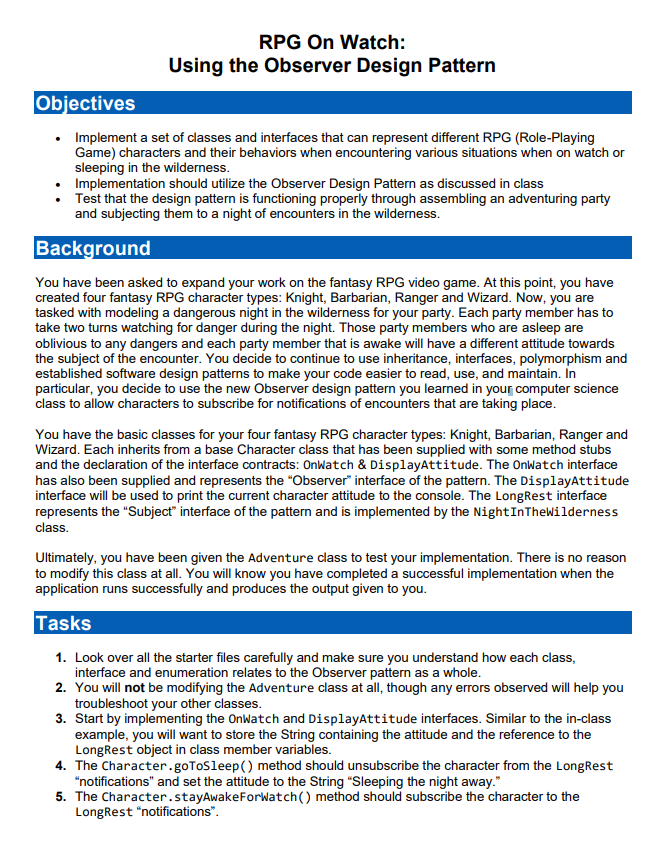
RPG On Watch: Using the Observer Design Pattern Objectives Implement a set of classes and interfaces that can represent different RPG (Role-Playing Game) characters and their behaviors when encountering various situations when on watch or sleeping in the wilderness. Implementation should utilize the Observer Design Pattern as discussed in class Test that the design pattern is functioning properly through assembling an adventuring party and subjecting them to a night of encounters in the wilderness. Background You have been asked to expand your work on the fantasy RPG video game. At this point, you have created four fantasy RPG character types: Knight, Barbarian, Ranger and Wizard. Now, you are tasked with modeling a dangerous night in the wilderness for your party. Each party member has to take two turns watching for danger during the night. Those party members who are asleep are oblivious to any dangers and each party member that is awake will have a different attitude towards the subject of the encounter. You decide to continue to use inheritance, interfaces, polymorphism and established software design patterns to make your code easier to read, use, and maintain. In particular, you decide to use the new Observer design pattern you learned in your computer science class to allow characters to subscribe for notifications of encounters that are taking place. You have the basic classes for your four fantasy RPG character types: Knight, Barbarian, Ranger and Wizard. Each inherits from a base Character class that has been supplied with some method stubs and the declaration of the interface contracts: OnWatch & DisplayAttitude. The OnWatch interface has also been supplied and represents the "Observer interface of the pattern. The DisplayAttitude interface will be used to print the current character attitude to the console. The Longest interface represents the "Subject" interface of the pattern and is implemented by the NightInTheWilderness class. Ultimately, you have been given the Adventure class to test your implementation. There is no reason to modify this class at all. You will know you have completed a successful implementation when the application runs successfully and produces the output given to you. Tasks 1. Look over all the starter files carefully and make sure you understand how each class, interface and enumeration relates to the Observer pattern as a whole. 2. You will not be modifying the Adventure class at all, though any errors observed will help you troubleshoot your other classes. 3. Start by implementing the OnWatch and DisplayAttitude interfaces. Similar to the in-class example, you will want to store the String containing the attitude and the reference to the LongRest object in class member variables. 4. The Character.goToSleep() method should unsubscribe the character from the LongRest "notifications" and set the attitude to the String "Sleeping the night away." 5. The character.stayAwakeForwatch() method should subscribe the character to the LongRest "notifications". 6. Each character will implement the observeEncounter() method differently because each will have their own unique attitude (as represented by a String) depending upon what is encountered. The following are the attitude values: o Knight Nothing - "Enjoying some quiet time polishing my sword." Squirrel - "I hope the squirrel doesn't encounter an owl." . Goblin "I bet I could scare the goblin away with a creepy noise." Troll "Now it's time to prove my mettle on this troll.". Dragon - "I don't like this dragon... I've been burnt before!" o Barbarian Nothing - "Staring into the fire... feeling hungry." Squirrel - "Squirrel would make a good snack." Goblin - "I could slice that goblin in two with one blow." Troll "Bet I could dice up troll faster than it regenerates." Dragon -"Wonder how bad the dragon's fire hurts!" o Ranger Nothing - "The stars are beautiful." Squirrel "The simple life of a squirrel is marvelous." . Goblin "Goblins are such a distortion of nature." Troll - "I hate trolls! Time to light up my arrows." Dragon - "My arrows cannot penetrate the dragon scales!" Wizard Nothing - "Reading my spell book." Squirrel "I could transform that squirrel into a raven." Goblin - "I hope that goblin doesn't see me." Troll "Oh no, a troll! I wish I had prepared my fireball spell!" Dragon - "See ya, I'm outta here!" 7. The display() method should print the current attitude of the character to the console. 8. After implementing the character functionality, it is time to work on the NightInTheWilderness class and implement the LongRest interface. Similar to the in-class example, you will want to store the current Encounter state and the ArrayList of "observers". The stayAwake() method should add the character to the "observers" list if the character is not already in the list The gotoSleep() method should remove the character from the observers" list. The setEncounter() method should store the current Encounter and publish a notification to each of the observers. The somethingHappened() method publishes a notification to each of the observers. 9. Compile and run the Adventure program and confirm that you get the following results: --- First Watch * Knight in Shining Armor Now it's time to prove my mettle on this troll. * Fur-clad Raging Barbarian Bet I could dice up troll faster than it regenerates. * Quick, Stealthy Ranger Sleeping the night away. * Mysterious, Arcane Wizard Sleeping the night away. --- Second Watch --- * Knight in Shining Armor Sleeping the night away. * Fur-clad Raging Barbarian Squirrel would make a good snack. * Quick, Stealthy Ranger The simple life of a squirrel is marvelous. * Mysterious, Arcane Wizard Sleeping the night away. --- Third Watch --- * Knight in shining Armor Sleeping the night away. * Fur-clad Raging Barbarian Sleeping the night away. * Quick, Stealthy Ranger Goblins are such a distortion of nature. * Mysterious, Arcane wizard I hope that goblin doesn't see me. --- Fourth watch --- * Knight in Shining Armor I don't like this dragon... I've been burnt before! * Fur-clad Raging Barbarian Sleeping the night away. * Quick, Stealthy Ranger Sleeping the night away. * Mysterious, Arcane Wizard See ya, I'm outta here! 10. Document your project: o Write a plain-text README file, called README, following the format described in the README_TEMPLATE.txt file. o Comment your code appropriately, assume someone may be looking at your code and not know what you are trying to accomplish. Grading Points will be awarded according to the following breakdown: Tasks Points Documentation: README file, comments 10 Observer pattern functionality within the classes 30 Quality - code formatting, naming conventions, style, etc. 10 Required Files Submit the following files within a zip file named: Lab02_RPGOnWatch_LastName_FirstName.zip: README Adventure.java Barbarian.java Character.java DisplayAttitude.java Encounter.java Knight.java LongRest.java NightInTheWilderness.java OnWatch.java Ranger.java Wizard.java
Step by Step Solution
There are 3 Steps involved in it

Get step-by-step solutions from verified subject matter experts
 Study Help