







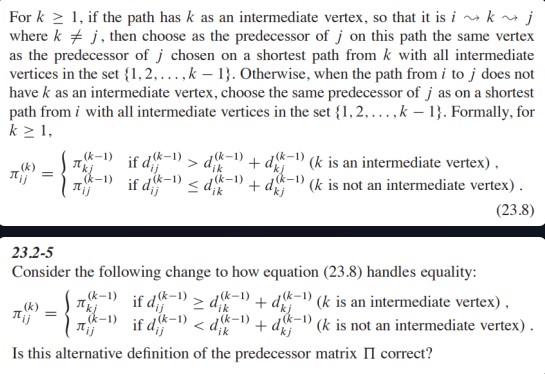
Question: For k 1 , if the path has k as an intermediate vertex, so that it is i k j where ? b a r
For if the path has as an intermediate vertex, so that it is
where then choose as the predecessor of on this path the same vertex
as the predecessor of chosen on a shortest path from with all intermediate
vertices in the set dots, Otherwise, when the path from to does not
have as an intermediate vertex, choose the same predecessor of as on a shortest
path from i with all intermediate vertices in the set dots, Formally, for
Consider the following change to how equation handles equality:
Step by Step Solution
There are 3 Steps involved in it
1 Expert Approved Answer
Step: 1 Unlock

Question Has Been Solved by an Expert!
Get step-by-step solutions from verified subject matter experts
Step: 2 Unlock
Step: 3 Unlock
 Study Help