







Question: For Kruskal's algorithm, the time required to initially sort the edges according to their weights is (m log m), where m:= E is the number
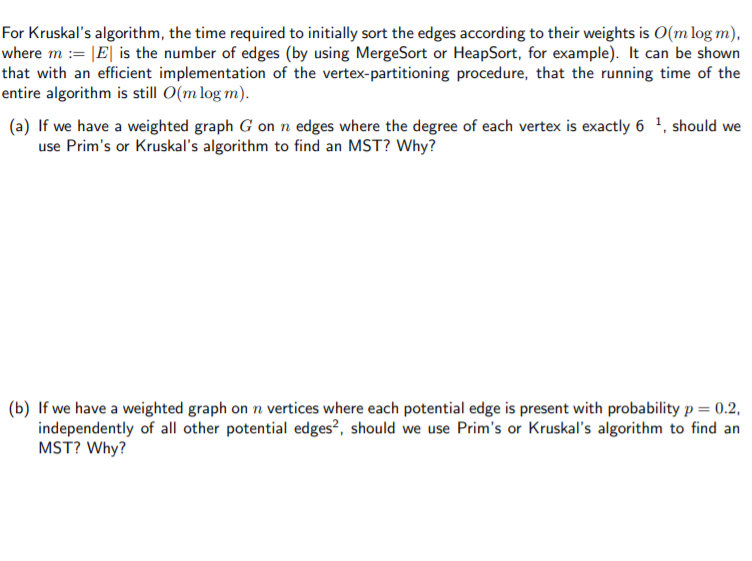
For Kruskal's algorithm, the time required to initially sort the edges according to their weights is (m log m), where m:= E is the number of edges (by using Merge Sort or Heap Sort, for example). It can be shown that with an efficient implementation of the vertex-partitioning procedure, that the running time of the entire algorithm is still Om log m). (a) If we have a weighted graph G on n edges where the degree of each vertex is exactly 6 1, should we use Prim's or Kruskal's algorithm to find an MST? Why? (b) If we have a weighted graph on n vertices where each potential edge is present with probability p= 0.2, independently of all other potential edges, should we use Prim's or Kruskal's algorithm to find an MST? Why? For Kruskal's algorithm, the time required to initially sort the edges according to their weights is (m log m), where m:= E is the number of edges (by using Merge Sort or Heap Sort, for example). It can be shown that with an efficient implementation of the vertex-partitioning procedure, that the running time of the entire algorithm is still Om log m). (a) If we have a weighted graph G on n edges where the degree of each vertex is exactly 6 1, should we use Prim's or Kruskal's algorithm to find an MST? Why? (b) If we have a weighted graph on n vertices where each potential edge is present with probability p= 0.2, independently of all other potential edges, should we use Prim's or Kruskal's algorithm to find an MST? Why
Step by Step Solution
There are 3 Steps involved in it

Get step-by-step solutions from verified subject matter experts
 Study Help