







Question: For my discrete mathematical structures for computer science class. Please answer all the parts. I'll be sure to rate. 4. For each integer n 2
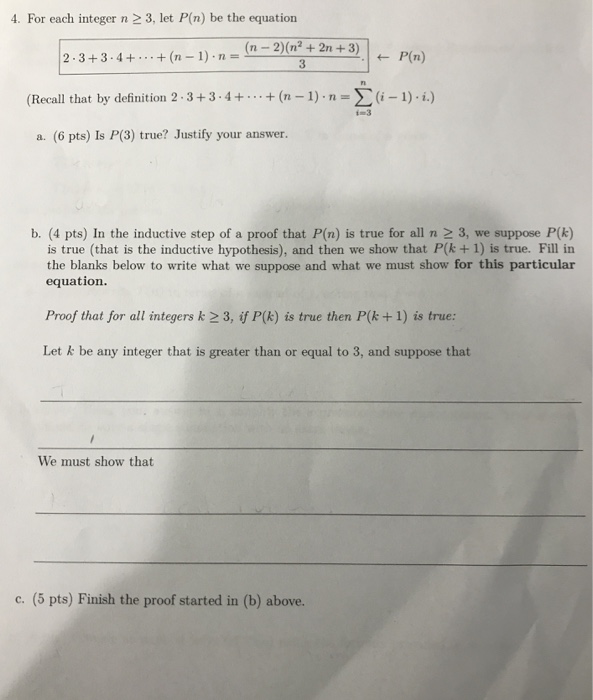
4. For each integer n 2 3, let P(n) be the equation (n-2)(n2+2n+3).| ? P(n) 2.3+3.4+ +(n-1),n= 3 (Recall that by definition 2.3+3.4+ (n-1)-n-Xi-1).i.) a. (6 pts) Is P(3) true? Justify your answer. b. (4 pts) In the inductive step of a proof that P(n) is true for all n 2 3, we suppose P(k) is true (that is the inductive hypothesis), and then we show that P(k +1) is true. Fill in the blanks below to write what we suppose and what we must show for this particular equation. Proof that for all integers k 23, if P(k) is true then P(k +1) is true: Let k be any integer that is greater than or equal to 3, and suppose that We must show that c. (5 pts) Finish the proof started in (b) above
Step by Step Solution
There are 3 Steps involved in it

Get step-by-step solutions from verified subject matter experts
 Study Help