







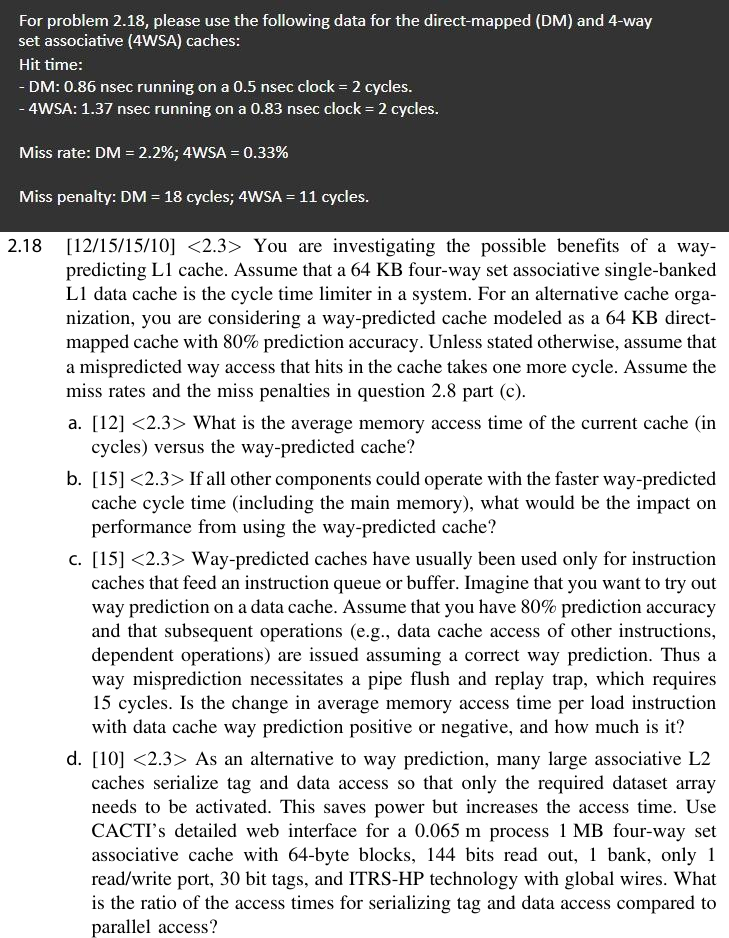
Question: For problem 2 . 1 8 , please use the following data for the direct - mapped ( DM ) and 4 - way set
For problem please use the following data for the directmapped DM and way
set associative WSA caches:
Hit time:
DM: nsec running on a nsec clock cycles.
WSA: nsec running on a nsec clock cycles.
Miss rate: ;WSA
Miss penalty: DM cycles; WSA cycles.
You are investigating the possible benefits of a way
predicting L cache. Assume that a KB fourway set associative singlebanked
L data cache is the cycle time limiter in a system. For an alternative cache orga
nization, you are considering a waypredicted cache modeled as a direct
mapped cache with prediction accuracy. Unless stated otherwise, assume that
a mispredicted way access that hits in the cache takes one more cycle. Assume the
miss rates and the miss penalties in question part c
a: What is the average memory access time of the current cache in
cycles versus the waypredicted cache?
b: If all other components could operate with the faster waypredicted
cache cycle time including the main memory what would be the impact on
performance from using the waypredicted cache?
c Waypredicted caches have usually been used only for instruction
caches that feed an instruction queue or buffer. Imagine that you want to try out
way prediction on a data cache. Assume that you have prediction accuracy
and that subsequent operations eg data cache access of other instructions,
dependent operations are issued assuming a correct way prediction. Thus a
way misprediction necessitates a pipe flush and replay trap, which requires
cycles. Is the change in average memory access time per load instruction
with data cache way prediction positive or negative, and how much is it
d: As an alternative to way prediction, many large associative L
caches serialize tag and data access so that only the required dataset array
needs to be activated. This saves power but increases the access time. Use
CACTI's detailed web interface for a process fourway set
associative cache with byte blocks, bits read out, bank, only
readwrite port, bit tags, and ITRSHP technology with global wires. What
is the ratio of the access times for serializing tag and data access compared to
parallel access?
Step by Step Solution
There are 3 Steps involved in it
1 Expert Approved Answer
Step: 1 Unlock

Question Has Been Solved by an Expert!
Get step-by-step solutions from verified subject matter experts
Step: 2 Unlock
Step: 3 Unlock
 Study Help