







Question: For problem 9.14 the problem is worked for you in the attached Excel document. Use this document and address the following questions to earm credit
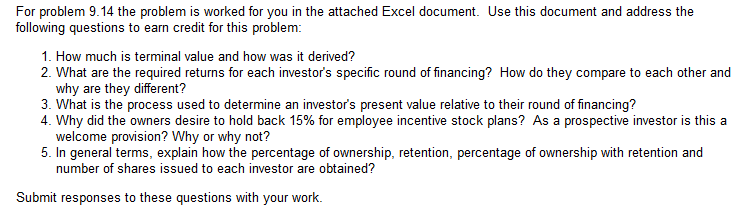
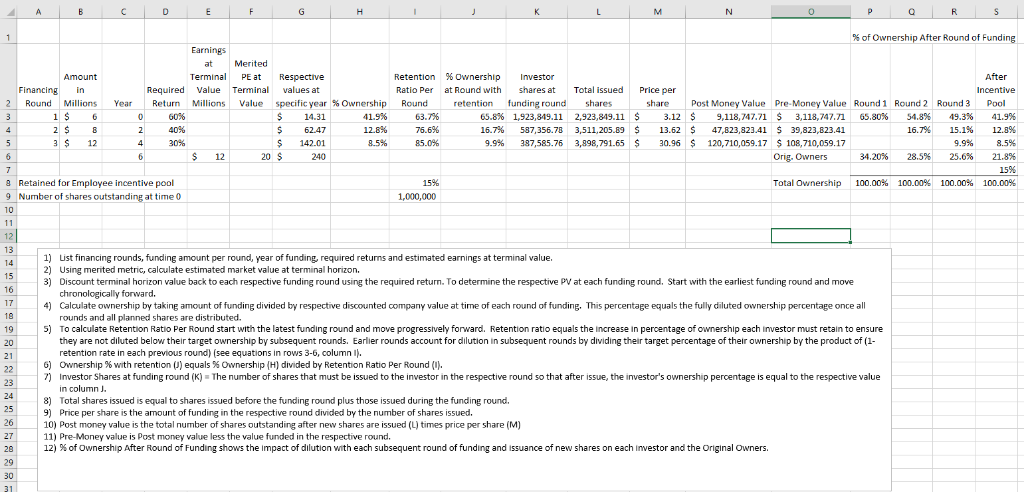
For problem 9.14 the problem is worked for you in the attached Excel document. Use this document and address the following questions to earm credit for this problem: 1. How much is terminal value and how was it derived? 2. What are the required returns for each investor's specific round of financing? How do they compare to each other and why are they different? . What is the process used to determine an investor's present value relative to their round of financing? 4. Why did the owners desire to hold back 15% for employee incentive stock plans? As a prospective investor is this a welcome provision? Why or why not? 5. In general terms, explain how the percentage of ownership, retention, percentage of ownership with retention and number of shares issued to each investor are obtained? Submit responses to these questions with your work. 0 % of Ownership After Round of Funding TemiaPE Respective Required Value Terminal values at %Ownership at Round with investor After Financingin Ratio Per Total issued Price per share shares at Round Millions Year Return Millions Value specific year %Ownership Round retention funding round shares Post Money Value Pre-Money Value Round 1 Round 2 Round 3 Pool 65.8% 1,923,849.11 2,923,849.11 $ 3.12 $ 9,118,747.71 $ 3,118,747.71 65.30% 54.3% 49.3% 41.9% 16.7% 15.1% 12.8% 9.9% 8.5% 34.20% 28.5% 25.6% 21.8% 514.31 41.9% 16.796 587,356.78 3,511,205.89 $ 13.62 $ 47,823,823.41 $ 39,823,823.41 9.9% 387,585.76 3,898,791.65 $ 30.96 $ 120,710,059.17 $108,710,059.17 75.6% 3 $ 12 $142.01 $ 12 20 S 8 Retained for Employee incentive pool 9 Number of shares outstanding at time 0 10 Total ownership 100.00% 100.0096 100.00% 100.00% 1,000,000 12 13 1) Ust financing rounds, funding amount per round, year of funding, required returns and estimated earnings at terminal value 2) Using merited metric, calculate estimated market value at terminal horizon. 3) Discount terminal horizon value back to each respective funding round using the required return. To determine the respective PV at each funding round. Start with the earliest funding round and move 16 17 18 195) To calculate Retention Ratio Per Round start with the latest funding round and move progressively forward. Retention ratio equals the increase in percentage of ownership each investor must retain to ensure 20 chronologically forward. 4) Calaulate ownership by taking amount of funding divided by respective discounted company value at time of each round of funding. This percentage equals the fully diluted ownership percentage once all rounds and all planned shares are distributed. they are not diluted below their target ownership by subsequent rounds. Earlier rounds account for dilution in subsequent rounds by dividing their target percentage of their ownership by the product of (1- retention rate in each previous round) (see equations in rows 3-6, column I. 6) 22 , Ownership % with retention (J) equals % Ownership (H) dMded by Retention Ratio Per Round (I), 7) Investor Shares at funding round (K) The number of shares that must be issued to the investor in the respective round so that after issue, the investor's ownership percentage is equal to the respective value in column J 8) Total shares issued is equal to shares issued before the funding round plus those issued during the funding round 9) Price per share is the amount of funding in the respective round divided by the number of shares issued. 10) Post money value is the total number of shares outstanding after new shares are issued (L) times price per share (M) 11) Pre-Money value is Post money value less the value funded in the respective round. 12) % of ownership After Round of Funding shows the impact of dilution with each subsequent round of funding and issuance of new shares on each investor and the original owners 26 28 30 For problem 9.14 the problem is worked for you in the attached Excel document. Use this document and address the following questions to earm credit for this problem: 1. How much is terminal value and how was it derived? 2. What are the required returns for each investor's specific round of financing? How do they compare to each other and why are they different? . What is the process used to determine an investor's present value relative to their round of financing? 4. Why did the owners desire to hold back 15% for employee incentive stock plans? As a prospective investor is this a welcome provision? Why or why not? 5. In general terms, explain how the percentage of ownership, retention, percentage of ownership with retention and number of shares issued to each investor are obtained? Submit responses to these questions with your work. 0 % of Ownership After Round of Funding TemiaPE Respective Required Value Terminal values at %Ownership at Round with investor After Financingin Ratio Per Total issued Price per share shares at Round Millions Year Return Millions Value specific year %Ownership Round retention funding round shares Post Money Value Pre-Money Value Round 1 Round 2 Round 3 Pool 65.8% 1,923,849.11 2,923,849.11 $ 3.12 $ 9,118,747.71 $ 3,118,747.71 65.30% 54.3% 49.3% 41.9% 16.7% 15.1% 12.8% 9.9% 8.5% 34.20% 28.5% 25.6% 21.8% 514.31 41.9% 16.796 587,356.78 3,511,205.89 $ 13.62 $ 47,823,823.41 $ 39,823,823.41 9.9% 387,585.76 3,898,791.65 $ 30.96 $ 120,710,059.17 $108,710,059.17 75.6% 3 $ 12 $142.01 $ 12 20 S 8 Retained for Employee incentive pool 9 Number of shares outstanding at time 0 10 Total ownership 100.00% 100.0096 100.00% 100.00% 1,000,000 12 13 1) Ust financing rounds, funding amount per round, year of funding, required returns and estimated earnings at terminal value 2) Using merited metric, calculate estimated market value at terminal horizon. 3) Discount terminal horizon value back to each respective funding round using the required return. To determine the respective PV at each funding round. Start with the earliest funding round and move 16 17 18 195) To calculate Retention Ratio Per Round start with the latest funding round and move progressively forward. Retention ratio equals the increase in percentage of ownership each investor must retain to ensure 20 chronologically forward. 4) Calaulate ownership by taking amount of funding divided by respective discounted company value at time of each round of funding. This percentage equals the fully diluted ownership percentage once all rounds and all planned shares are distributed. they are not diluted below their target ownership by subsequent rounds. Earlier rounds account for dilution in subsequent rounds by dividing their target percentage of their ownership by the product of (1- retention rate in each previous round) (see equations in rows 3-6, column I. 6) 22 , Ownership % with retention (J) equals % Ownership (H) dMded by Retention Ratio Per Round (I), 7) Investor Shares at funding round (K) The number of shares that must be issued to the investor in the respective round so that after issue, the investor's ownership percentage is equal to the respective value in column J 8) Total shares issued is equal to shares issued before the funding round plus those issued during the funding round 9) Price per share is the amount of funding in the respective round divided by the number of shares issued. 10) Post money value is the total number of shares outstanding after new shares are issued (L) times price per share (M) 11) Pre-Money value is Post money value less the value funded in the respective round. 12) % of ownership After Round of Funding shows the impact of dilution with each subsequent round of funding and issuance of new shares on each investor and the original owners 26 28 30
Step by Step Solution
There are 3 Steps involved in it

Get step-by-step solutions from verified subject matter experts
 Study Help