



Question: For problems 1 and 2, rewrite the argument in line-by-line form. Then determine whether each step of the argument is correct or not. If each
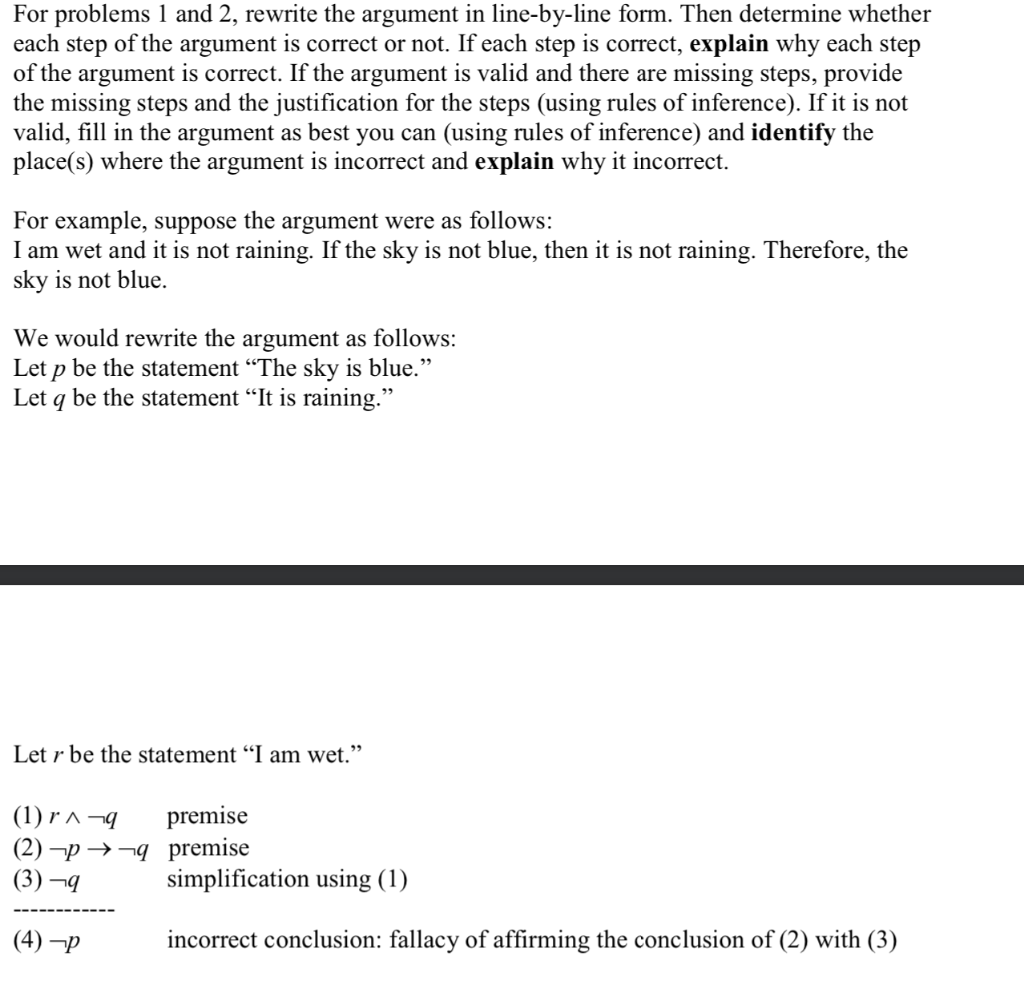

For problems 1 and 2, rewrite the argument in line-by-line form. Then determine whether each step of the argument is correct or not. If each step is correct, explain why each step of the argument is correct. If the argument is valid and there are missing steps, provide the missing steps and the justification for the steps (using rules of inference). If it is not valid, fill in the argument as best you can (using rules of inference) and identify the place(s) where the argument is incorrect and explain why it incorrect. For example, suppose the argument were as follows: I am wet and it is not raining. If the sky is not blue, then it is not raining. Therefore, the sky is not blue. We would rewrite the argument as follows: Let p be the statement The sky is blue. Let q be the statement It is raining. Letr be the statement "I am wet." (1) r^ (2) p (3) premise premise simplification using (1) ----- (4) 2 incorrect conclusion: fallacy of affirming the conclusion of (2) with (3) 2. If n is a real number and n > 3, then n > 81. Suppose n is a real number and n
Step by Step Solution
There are 3 Steps involved in it

Get step-by-step solutions from verified subject matter experts