







Question: For problems 2, 3, and 4, assume demand for electricity in Alberta is p = 100 q and the marginal cost of production is c
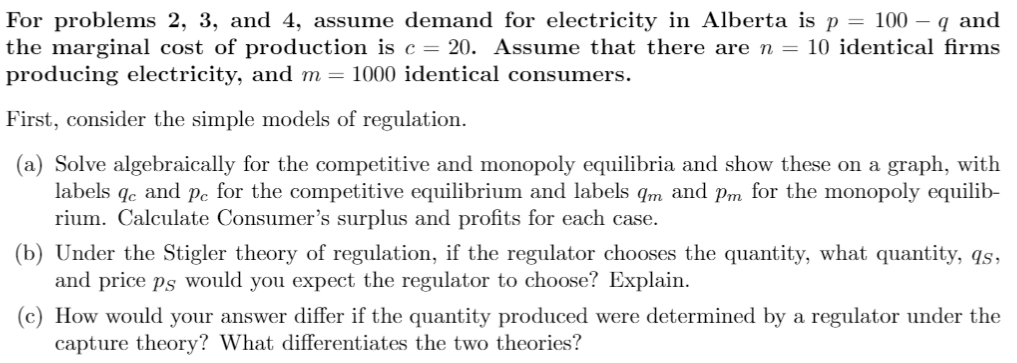
For problems 2, 3, and 4, assume demand for electricity in Alberta is p = 100 q and the marginal cost of production is c = 20. Assume that there are n = 10 identical firms producing electricity, and m= 1000 identical consumers. First, consider the simple models of regulation. (a) Solve algebraically for the competitive and monopoly equilibria and show these on a graph, with labels qc and pe for the competitive equilibrium and labels qm and Pm for the monopoly equilib- rium. Calculate Consumer's surplus and profits for each case. (b) Under the Stigler theory of regulation, if the regulator chooses the quantity, what quantity, as, and price ps would you expect the regulator to choose? Explain. (c) How would your answer differ if the quantity produced were determined by a regulator under the capture theory? What differentiates the two theories? For problems 2, 3, and 4, assume demand for electricity in Alberta is p = 100 q and the marginal cost of production is c = 20. Assume that there are n = 10 identical firms producing electricity, and m= 1000 identical consumers. First, consider the simple models of regulation. (a) Solve algebraically for the competitive and monopoly equilibria and show these on a graph, with labels qc and pe for the competitive equilibrium and labels qm and Pm for the monopoly equilib- rium. Calculate Consumer's surplus and profits for each case. (b) Under the Stigler theory of regulation, if the regulator chooses the quantity, what quantity, as, and price ps would you expect the regulator to choose? Explain. (c) How would your answer differ if the quantity produced were determined by a regulator under the capture theory? What differentiates the two theories
Step by Step Solution
There are 3 Steps involved in it

Get step-by-step solutions from verified subject matter experts
 Study Help