







Question: For problems 6 & 7 read the following: These questions are abstract , the contents of what is actually found in the relations is not
For problems & read the following:
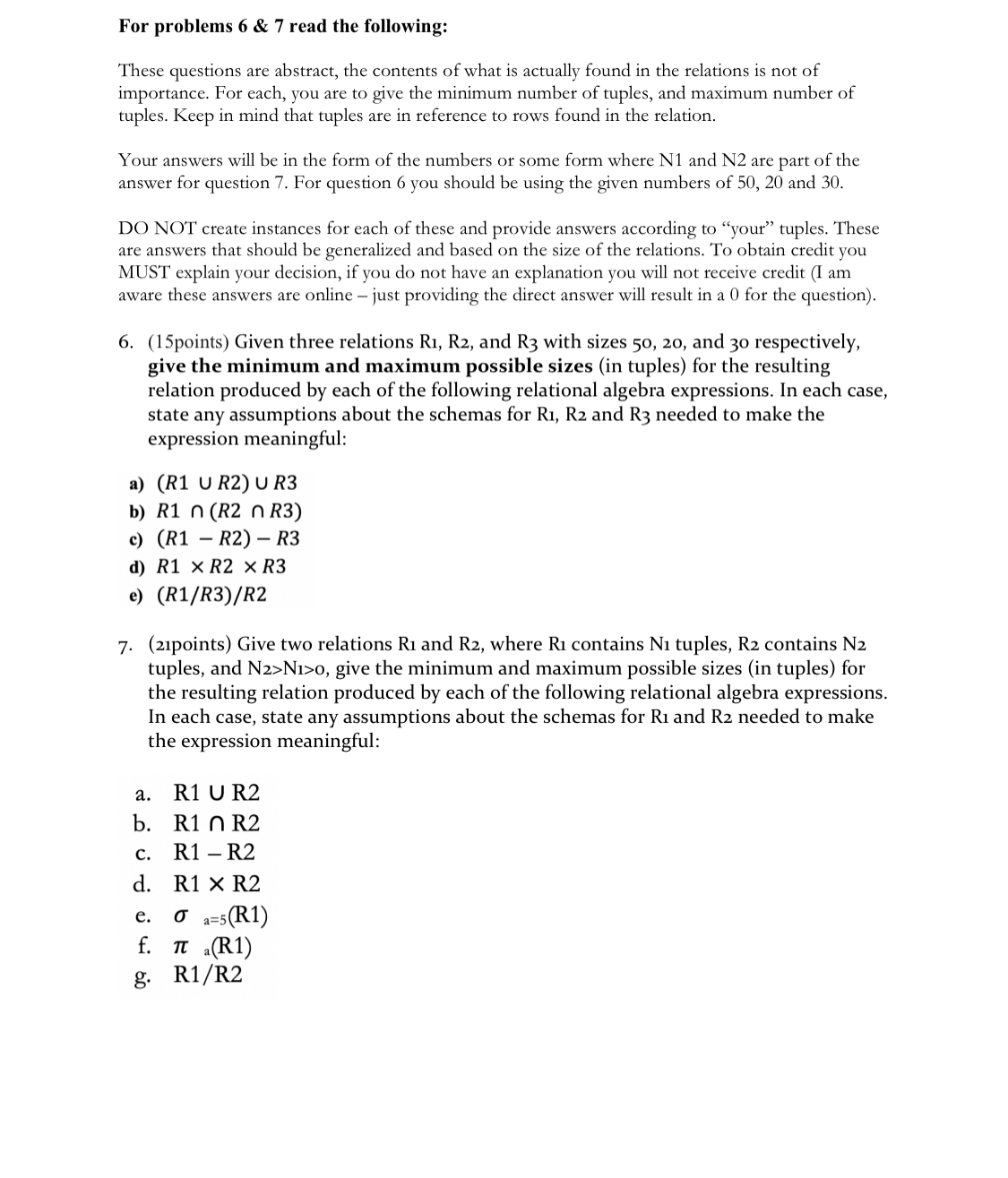
These questions are abstract the contents of what is actually found in the relations is not of importance. For each, you are to give the minimum number of tuples, and maximum number of tuples. Keep in mind that tuples are in reference to rows found in the relation.
Your answers will be in the form of the numbers or some form where N and N are part of the answer for question For question you should be using the given numbers of and
DO NOT create instances for each of these and provide answers according to "your" tuples. These are answers that should be generalized and based on the size of the relations. To obtain credit you MUST explain your decision, if you do not have an explanation you will not receive credit I am aware these answers are online just providing the direct answer will result in a for the question
points Given three relations and with sizes and respectively, give the minimum and maximum possible sizes in tuples for the resulting relation produced by each of the following relational algebra expressions. In each case, state any assumptions about the schemas for and needed to make the expression meaningful:
a
b
c
d
e
points Give two relations and where contains tuples, contains tuples, and give the minimum and maximum possible sizes in tuples for the resulting relation produced by each of the following relational algebra expressions. In each case, state any assumptions about the schemas for and needed to make the expression meaningful:
a R U R
b R
c RR
d
e
f
g
Step by Step Solution
There are 3 Steps involved in it
1 Expert Approved Answer
Step: 1 Unlock

Question Has Been Solved by an Expert!
Get step-by-step solutions from verified subject matter experts
Step: 2 Unlock
Step: 3 Unlock
 Study Help