







Question: For Problems 7andra a live-ednoe file taled MLxprobien set 1B astname.mix. D Engineering Application I n 2004, Burt Rutan won the Space X prize with
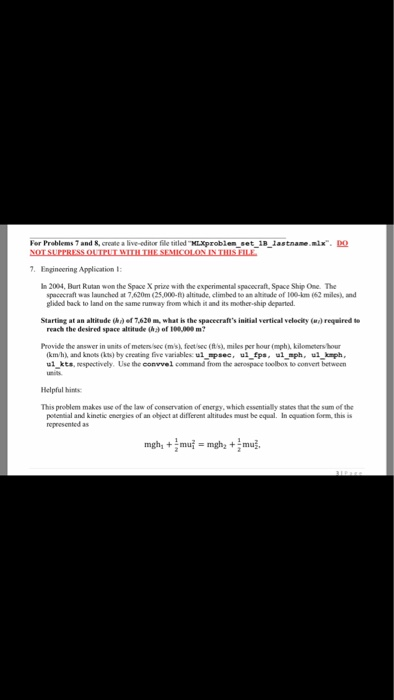
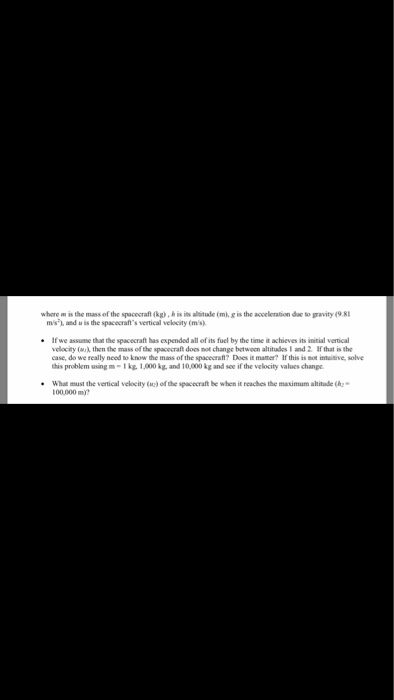
For Problems 7andra a live-ednoe file taled MLxprobien set 1B astname.mix. D Engineering Application I n 2004, Burt Rutan won the Space X prize with the experimental spacecraft, Space Ship One The spacecraft was launched at 7,620m(25,000-R) altitude, climbed to an aitade of 100-km (62 milesh, and glided back to land on the same rumway from which it and its mother-ship departed. Starting at an altitude ef7,620 m, what is the spacecraft's initial vertical velecity () reguirede reach the desired space altitude th of 100,000 m Provide the answer in wnits of meters sec (m's) foetisec (f's), miles per hour (mph, kilometenshour (km/h) and knos(as) by creating five variablex ul pse, fps, l aph, ul kph, kts, spectively. Use the convvel command from the acrospace toolbox to convert between Helpful hints This problem makes use of the law of conservation of energy,which essentialy states thait the sum of the potential and kinetic energies of an object at different altitudes must be equal. In oquation form, this is represented as where m is the mass of the spacecraft (kghisisalnde (m), gis the acceleration d e topuity (9.81 mis'h and u is the spacecraft's vertical velocity (ms) - If we assume that the spacecraft has expended all of its fuel by the time it achieves its initial vertical velocity (uk, then the mass of the spacecraft does not change betwoen altitudes I and 2 If that is the case, do we really need to know the mass of the spacecraft? Does it mamer? If this is mot ituitive, solve this problem usingm- kg 1,000 kg, and 10,000 kg and see if the velocity values chanpe What must the vertical velocity () of the spacecraft be when it reaches the maximum altitude (h 100,000 m For Problems 7andra a live-ednoe file taled MLxprobien set 1B astname.mix. D Engineering Application I n 2004, Burt Rutan won the Space X prize with the experimental spacecraft, Space Ship One The spacecraft was launched at 7,620m(25,000-R) altitude, climbed to an aitade of 100-km (62 milesh, and glided back to land on the same rumway from which it and its mother-ship departed. Starting at an altitude ef7,620 m, what is the spacecraft's initial vertical velecity () reguirede reach the desired space altitude th of 100,000 m Provide the answer in wnits of meters sec (m's) foetisec (f's), miles per hour (mph, kilometenshour (km/h) and knos(as) by creating five variablex ul pse, fps, l aph, ul kph, kts, spectively. Use the convvel command from the acrospace toolbox to convert between Helpful hints This problem makes use of the law of conservation of energy,which essentialy states thait the sum of the potential and kinetic energies of an object at different altitudes must be equal. In oquation form, this is represented as where m is the mass of the spacecraft (kghisisalnde (m), gis the acceleration d e topuity (9.81 mis'h and u is the spacecraft's vertical velocity (ms) - If we assume that the spacecraft has expended all of its fuel by the time it achieves its initial vertical velocity (uk, then the mass of the spacecraft does not change betwoen altitudes I and 2 If that is the case, do we really need to know the mass of the spacecraft? Does it mamer? If this is mot ituitive, solve this problem usingm- kg 1,000 kg, and 10,000 kg and see if the velocity values chanpe What must the vertical velocity () of the spacecraft be when it reaches the maximum altitude (h 100,000 m
Step by Step Solution
There are 3 Steps involved in it

Get step-by-step solutions from verified subject matter experts
 Study Help